
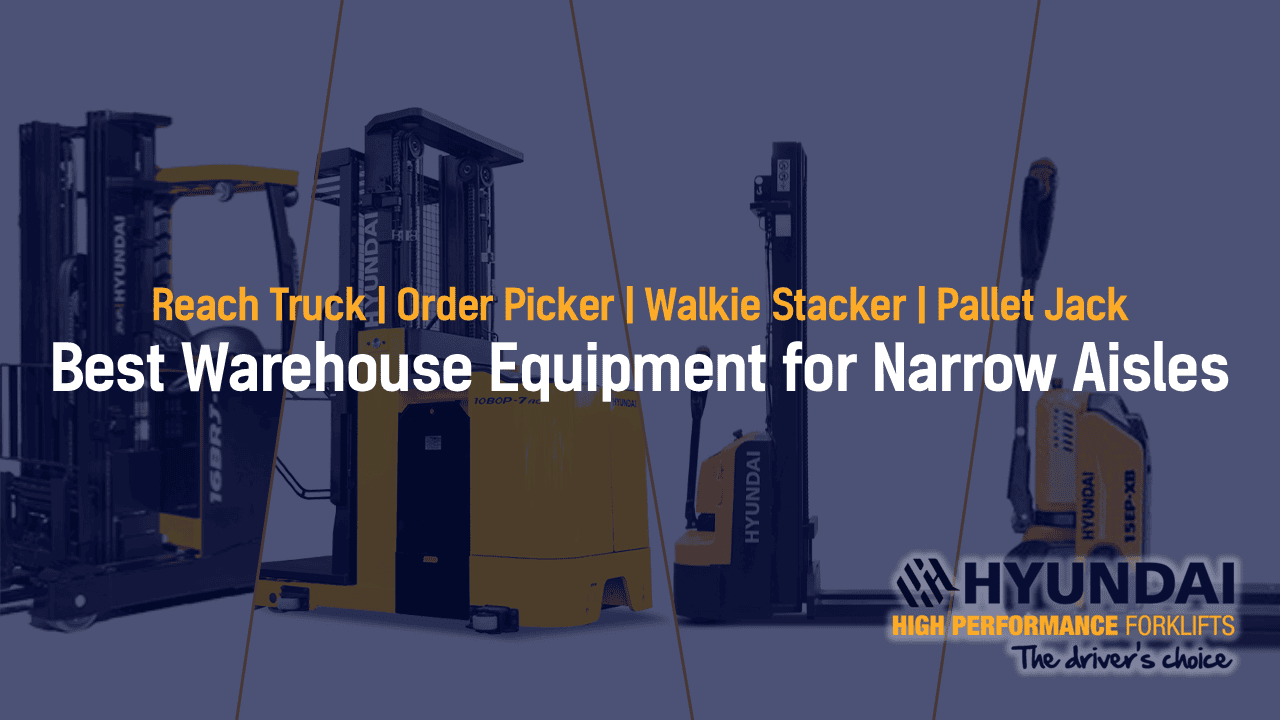
Aisle width looks like a simple number on a warehouse drawing until it starts dictating your throughput, damage rates and labour efficiency. Choosing the best equipment for narrow aisles is less about finding one machine with the smallest turning circle and more about matching lift task, rack layout, travel distance and load profile to the right equipment category.
Australian warehouses are under pressure to store more stock in less space, often by moving to narrow aisle warehouse designs. A narrow aisle design can lift capacity without expanding the building footprint. The catch is that the wrong truck in a tight aisle slows everything down. Operators make extra corrections, pallets get clipped, and cycle times stretch out across the shift. The right equipment does the opposite – it keeps product moving safely and predictably.
The best equipment for narrow aisles depends on what the machine needs to do for most of the day. If you are replenishing high racking, the answer will usually differ from a picking operation or a short-distance pallet movement task. There is no single winner across every site.
A practical starting point is to separate narrow aisle work into three jobs: putaway and retrieval at height, case or piece picking, and low-level pallet transport. Once those jobs are clear, equipment selection becomes far more straightforward.
In many operations, a reach truck is the first serious answer to narrow aisle storage and narrow aisle forklifts in general. It works in tighter aisles than a counterbalance forklift and still offers strong lift heights and good visibility through the mast. For warehouses handling palletised goods in racking, they strike a strong balance between density and productivity.
Their advantage is simple. The truck can stay compact in the aisle while the mast or carriage reaches forward to place or retrieve the load. That reduces the space needed to turn and position the machine. In fast-moving distribution environments, this often translates into cleaner rack access and better use of vertical storage.
That said, reach trucks are not the right choice for every floor or every load type. They perform best on well-maintained, level warehouse floors. If your site regularly moves from indoor aisles to rough external surfaces, a dedicated reach truck may not give you the flexibility of a broader mixed fleet.
If your operation is built around order fulfilment rather than full pallet handling, order pickers are often the better fit. They are purpose-built for operators who need direct access to stock at various heights, especially in e-commerce, parts distribution, retail supply and fast-moving consumer goods.
The value here is not just aisle access. It is reducing wasted movement. Instead of using equipment designed mainly for pallet transport, operators can work at the right picking height with better control and less climbing on and off machines. Over time, that matters for both productivity and safety.
The trade-off is that order pickers are specialised. If your warehouse mainly stores and shifts full pallets, they will not replace reach trucks or stackers as the core narrow aisle machine.
Walkie stackers can be an efficient option where loads are lighter, travel distances are shorter and budget discipline matters. They are common in back-of-house warehouse zones, smaller distribution spaces and operations that need occasional racking access without stepping up to a full reach truck fleet.
In the right application, a walkie stacker can deliver very good value. It takes up little space, is comparatively easy to manoeuvre and suits low to medium-intensity work. For smaller businesses or secondary storage areas, that can be enough.
The main limit is throughput. If your team is constantly moving stock across a high-volume operation, a walkie stacker may start to feel like a compromise. Slower travel speeds, lower lift performance and operator fatigue in intensive use can all affect output.
A standard counterbalance forklift still has an important place in many fleets, but it is often not the best equipment for narrow aisles. The basic issue is geometry. Counterbalance trucks need more room to turn, align and place loads because the load sits out front and the machine balances it with weight at the rear.
In wider yards, loading docks and general-purpose handling areas, that is not a problem. In tight aisle warehouse environments, it becomes one. You may be able to force a counterbalance truck into a narrow layout on paper, but day-to-day performance will usually show the downside through slower aisle entry, more steering corrections and higher risk of rack or stock contact.
For businesses planning a new layout or reviewing fleet mix, this is where a proper site assessment pays off. Equipment should fit the aisle. The aisle should not be widened just to suit the wrong machine.
Not every narrow aisle task requires lifting to height. Electric pallet jacks remain highly effective for low-level transport, dock-to-staging movement and short internal runs where space is limited and speed matters. In support zones around narrow aisle racking, they help keep product flowing without tying up higher-value lift equipment on basic transfer jobs.
This is where fleet planning often improves productivity more than buying a single larger machine. A reach truck may handle putaway while electric pallet jacks clear staging lanes and replenish floor-level stock. Each machine does the work it is designed for, and operators spend less time waiting for shared equipment.
Aisle width is only part of the equipment decision. Other factors also matter, such as:
lift height
load dimensions
pallet condition
floor quality
battery strategy
If your pallets are inconsistent, damaged or poorly wrapped, a high-performing narrow aisle truck will not solve the handling risk on its own. If your floor is uneven, mast stability and operator confidence can suffer. If your shift pattern is demanding, battery charging and changeover arrangements can either support uptime or quietly restrict it.
For many Australian operations, power choice also matters. Electric equipment is often the natural fit indoors because of emissions, noise and control. High-voltage lithium models can be especially attractive where rapid opportunity charging and reduced battery maintenance support multi-shift performance. But the best answer still depends on duty cycle, available charging infrastructure and total fleet use.
Narrow aisles leave less room for error. That makes visibility, control and service support just as important as lift capacity. A machine that looks efficient in a brochure but spends too much time offline or proves difficult to maintain under real shift conditions will cost more than it saves.
This is why many buyers look beyond the truck itself. Dealer backing, parts availability, technician support and operator training all affect whether narrow aisle equipment delivers real return. In a high-density warehouse, downtime can quickly ripple through putaway, replenishment and dispatch.
Working with a supplier that can support equipment across supply, servicing, battery solutions and fleet planning usually leads to a stronger long-term outcome. For businesses wanting that broader support model, Hyundai Material Handling Australia provides equipment, rental and aftersales capability built around uptime and practical fleet performance, with local technicians, genuine parts support and battery partners across major Australian warehouse hubs.
The most productive narrow aisle fleet is often a combination rather than a single equipment class. A reach truck may be the best choice for racking, but not for dock work. A walkie stacker may suit a lower-volume storage area, while an order picker supports a separate fulfilment zone.
This matters because warehouses rarely operate with one task profile all day. Receiving, replenishment, reserve storage and dispatch all place different demands on equipment. A mixed fleet can reduce bottlenecks, provided each machine has a clear role.
The risk is overcomplicating the fleet with too many machines doing nearly the same job. If overlap is high, utilisation drops and costs rise. Good equipment planning is not about buying more categories. It is about buying the right ones.
If you are reviewing the best equipment for narrow aisles, start with the operating reality rather than the brochure spec. Measure the true aisle width, rack beam heights and turning areas. Look at your heaviest and most awkward loads, not just the average pallet. Review how far machines travel per shift and where congestion actually occurs.
Then assess the full commercial picture. Purchase may suit one site, while rental or leasing may make more sense for seasonal peaks, project work or fast-growing operations. The best machine on paper is only the best choice if it matches your throughput, labour model and service expectations.
A narrow aisle operation performs well when storage density, operator safety and equipment uptime all move in the same direction. Get that balance right and the warehouse feels less constrained, even when the aisles are tight.
If your current fleet is making operators work too hard for every pallet movement, that is usually the clearest sign the layout and the equipment are no longer aligned.
Hyundai Forklifts Australia has delivered high-voltage lithium forklift training to...
If you run forklifts in a dusty yard, precast plant,...
Forklift selection in a precast concrete yard is rarely settled...