
When a forklift operator threads a load through tight markers under pressure, you learn more than who has the steadiest hands. The Australian Forklift Championship and Hyundai Material Handling belong in the same conversation because both make one point clear: skill, control and equipment quality directly shape safety, uptime and productivity.
For warehouse managers, fleet managers and safety leaders, that matters far beyond event day. A championship setting puts forklift operation under a spotlight. Every turn, lift, stop and placement exposes what good equipment support looks like and where operator technique makes a measurable difference, showing how the right machine specification can reduce risk on site.
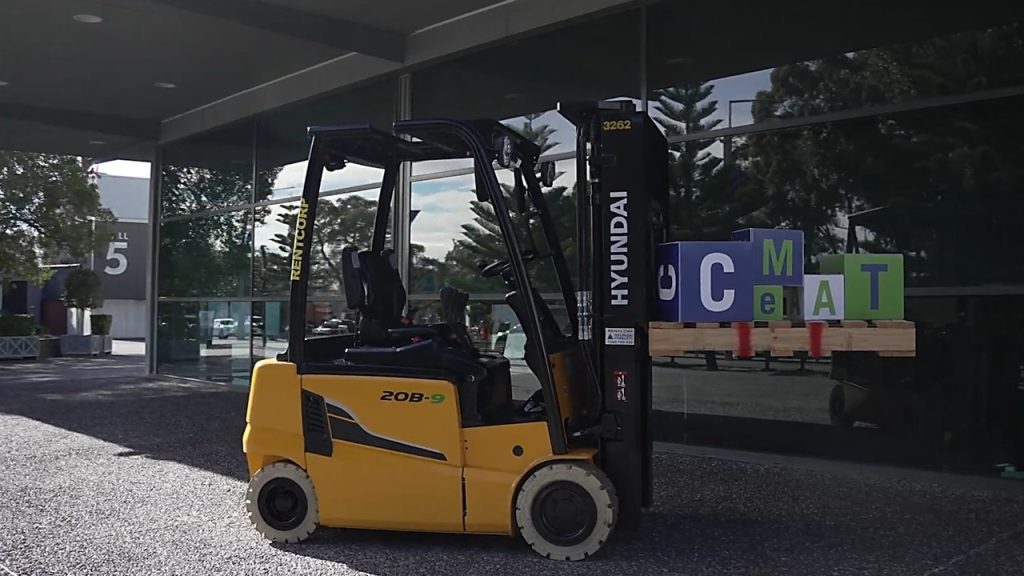
A Hyundai 20B-9 electric forklift stages the CeMAT block display on a pallet outside the exhibition hall entrance.
The partnership works because there is alignment. Hyundai Forklifts’ commitment to safety, operator development and equipment performance matches exactly what the Australian Forklift Championship is designed to test – and that alignment is why the partnership has held for three consecutive years.
That role goes beyond a logo on a banner. As the equipment partner, Hyundai handles competition logistics, machine setup, safety briefings and competitor engagement on the day. When more than 30 of Australia’s top forklift operators lined up at Sydney Olympic Park for the 2025 Championship, the machines under them were Hyundai’s. That is a different kind of product validation – the kind that a brochure specification alone cannot give you.
The partnership has already been extended. Hyundai is confirmed as returning Official Forklift Sponsor for the 2026 Championship, heading to Melbourne Convention and Exhibition Centre during CeMAT Australia this June.
Hyundai High Performance Forklifts is exhibiting at CeMAT Australia 2026 on stand O41, highlighting premium forklifts and warehouse equipment for Australian businesses.
The 2025 Championship, held at Sydney Olympic Park during CeMAT Australia, brought together more than 30 of the country’s top forklift operators across Counterbalance and Reach Truck categories. The results reflected what serious competition always reveals – that precision under pressure separates good operators from exceptional ones.
Corporate Team Category
Pakoti’s win carries weight beyond the podium because it opens the door to a new kind of opportunity for an Australian champion. As part of Hyundai’s extended partnership commitment, the 2025 Individual Champion was flown to Singapore to represent Australia at the CeMAT Southeast Asia Forklift Championship – the first time an Australian champion has been given an international platform of this kind. That decision reflects a deliberate step up in what the Championship means for the industry, not just locally but across the region.
The Corporate Team competition carried its own broader purpose. All funds raised through that category were donated to Healthy Heads in Trucks & Sheds (HHTS), supporting mental health and wellbeing initiatives across Australia’s transport, warehousing and supply chain workforce – a reminder that the Championship is as much about the people in the industry as it is about the machines they operate.
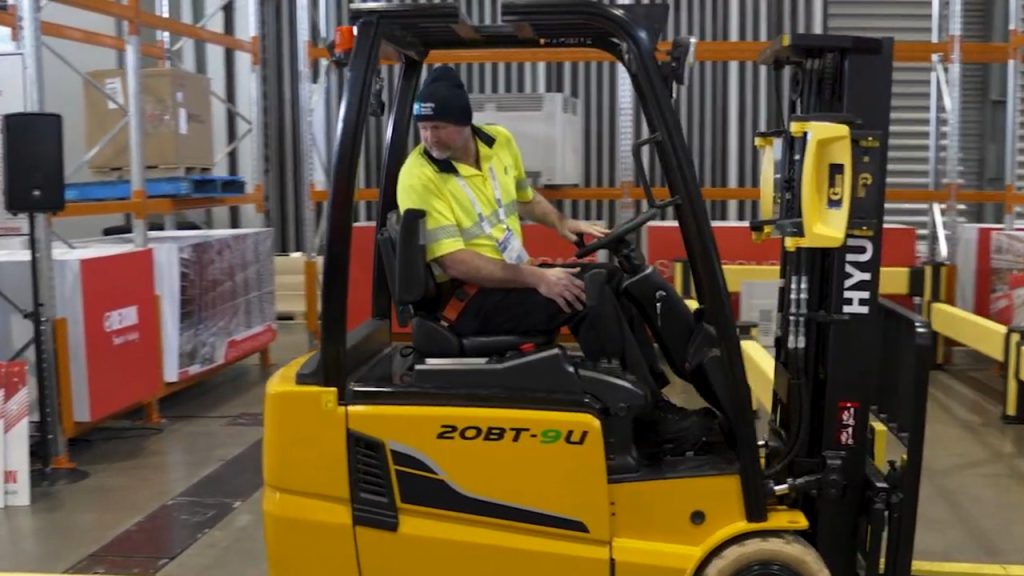
An operator drives a Hyundai 20BT-9U counterbalance forklift through a marked course inside a warehouse-style exhibition space.
The Australian Forklift Championship is not just a crowd-friendly test of precision. At its best, it reflects the pressures operators deal with every day in warehouses, distribution hubs, yards and industrial facilities across Australia. Tight aisles, awkward loads, visibility challenges and time pressure are standard operating conditions in real businesses are standard operating conditions in real businesses, not temporary obstacles set up for a show.
That is why events like this resonate with serious operators. They show that forklift performance is never only about lift capacity on a brochure, but about how controllable, predictable and comfortable the truck is for an operator over a full shift. A machine can look competitive on paper and still fall short if it creates fatigue, slows cycle times or makes delicate handling harder than it should be.
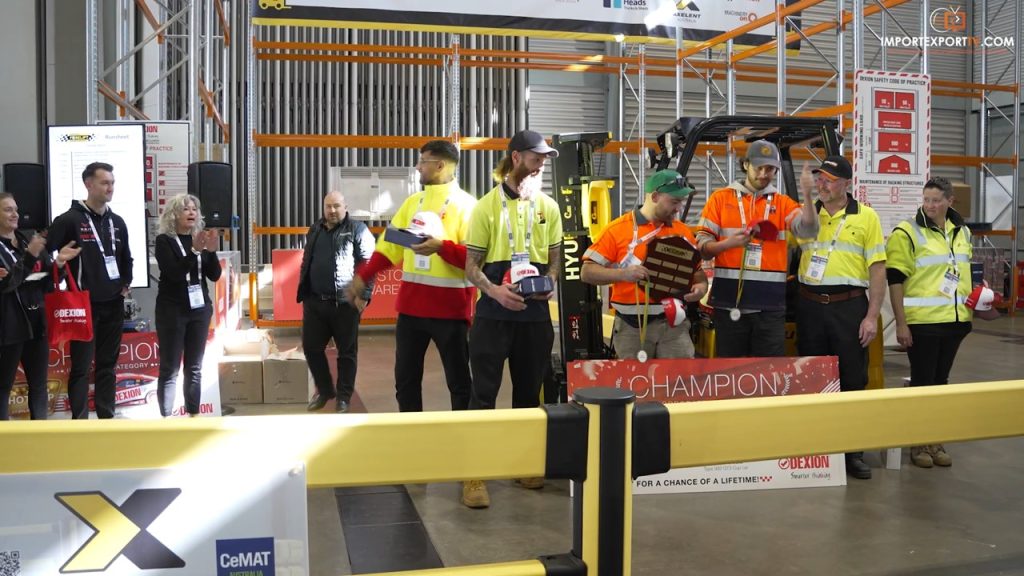
Finalists and event officials gather in front of a Hyundai forklift during the award presentation at an indoor forklift skills championship.
For decision-makers, the value is practical. Watching elite operators work highlights the gap between merely functional equipment and equipment that supports repeatable, safe performance. That gap can be expensive when your site is moving stock all day, every day.
Talking about the Australian Forklift Championship and Hyundai naturally leads to one question: what does high-level operator performance demand from the machine itself? The answer is straightforward. It demands consistency, visibility, responsive control and durability under load.
That is where Hyundai’s position is relevant. In high-throughput environments, a forklift is never an isolated asset; it sits inside a broader productivity system that includes operator training, maintenance planning, energy strategy, site layout and service response. Strong equipment only delivers full value when the support around it is equally dependable.
This is why buyers increasingly look beyond upfront purchase price. They want forklifts that can hold performance over time and service support that reduces disruptions when issues arise. If a site loses hours waiting on repairs, the total cost shows up quickly in delayed dispatch, labour inefficiency and customer pressure. Reliable machinery backed by practical aftersales support is not a bonus – it is part of operational control.
What matters most for fleets is not who wins a trophy, but the standard that emerges from competition. The benchmark is smooth, accurate, safe material handling under pressure. For commercial fleets, that benchmark should shape buying and management decisions.
A high-performing site needs more than capable operators. It needs equipment matched to the task. That starts with choosing the right power and fuel type for the work your site actually does. An electric forklift may be the right fit for indoor warehousing where emissions, noise and energy efficiency matter. An LPG unit may suit mixed-use operations needing flexibility. Diesel still has a place in certain heavier-duty outdoor environments. High-voltage lithium options are increasingly attractive for businesses chasing charging efficiency, reduced maintenance and stronger utilisation across multi-shift work.
There is no single best answer for every site. It depends on load profile, duty cycle, floor conditions, operating hours, ventilation, available charging infrastructure and service support. That is exactly why fleet planning matters. The wrong machine in the wrong application will show its weaknesses quickly, whether that is in operator fatigue, battery constraints, turning limitations or avoidable maintenance events.
The best operators at the Australian Forklift Championship share the same qualities: calm, precise and disciplined. They understand load balance, travel speed, braking distance and the value of smooth input over rushed correction. That level of consistency does not happen by accident – and it does not survive long on equipment that works against the operator.
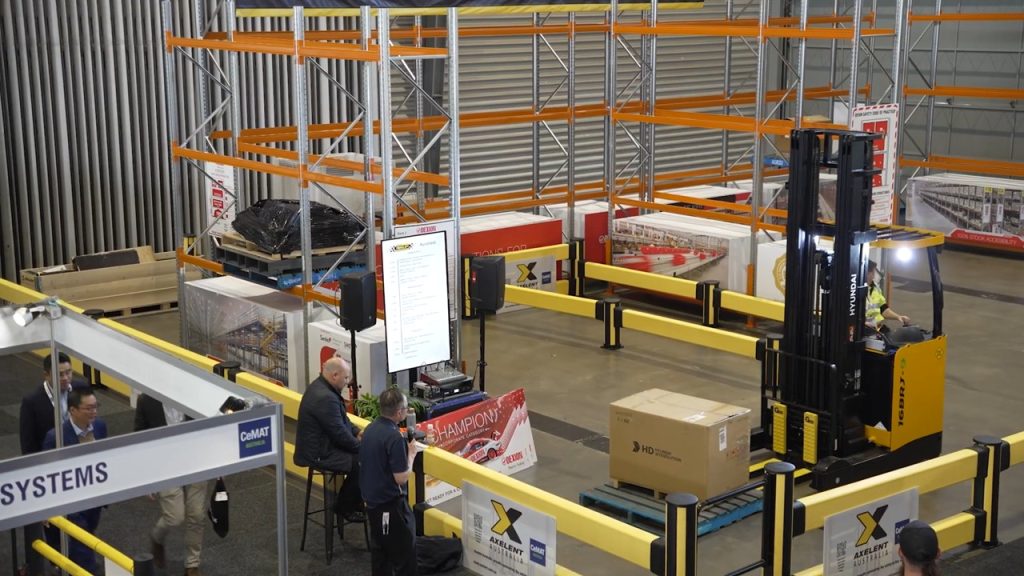
A Hyundai reach truck navigates a pallet through a protected aisle during a live forklift skills course at CeMAT Australia.
For businesses, this has a direct implication. Equipment investment and operator development work together, not separately. Refresher training and site-specific familiarisation lift the return on your fleet – but only when the machine itself supports repeatable, confident operation. A forklift that demands constant correction creates fatigue. Fatigue creates incidents. That cost shows up on your floor, not on a spec sheet.
A competition environment sharpens your eye so that you start noticing what makes handling easier and what creates hesitation – and those observations should carry through to any fleet review or buying decision. That is useful when assessing a fleet upgrade or new equipment category.
First, look at control precision. Jerky hydraulic response or inconsistent braking can slow tasks and increase the risk of product damage. Second, consider operator visibility. Mast design, cabin layout and sightlines influence both safety and confidence, particularly in racking, loading docks and congested work zones. Third, think about ergonomics. Long shifts punish poor seating, awkward control placement and excessive vibration.
Then there is the less visible part – serviceability and support. A forklift that is easy to maintain and backed by responsive parts and service can protect uptime better than a machine with attractive specs but weak support coverage. For operators in Melbourne, Brisbane, Perth or regional industrial corridors, local dealer capability can make a meaningful difference when turnaround time matters. Find your local Hyundai forklifts dealer today.
Events built around forklift skill naturally reinforce a bigger point: the way forklifts are driven shows up directly in safety outcomes and in how smoothly operations run. Poor handling leads to damaged stock, rack strikes, near misses and downtime. Good handling supports throughput because it reduces disruption.
That is why equipment selection should be viewed through a safety lens from the start. Stability, visibility, warning systems, braking performance and smart diagnostics all contribute to safer operation. So does choosing the right truck for the aisle width, load height and site surface.
There is a trade-off worth acknowledging here. Some businesses focus heavily on speed because dispatch pressure is real. But pushing for higher pace with under-specified equipment or insufficient training usually creates more cost, not less. A safer, better-matched fleet often improves output because operators can work with more confidence and fewer interruptions.
The distance between a forklift championship and a live warehouse operation is smaller than it looks. Both depend on repeatability. On a championship course, one poor movement costs points. On a live site, it can cost time, stock, repairs or a safety incident.
That is why the conversation around the Australian Forklift Championship and Hyundai matters commercially. It directs attention back to the fundamentals that shape site performance every day: fit-for-purpose equipment, trained operators, dependable servicing and a fleet strategy aligned with actual workload.
For some businesses, that may mean replacing ageing units that are dragging down reliability. For others, it may mean moving part of the fleet to electric or lithium-powered equipment to better support indoor operations and lower maintenance demands. In many cases, the best next step is not a full fleet change but a more disciplined review of utilisation, downtime patterns and application mismatch.
A serious material handling partner should help with that assessment rather than simply recommending the next available machine. That means understanding the site, the loads, the shifts, the bottlenecks and the support requirements after delivery. Hyundai Material Handling Australia operates in that space – not only as an equipment supplier, but as a fleet and support partner focused on uptime, safety and long-term value.
The real takeaway is simple. When operator skill is matched with the right forklift and the right support, performance stops being theoretical. It shows up in cleaner shifts, safer handling and stronger output where it counts most – on your floor, under your deadlines, with no room for excuses.
A farm forklift should match your loads, your ground conditions...
A stand-up reach truck suits frequent stops and short trips,...
Life in a hire fleet is demanding. A forklift can...