
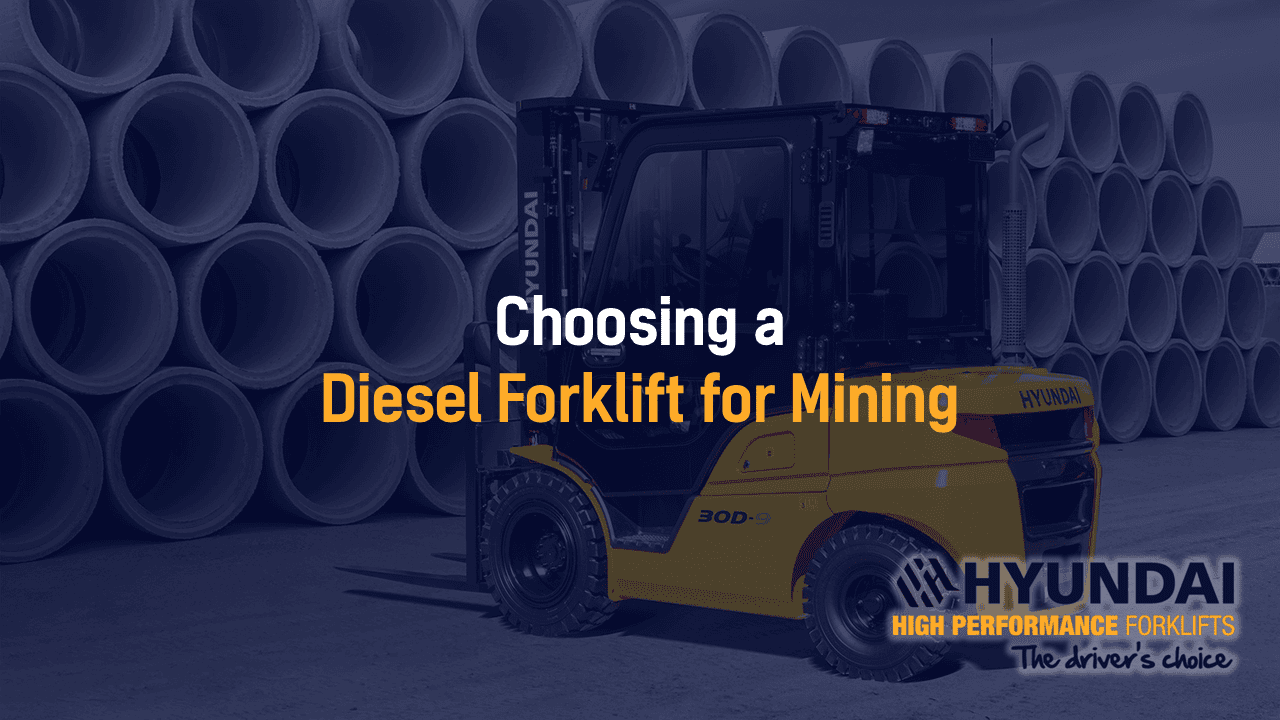
Diesel forklifts for mining applications face extreme conditions that standard warehouse equipment cannot handle. On Australian mine sites, these machines work through dust, heat, uneven terrain and 24/7 operational pressure where downtime directly translates to lost production. This changes the entire buying decision beyond simple capacity specifications. A mining-spec forklift needs cooling systems that handle 40°C+ heat, accessible service points for remote maintenance, and cab protection against falling debris.
Mining applications tend to punish equipment faster than standard warehouse work. Loads are often heavy, awkward and dirty. Travel paths can shift from compacted surfaces to rough outdoor areas. Operators may be working across maintenance yards, processing areas, workshops and laydown zones in the same shift. In that environment, a forklift needs to be more than powerful. It needs to be engineered for consistent output and supported properly once it is on site.
See how Hyundai configures forklifts for harsh mining environments.
The main advantage of diesel in mining is straightforward – high torque, strong lifting performance and long run times without relying on charging infrastructure. For sites handling palletised consumables, steel, parts, bulk bags or maintenance equipment over long shifts, that matters. Refuelling is quick, and the machine is typically better suited to sustained outdoor work than many alternatives.
That said, not every mining task automatically points to diesel. If the forklift will spend most of its time inside enclosed workshops or controlled processing spaces, emissions and ventilation become part of the equation. In those areas, electric or LPG may deserve a closer look. The right answer depends on where the truck will operate, how many hours it will run and what your site rules require. Hyundai offers diesel, LPG and electric forklifts engineered for different mining environments, allowing operations to match the power source to the application rather than compromise on performance.
For many open or mixed-use mining environments, diesel still earns its place because it handles demanding duty cycles well. It offers the kind of dependable muscle operations managers want when the job involves heavy attachments, repeated travel and less-than-perfect ground conditions.
A common mistake is choosing a forklift based on headline lift capacity alone. On a mine site, the real question is whether that capacity holds up with the load centres, attachments and travel demands of the actual application. A 3.5-tonne truck on paper may not be the right fit if you are regularly moving longer loads, using specialised tynes or carrying equipment that shifts the centre of gravity.
You also need to think about mast configuration, lift height and clearance. Workshop access points, containers, racking and service bays all shape what the forklift can realistically do. If a truck is too large, it can become slow and awkward in tighter maintenance areas. If it is undersized, you will feel it in reduced productivity and increased wear.
The better approach is to match the machine to the heaviest regular task, not the occasional light one. That usually delivers a safer, more productive result over the life of the fleet.
Mining yards are rarely kind to tyres, drivetrains or operator comfort. Potholes, loose material, edges and slopes all influence machine selection. A diesel forklift for mining should be assessed not just for lift performance, but for stability and durability across the surfaces it will travel every day.
Tyre choice plays a big role here. Pneumatic tyres may be the better option where rough outdoor conditions are constant, while cushion tyres generally make less sense outside smoother hardstand areas. Suspension and seat quality matter as well. Operators who spend full shifts in the truck will notice poor ergonomics quickly, and fatigue is not just a comfort issue. It affects safety and handling precision.
Mining operations work under strict safety expectations, and forklifts sit right in the middle of that. Visibility, braking performance, lighting and stability all need careful consideration. The safest truck is not necessarily the one with the longest feature list. It is the one suited to the site, the load and the people operating it.
Good visibility through the mast helps when moving loads around people, plant and stored materials. Clear operator displays and intuitive controls reduce errors. Strong overhead protection is essential in heavy-duty environments where falling objects and harsh handling risks are part of the job.
There is also the question of operator training and fleet consistency. If your site runs multiple forklifts, keeping control layouts and operating behaviour consistent across the fleet can help reduce familiarisation issues. That becomes more valuable when teams work across shifts or move between different sections of the site.
Mining businesses should also assess whether the forklift suits specific site requirements around emissions, fire risk, exclusion zones and maintenance procedures. A diesel unit may be ideal in one part of the operation and unsuitable in another. That is not a flaw in the machine. It is simply a reminder that application fit comes first.
The best fleet decisions usually come from a proper site review rather than a catalogue comparison. Looking at load types, surface conditions, operating hours and service access gives a clearer picture of whether diesel is the strongest option for the role.
On mining jobs, a forklift can be critical support equipment. If it is down, parts do not move, shutdown work slows and crews wait around. That is why aftersales support should carry as much weight as engine power or lift speed.
When assessing suppliers, ask practical questions. How quickly can parts be sourced? What does field service coverage look like? Is there access to remote fault finding or advanced technician support? Can the supplier support rental or replacement equipment if an unplanned issue takes a truck out of service?
This is where a full-service partner often delivers more value than a simple equipment seller. The machine is only one part of the result. Ongoing maintenance planning, dealer access, warranty support and technician capability all affect how well the fleet performs over time. Hyundai Material Handling Australia approaches this as a long-term equipment partnership, which is exactly what demanding industrial buyers should expect.
A diesel forklift for mining can be the right commercial decision even if the upfront cost is not the lowest option on the table. Cheap equipment has a way of becoming expensive once repairs, downtime and shorter service life start stacking up.
Whole-of-life cost gives a more realistic picture. That includes fuel use, scheduled servicing, tyre wear, parts availability, operator efficiency and the impact of downtime on your operation. A stronger machine with better service backing often delivers lower cost per operating hour, even if the purchase price is higher.
Finance, rental and lease structures also deserve attention. Some mining businesses want to preserve capital and align equipment costs to contracts or project timelines. Others want ownership and tighter long-term control of the fleet. There is no universal answer. The right structure depends on site duration, utilisation rates and how much flexibility the operation needs.
Diesel makes strong sense where the forklift will work outdoors, handle heavier loads, run long shifts and operate away from charging infrastructure. It is also a practical choice where quick refuelling and high torque are priorities. For many mining support tasks, those strengths are hard to ignore.
But there are cases where diesel is the wrong fit. If the truck will spend most of its life indoors, if ventilation is limited, or if site sustainability targets are pushing low-emission equipment, electric alternatives may be more suitable. The smartest fleet strategy is not about backing one power type across every application. It is about choosing the right machine for each job.
Start with the application, not the brochure. Define the maximum load, average load, travel distance, ground conditions, shift length and work zones. Then look at attachments, operator requirements and service expectations. Once that picture is clear, the forklift category usually becomes easier to narrow down.
From there, focus on supplier capability. In mining, machine quality and support quality go together. You want proven engineering, but you also want responsive service, available parts and practical advice on how to keep the truck productive in the field.
The best diesel forklift for mining is not simply the biggest or the cheapest. It is the one that fits the site, stands up to the workload and comes backed by support that keeps your operation moving. If your next forklift has to earn its keep in harsh conditions, that is the benchmark worth using.
Your forklift fleet is ready for peak season when utilisation...
In busy warehouses and distribution centres, forklift safety depends on...
A forklift pre-start checklist covers visual checks, operational checks and...