
A forklift that hesitates on the ramp, runs hot by mid-shift, or spends too much time off the floor is not just an equipment issue – it is a throughput issue, a safety issue, and a cost issue. Heavy, high-productivity work was once considered diesel-only territory. The Hyundai High-Voltage B-X Series electric forklifts change that for Australian operations.
With a full lineup of electric forklifts from 4.0 to 9.0 tonnes, high-voltage LFP battery technology, and performance data that matches diesel head-to-head, the B-X Series is a direct answer to fleets looking to electrify without compromising output. But not all electric forklifts are built for this transition – the B-X Series is.
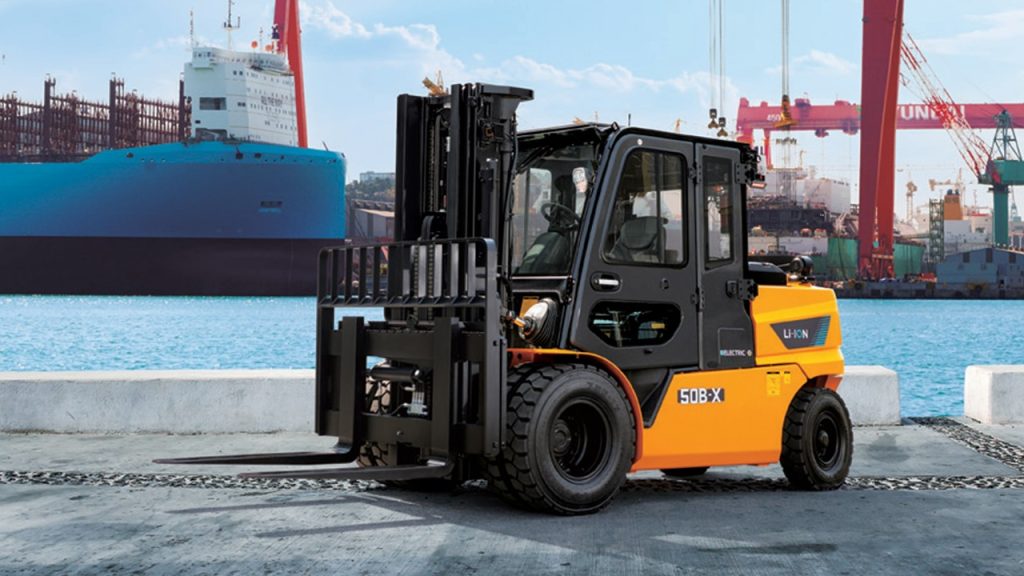
Hyundai 50B-X electric forklift – 5 tonne capacity with high-voltage LFP battery, built for heavy-duty outdoor operations
Diesel forklifts are familiar and proven – but familiarity is not the same as best fit. Across Australian warehouses, distribution centres, food facilities, and mixed industrial sites, fleet managers are examining total operating cost more closely than ever. The B-X Series addresses every major concern that has historically kept diesel in place.
Running costs: Annual fuel and maintenance costs for the B-X are approximately 70% lower than equivalent diesel (ICE) models. Hyundai’s TCO data compares the B-X directly against the D-9V diesel equivalent. The break-even point arrives at Year 3. Estimated savings over 10 years reach approximately $58,000 (4–5 tonne range) to $76,000 (6–9 tonne range).
Performance: The 70B-X matches the 70D-9V diesel exactly on lift and lower speeds – 480 mm/s unloaded lift, 450 mm/s loaded lift, 500 mm/s lower – while achieving a maximum loaded gradeability of 40%, compared to 45% for diesel forklifts. Travel speed loaded/unloaded is 27/28.5 km/h. For most industrial applications in Australia, the gap is operationally insignificant.
Environment and compliance: Zero exhaust emissions at point of use. No combustion noise. The B-X Series suits food production, pharmaceuticals, cold storage, and any site where air quality, carbon neutral targets, or ESG commitments carry operational weight.
Charging flexibility: LFP lithium technology supports opportunity charging. Instead of waiting on overnight windows or managing spare battery banks, operators top up during breaks and shift changeovers. Multi-shift operations maintain throughput without battery logistics overhead.
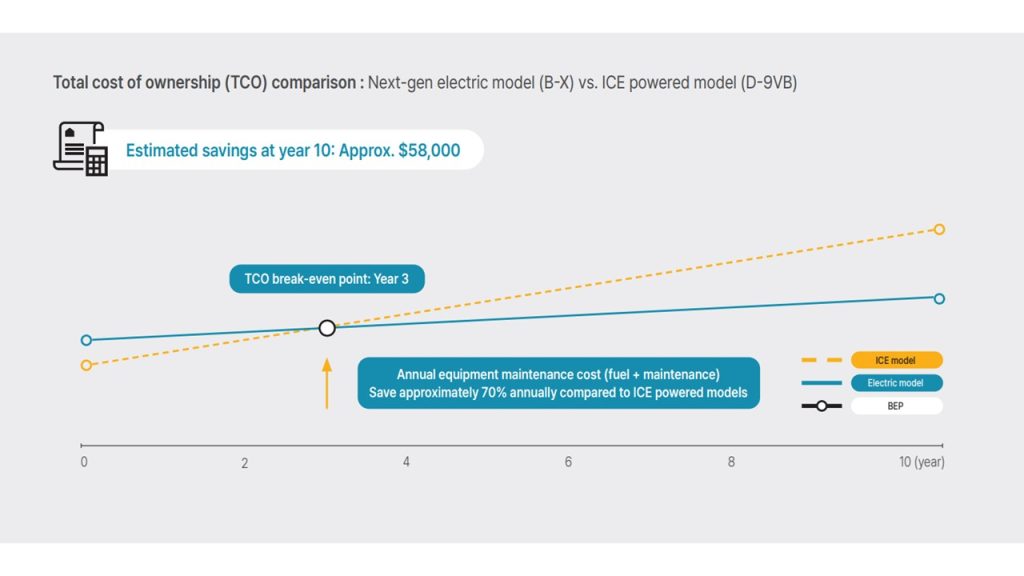
TCO comparison: Hyundai B-X electric forklift vs ICE diesel model (D-9VB)
Standard electric forklifts handle warehouse essentials well. On ramps, extended outdoor runs, and back-to-back heavy shifts, they hit a ceiling. Performance becomes unstable as battery charge drops – a problem that directly affects throughput, safety, and operator confidence. The Hyundai B-X Series is engineered where that ceiling used to be.
High-voltage architecture: The 40-55 B-X range operates at 309V (LFP, 173Ah standard). The 60-90 B-X range runs at 347.7V (200Ah standard, 268Ah option). In practice, higher voltage means the same power output is delivered at lower current, which reduces heat generation across the pack and supports consistent performance throughout the shift.
IP67/IP69K-rated protection: The battery pack, drive motor, hydraulic motor, power distribution unit, and battery thermal management system are all rated IP67 – waterproof and dustproof for outdoor use in wet conditions. The vehicle control unit (VCU) is rated IP69K. The B-X can be used and stored outdoors in all Australian weather conditions.
Drive motor performance: All models in the 40-90 B-X range are equipped with AC drive systems. The 40-55 B-X uses a 65 kW drive motor. The 60-90 B-X uses a 75 kW drive motor. Both deliver immediate, consistent torque from standstill through to full load cycles.
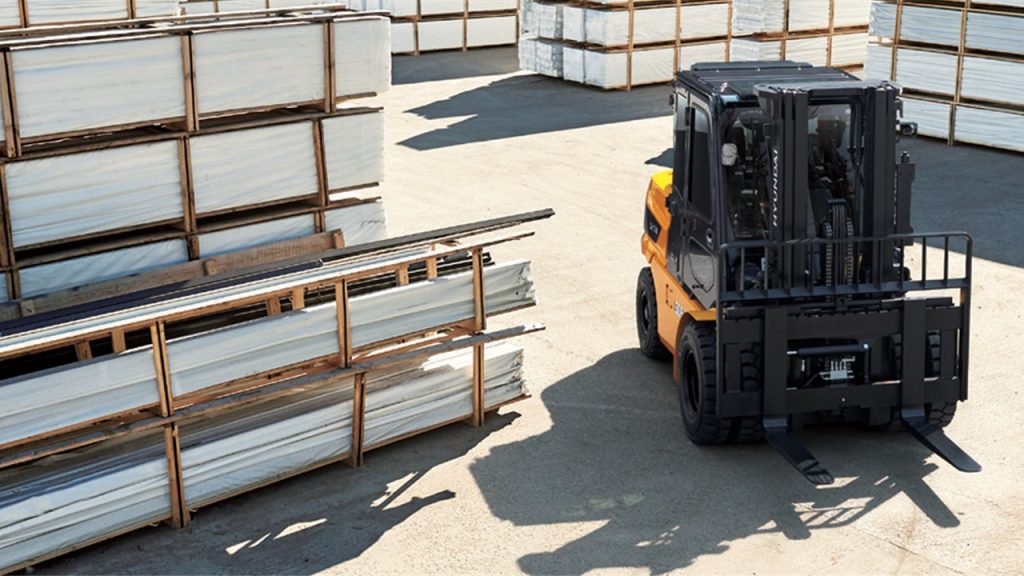
Hyundai B-X Series navigating stacked timber packs and sheet materials – built for outdoor yards where load variety and manoeuvrability matter.
The B-X range answers one practical question – how much capacity do you need without compromising manoeuvrability, operator control and efficiency? Each model in the lineup meets a different handling profile. These range from moderate warehouse loads through to sustained heavy-duty industrial applications.
For Australian businesses moving palletised freight, raw materials, timber packs, steel product or container loads, model selection is rarely just about the headline lifting number. It comes down to what you lift every day, how much room you have to move, how long the shift runs and how much downtime your site can tolerate. A well-matched forklift supports throughput. A poor match creates bottlenecks, operator frustration and avoidable maintenance pressure.
At the lighter end of the B-X lineup, the 40 B-X, 45 B-X, 50 B-X and 55 B-X are designed for operations where agility and efficiency remain as important as lifting capacity. The 40 B-X is likely to appeal to sites that need dependable lifting performance without stepping into a larger footprint than the job requires. In practical terms, that suits warehouse loading zones, manufacturing facilities and mixed indoor-outdoor operations where moderate loads are common and turning space may be limited. The 45 B-X shares the same dimensions and battery specifications with the 40 B-X with carriage of 4,500 kg at the same 2,987 mm turning radius. But it holds the strongest runtime figure in the lighter lineup, with the 93kWh battery option supporting up to 14 hours of operation on a single charge.
The 50 B-X and 55 B-X move into heavier freight territory at 4,990 kg and 5,500 kg respectively, with a slightly larger turning radius of 3,054 mm. Both share the same wheelbase as the 40 and 45B-X, which simplifies fleet standardisation across a mixed site. The 50 B-X can be a strong fit for freight operators, general warehousing, food production and distribution centres that deal with changing load profiles across the week. It suits fleets that need one machine for inbound pallets, outbound loads and heavier stock. It does this without becoming cumbersome in tighter spaces.
All four models run on LFP battery chemistry at 309V, with the standard 53kWh pack included and 70kWh or 93kWh options available depending on shift requirements.
For heavier and more demanding industrial environments, the upper B-X range steps in where the lighter models leave off. The 60 B-X is where industrial users find a strong middle ground, especially when load weights vary across the day. It offers stronger lifting capability with balanced control and predictable handling. For Australian industrial sites, it works hard without becoming a specialist outlier in the yard.
The 80 B-XL stands out because the application may not just be about weight. Load length, load centre and stability matter more in timber, steel and manufacturing. Product shape creates handling challenges that go beyond standard pallet work. If the work involves larger or more awkward product, the 80 B-XL keeps the operation moving without overworking a smaller truck.
The 90 B-X belongs in serious industrial environments. Think high-demand outdoor applications and large raw material movements where sustained heavy lifting is a daily requirement, not an occasional one. Ultimately, for procurement teams, the decision here is also about risk control. If under-capacity equipment is being pushed too hard, that affects safety, wear rates and uptime. In the right environment, a 90 B-X is not overkill – it is the correct tool for maintaining productivity and operator confidence under load.
Beyond the current 4-9 tonne B-X range, heavier versions covering 10-13 tonnes and 16-18 tonnes are scheduled for release in 2026. For Australian operators planning fleet upgrades or looking to electrify heavy-duty applications that previously required diesel, this expansion is worth tracking closely. To get the earliest information on the new heavy lineup, visit Hyundai Material Handling Australia at CeMAT Australia in Melbourne. It is the most direct way to understand how the extended range fits into your specific operation before broader market availability
Charge time and run time serve different purposes in fleet planning. Charge time measures how quickly energy returns to the battery. Run time measures how long the machine works before needing that energy again. In the B-X series, 20kW, 40kW and 120kW refer to charging power levels. The right choice depends on your shift structure, site power supply and how the truck is used through the day.
A 20kW charger fits single-shift or lighter two-shift sites with overnight or long stand-down charging. A 40kW charger suits busier operations that need faster energy recovery during planned pauses, balancing infrastructure demand with operational benefit. At 120kW, charging supports operations where truck availability is critical across intensive multi-shift use – requiring proper electrical planning, battery compatibility and a suitable charging environment. Plan charger selection as part of a whole-of-site strategy. The right charger depends on shift timing, expected battery draw, traffic flow and future fleet growth.
Opportunity charging means topping up the battery during natural breaks – meal breaks, shift changeovers, staging delays and loading windows. Rather than waiting for a low battery state, the truck charges across the day. For the B-X series, this approach supports longer effective run time and stronger truck availability.
Lithium technology accelerates charging acceptance and reduces battery maintenance demands, making short-duration charging more practical. Sites that build charging into their traffic flow and align charger placement with the work zone see the clearest gains in throughput and availability.
The 11-hour operating figure reflects a well-matched application running within its designed parameters. Load and travel patterns, ambient temperature, operator technique and shift demand patterns all shape real-world run time. In Australian conditions, charger placement and ventilation directly sustain performance.
Sites with variable load across the day benefit most from pairing the B-X series with opportunity charging. Topping up during quieter periods supports sustained availability through peak outbound windows – turning the 11-hour figure into a reliable planning target, not just a specification claim.
Travel performance covers more than top speed. It includes acceleration quality, gradeability, directional change, braking feel, and load stability. Lift performance extends beyond maximum height – it includes lift speed under load, hydraulic response, and lowering control.
Many sites lose time not from lack of speed, but from hesitation and inconsistent response. The B-X Series addresses this directly. Its electrical architecture and braking behaviour work together to support smoother, more controlled material handling than diesel alternatives.
Regenerative braking recovers kinetic energy during deceleration and returns it to the battery. In stop-start warehouse environments, this reduces energy waste and extends usable run time per shift. It also lowers mechanical braking demand, which reduces wear on friction components and supports more consistent truck availability.
Beyond energy savings, the safety benefit is equally practical. Progressive, predictable braking helps operators judge stopping distances with greater accuracy. This supports more precise pallet placement near racking, in high-bay storage, and in mixed-use areas where forklifts and pedestrians share space.
Higher-voltage architecture delivers stronger, more efficient power to both the drive motor and hydraulic system. This produces sharper acceleration from standstill, stronger traction under load, and stable performance across long shifts. It also supports better thermal management, so the truck maintains consistent output as battery state changes.
On the lift side as well, the high-voltage platform delivers strong lift speeds and responsive mast control. This matters in industries like timber, steel, pharmaceuticals, and general warehousing, where load weights and throughput demands shift throughout the day.
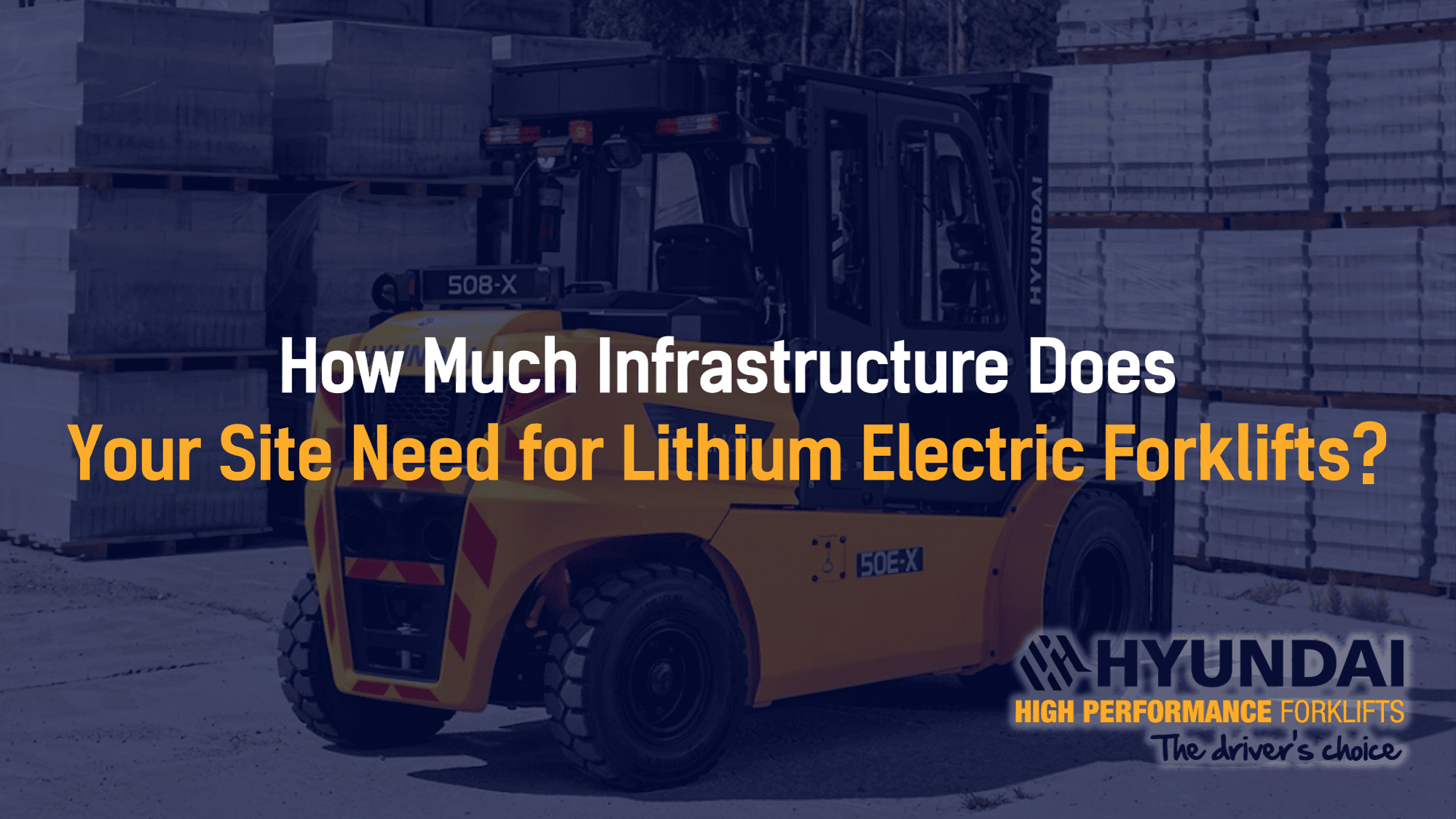
Sites looking at electric forklifts tend to raise the infrastructure...
Spec sheets make forklifts easy to compare. Capacity, lift height,...
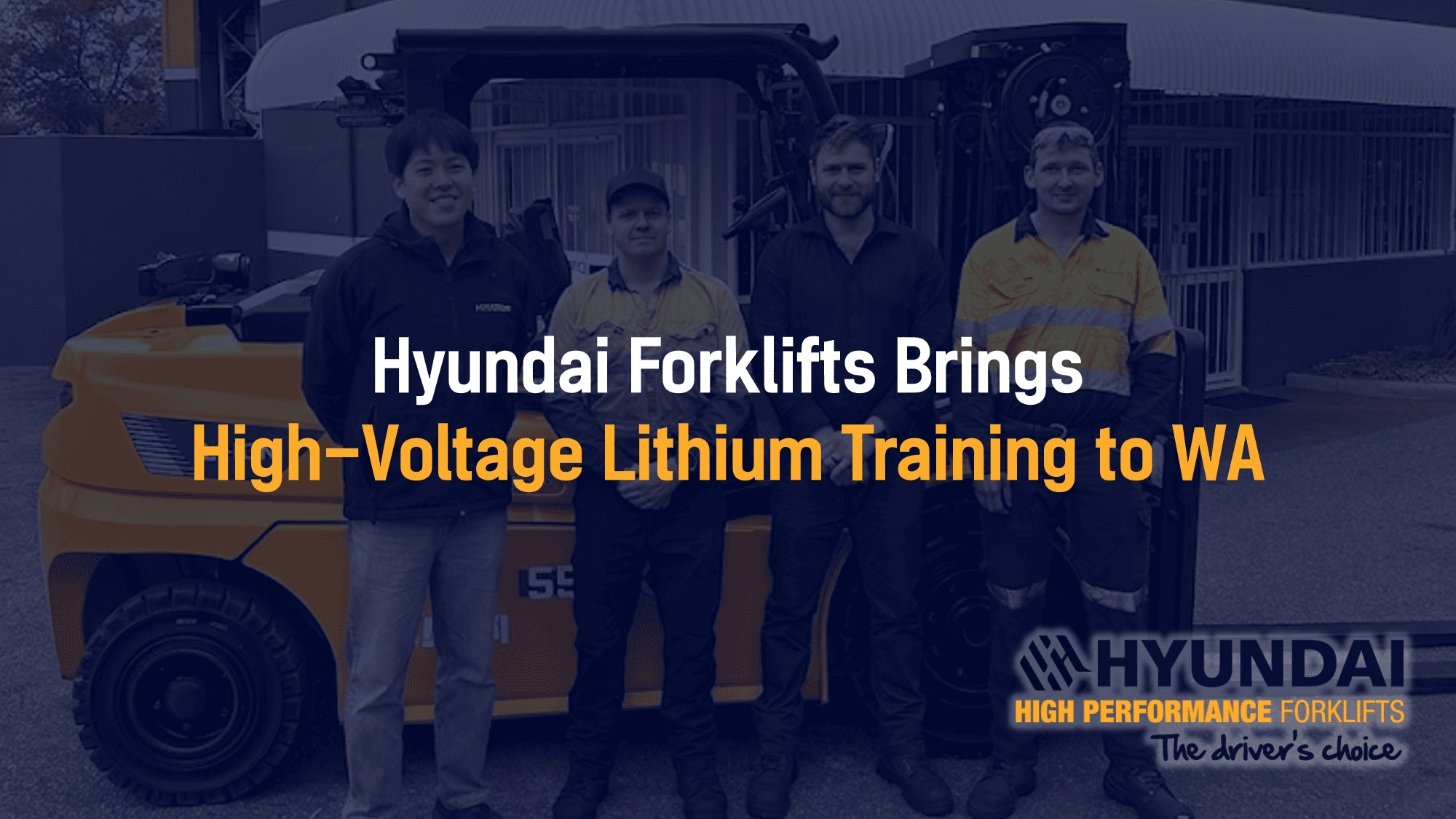
Hyundai Forklifts Australia has delivered its first high-voltage forklift training...