
Forklift safety rules in Australia are set by law and actively enforced. That is what sets this market apart. Regulators don’t just publish guidance. They inspect sites and prosecute businesses when the right controls are missing.
And the pressure is rising. NSW Minister Sophie Cotsis reported more than 600 forklift incidents to SafeWork NSW since January 2024, including four fatalities, and announced a month-long blitz. More than 250 inspectors carried out unannounced forklift safety checks across the state. For operators and the businesses that run them, that raises one simple test: can you show the right controls were in place?
That test starts with understanding what the law actually requires.
In Australia, operating a forklift is high risk work. That is not a figure of speech. It is a legal classification. Every operator must hold a High Risk Work Licence with an LF or LO class, and every business that runs forklifts carries a duty under WHS law to control the risks that come with them. So a forklift incident is rarely bad luck in the eyes of a regulator. Regulators ask whether the right controls were in place.
And those controls almost never come down to one moment. An incident usually starts earlier with the wrong truck for the task, rushed operator habits, poor traffic flow, missed maintenance, or unclear site rules. That is why forklift safety is not just an operator issue. It is an operational one, and it sits with supervisors, fleet managers and the business itself. It affects uptime, compliance, damage costs and workforce confidence.
For Australian operations running warehouses, transport yards, manufacturing plants, timber sites, steel handling or food and pharma facilities, the exposure is real on both sides. A single near miss can stop production. A serious incident can trigger a regulator investigation, equipment damage, workers compensation claims and long-term disruption. The sites that perform best treat safety as part of fleet design and daily workflow. They build it around clear duties, the right equipment and controlled traffic, not a box-ticking exercise.
Of all those controls, one carries more weight than the rest, keeping people and forklifts apart. Forklifts cause serious injuries and fatalities when they strike or crush pedestrians, and these incidents usually happen where nothing physically separates forklifts from people. It is consistently the failure regulators and courts focus on, because the harm is severe and the cause is rarely complicated.
The controls follow a clear order of preference. Physical separation comes first, dedicated pedestrian walkways, barriers and exclusion zones. Where you cannot physically separate forklifts from people, mark and enforce walkways and safe work zones, keep loads stable, make operators wear seatbelts, and hold visitors and delivery drivers to the same traffic rules. One-way travel paths, marked crossings and visibility aids at blind corners all cut down the points where a person and a machine can end up in the same space at the same time. Operator technique sits inside the same control. It means keeping loads low while travelling, slowing down before turning, sounding the horn at intersections – and where a load blocks forward vision – travelling in reverse, provided the path is clear and the operator is trained to do so.
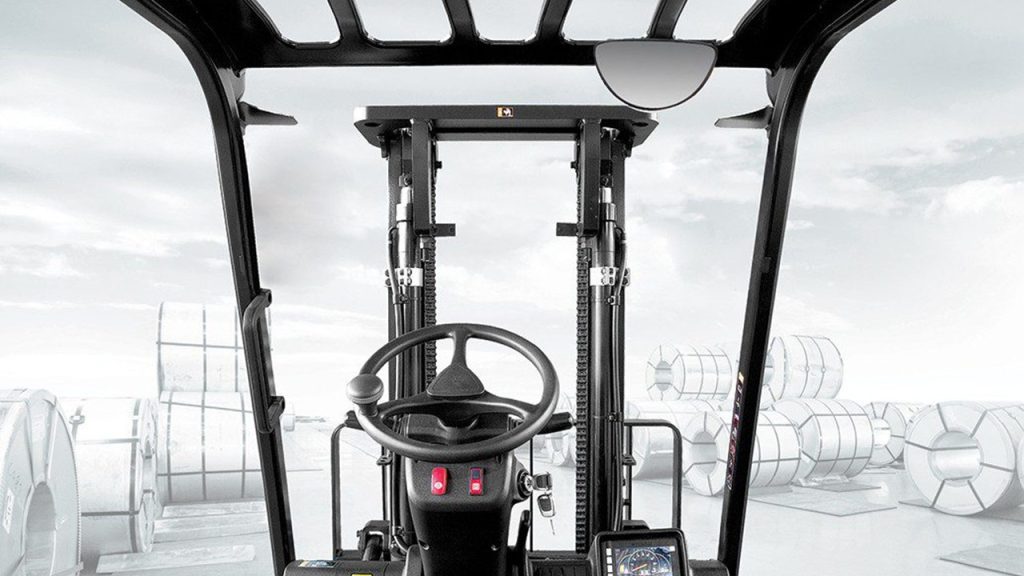
Clear sightlines under load matter most where long or bulky stock blocks forward vision.
Equipment can reinforce these controls, not replace them. Hyundai Material Handling’s Operator Presence Sensing System (OPSS) restricts travel, lift and tilt the moment the operator leaves the seat, and mirrors, lights and cameras are designed to cut the blind spots where pedestrian strikes happen. For active warning at aisle ends and blind corners – proximity alerts, pedestrian detection and telemetry – we go deeper in forklift warehouse safety technology, and the wider approach sits on our safety page. In a steel yard, for example, where long loads block forward vision, those sightline and detection controls often matter more than raw lift capacity.
A recent fatality shows how fast this turns deadly when separation and stability controls fail together. At a Queensland quarry, a forklift rolled onto its side while travelling on a concrete ramp and killed the operator, prompting Resources Safety & Health Queensland to issue a safety alert. Its recommendations map straight onto everyday controls. Assess forklifts for the terrain before use. Maintain braking, steering and operator restraints to OEM spec, and make sure operators wear them. Protect ramp edges with bunds or rails. Write ramp hazards into the traffic management plan so forklifts travel straight up and down rather than turning or crossing on a gradient. Keep one counter-intuitive fact in mind here: about 75% of side tip-overs happen when the forklift is empty, and the risk climbs as the mast lifts and the centre of gravity rises.
Machine design plays into stability too. The B-X Series runs the same tyre options as ICE-powered models for stable outdoor footing, with a reduced turning radius for tighter, more controlled manoeuvres – useful on a mining hardstand or ramp like the Queensland site above.
Pre-start checks get treated as a formality because the truck ran fine yesterday. But yesterday does not confirm today’s brakes, tyres, horn, warning lights or fork condition. The law requires a pre-start safety check every time an operator uses a different forklift and at the start of each shift, because the previous operator may not have left it safe. A simple, consistent checklist is what turns this from a habit into evidence that you met the duty.
Maintenance carries the same weight. Service and maintain industrial lift trucks according to the manufacturer’s instructions, and at least once every 12 months, with a maintenance, inspection and testing program built around those instructions. This is not paperwork for its own sake. Worn tyres, weak brakes, steering faults and hydraulic leaks are safety risks, because when a truck underperforms, operators start compensating, and that is when incidents become more likely.
Equipment can make this discipline easier rather than substitute for it. Hyundai’s onboard self-diagnosis surfaces fault codes through the dashboard cluster, so a developing brake, steering or hydraulic issue shows up before it becomes the fault an operator quietly works around mid-shift. Where this turns into a fleet-wide problem, fault visibility, service response times, diagnostics across many trucks, the deeper detail sits in our guide to electric forklift fleet management. For safety, the principle is enough. If fault reporting is unclear or service is slow, safety decisions get delayed, and a known fault stays on the floor longer than it should.
A traffic management plan only protects the operation if it is real – communicated, supervised and enforced – rather than a document filed away after an audit. It earns its keep in the high-pressure zones, and loading and unloading areas are the clearest example, because they compress several hazards into one space: reversing vehicles, changing floor levels, trailer movement, time pressure and foot traffic.
The controls here are concrete, not abstract. Provide driver safety zones with fixed physical barriers where truck drivers can wait while their vehicle is loaded, positioned so they can still see the work. Physical barriers include high-impact barriers, bollards or steel railings, and operating procedures should keep pedestrians out of loading and unloading areas entirely. Treat dock plates, wheel restraints, exclusion zones and clear communication procedures as critical controls in these areas, not optional extras. Ramps need specific rules – straight travel only, no turning or crossing on a gradient, with edges protected – exactly as the Queensland alert sets out.
Housekeeping belongs in the plan too. Loose shrink wrap, broken pallets, stray strapping and uneven ground create traction and load-shift problems that lead to sudden braking or loss of control, so clean, managed travel paths are a safety control, not just tidiness.
Charging belongs in the same site-safety picture, because in a busy facility it happens near people and stock. Hyundai’s lithium packs carry a multilayer safety architecture: a Battery Management System (BMS) tracks voltage, temperature and cell balance in real time, automated thermal-runaway detection steps in early, and select LiFePO₄ batteries add a built-in fire-suppression system. In temperature-sensitive environments like food and cold-storage sites, that matters twice over. A low-temperature heating system lets the same packs charge and run safely in chilled areas. The full detail is in our battery solutions.
Standards give you a benchmark to aim at. The AS 2359 series for powered industrial trucks covers operation, competency and maintenance, with a separate part on pedestrian proximity detection. Compliance with the standard is not strictly mandatory, but regulators and courts routinely treat it as the benchmark for what counts as a reasonably practicable measure. Aligning your traffic plan and servicing intervals to it is one of the clearest ways to show you met the duty.
Safety starts before any rule is written, at the point you choose the machine. A truck that is wrong for the environment forces operators into workarounds, and workarounds are where exposure builds. Capacity is only part of it. Load centre, attachments, aisle width, surface and duty cycle all change how safely a given truck can do the actual job.
Because this is a specification decision rather than a safety procedure, the detail belongs in the guides built for it. For example, sizing capacity in choosing the right tonne forklift, matching equipment to a warehouse in the best forklift for warehouses, and tight-space handling in the best equipment for narrow aisles.
Environment changes the risk profile entirely, so the right truck is a safety decision before it is a productivity one. A steel site handling long, off-centre loads needs stability and clear sightlines under load. A mining operation on rough hardstand and ramps leans on braking, tyres and rollover stability. A food and pharmaceutical facility adds chilled floors and hygiene constraints that reshape both traction and battery choice. No two of these carry the same exposure, which is why you have to match sightlines, braking, stability and operator training to the actual environment, not assume them from a spec sheet.
The strongest sites share one trait. Expectations are clear, and they are backed by action. Operators know the rules. Supervisors enforce them. Teams report near misses without delay, fix faults properly, and select equipment for the task rather than forcing it into one. None of that needs slogans. It needs discipline, and it needs the duty-holders to treat safety as part of how the operation runs every day.
Fatigue and complacency deserve the same attention. Repetitive tasks dull alertness, especially late in a shift or through peak throughput, so rotating tasks, keeping productivity targets realistic and acting on near misses early all help prevent the routine-driven incident that catches teams off guard.
Training is part of the machine-side story too. Even experienced operators need support when a new truck type, battery system or site layout is introduced, a point we expand on for electric forklifts in Melbourne, where cold-storage and port-driven sites change how operators work.
That is also where safety and productivity stop competing. A site that separates pedestrians, runs honest pre-start checks, maintains its trucks and manages its traffic is not only meeting its WHS duty. It is protecting uptime, throughput and the confidence of the people on the floor. The target is straightforward. As controls improve, incidents should fall. If you want a second set of eyes on where your operators are improvising, our team can help review fleet fit and safety controls.
HRWL is the licence a worker must legally hold to operate a forklift in Australia. Operators must be 18+, train through an RTO and pass assessment. The licence lasts five years, and each state regulator (such as SafeWork NSW) issues it, but it is recognised nationally. Every operator on site needs a current, correctly classed licence. And as an employer, verifying that – including for labour hire and casual staff – is the employer’s responsibility, not the worker’s.
LF licence (Licence – Forklift truck) is the high risk work licence class for standard forklifts such as counterbalance, reach and side-loading trucks. It is the most common class in warehousing and manufacturing, but it does not cover order pickers. For typical sit-down or reach trucks, LF is the licence to check for before anyone operates them.
LO licence (Licence – Order picking forklift truck) is the separate class for order picking forklifts such as stock pickers, where the operator rises with the load. An LF licence does not authorise LO work, so sites running order pickers need operators licensed specifically for them. A mixed forklift fleet often means dual licensing, so check LO separately before you buy or deploy order pickers. Otherwise you can end up with machines no one is licensed to run.
WHS laws are Australia’s Work Health and Safety framework. The primary duty sits with the business (the PCBU, or Person Conducting a Business or Undertaking), which must manage forklift hazards through trained operators, safe procedures and traffic management. Each state regulator enforces it. After an incident, the question is whether you met that duty. So licensing, pre-start checks and a traffic management plan are what protect the operation, not just the operator.
AS 2359 is the Australian Standard series for powered industrial trucks – the technical term that covers forklifts. It sets out good practice across operation, operator competency, maintenance and pedestrian safety, giving businesses and regulators a common benchmark. Compliance is not strictly mandatory, but regulators and courts routinely treat the standard as the benchmark for what counts as a reasonably practicable measure. Aligning your servicing, training and pedestrian controls to it is one of the clearest ways to show you met a WHS duty.
A farm forklift should match your loads, your ground conditions...
A stand-up reach truck suits frequent stops and short trips,...
Life in a hire fleet is demanding. A forklift can...