
Choosing a forklift for the timber industry means solving problems a standard warehouse truck never meets. A timber forklift handles long packs that block the operator’s view and push the load’s balance forward. It carries wet timber that outweighs the docket. It works a yard where sawdust, offcuts, and rain wear down tyres and drivelines. This guide covers what makes timber handling different, how to size a forklift for timber packs from 2,500 kg to 25,000 kg, and where diesel, LPG, electric, and attachments each fit a timber operation. Get the match right, and the machine handles long loads and rough yards as routine work. See how our forklifts for the timber industry are built for exactly these conditions.
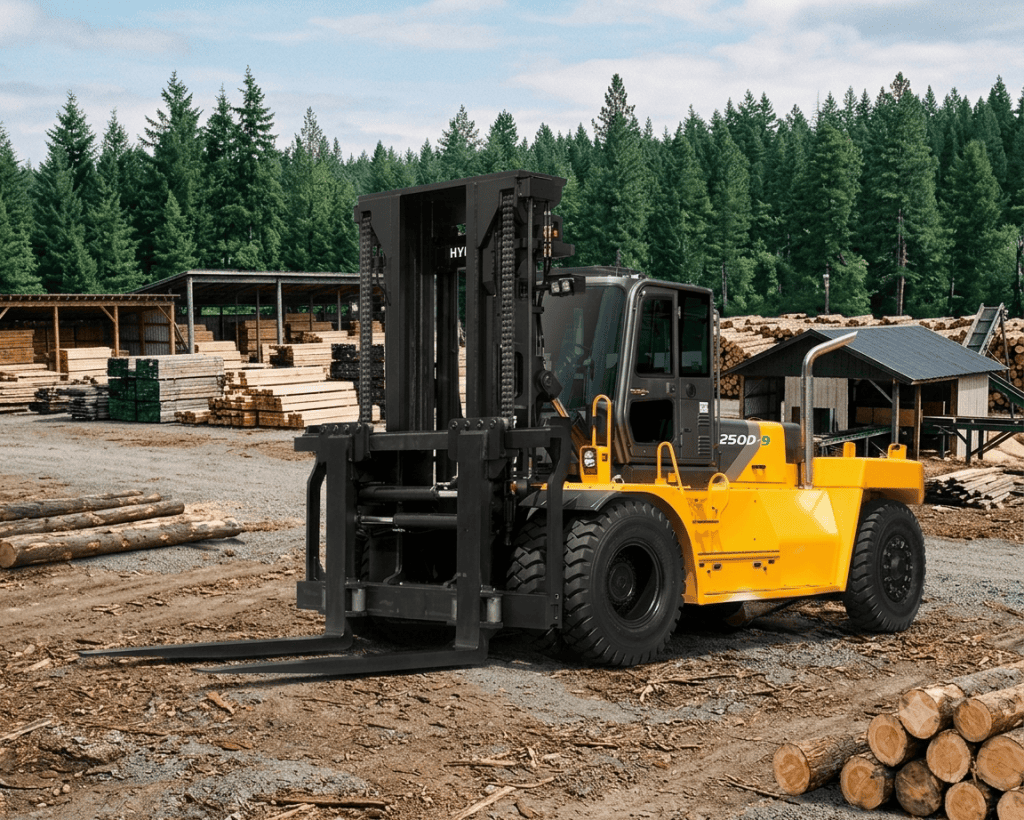
Timber does not behave like a neat stack of pallets. A pack of framing timber runs long, and length changes how a forklift handles it. The load pushes the centre of gravity forward. That forward reach cuts into rated capacity before you add a single kilogram. The same length blocks the operator’s forward view. A machine that felt safe with a pallet feels blind with a pack.
The yard adds the second problem. Timber sites cross smooth internal floors and rough external ground in one shift. Sawdust and bark pile up underfoot. Rain turns compacted surfaces greasy. A forklift built for a clean warehouse struggles the moment it rolls onto a working timber yard.
Durability comes first here, then speed. A timber forklift needs a strong chassis, a dependable mast, and braking that holds up under repeated heavy loads on rough ground. Throughput still matters. It should never cost you stability or component life.
Two load traits decide most timber forklift choices. Both look minor on a spec sheet and turn obvious on the yard.
Timber soaks up water, and water is heavy. A pack that weighs one figure kiln dried weighs far more after a wet week in an open yard. The rated weight on the paperwork describes the timber. It ignores the water the timber has taken on.
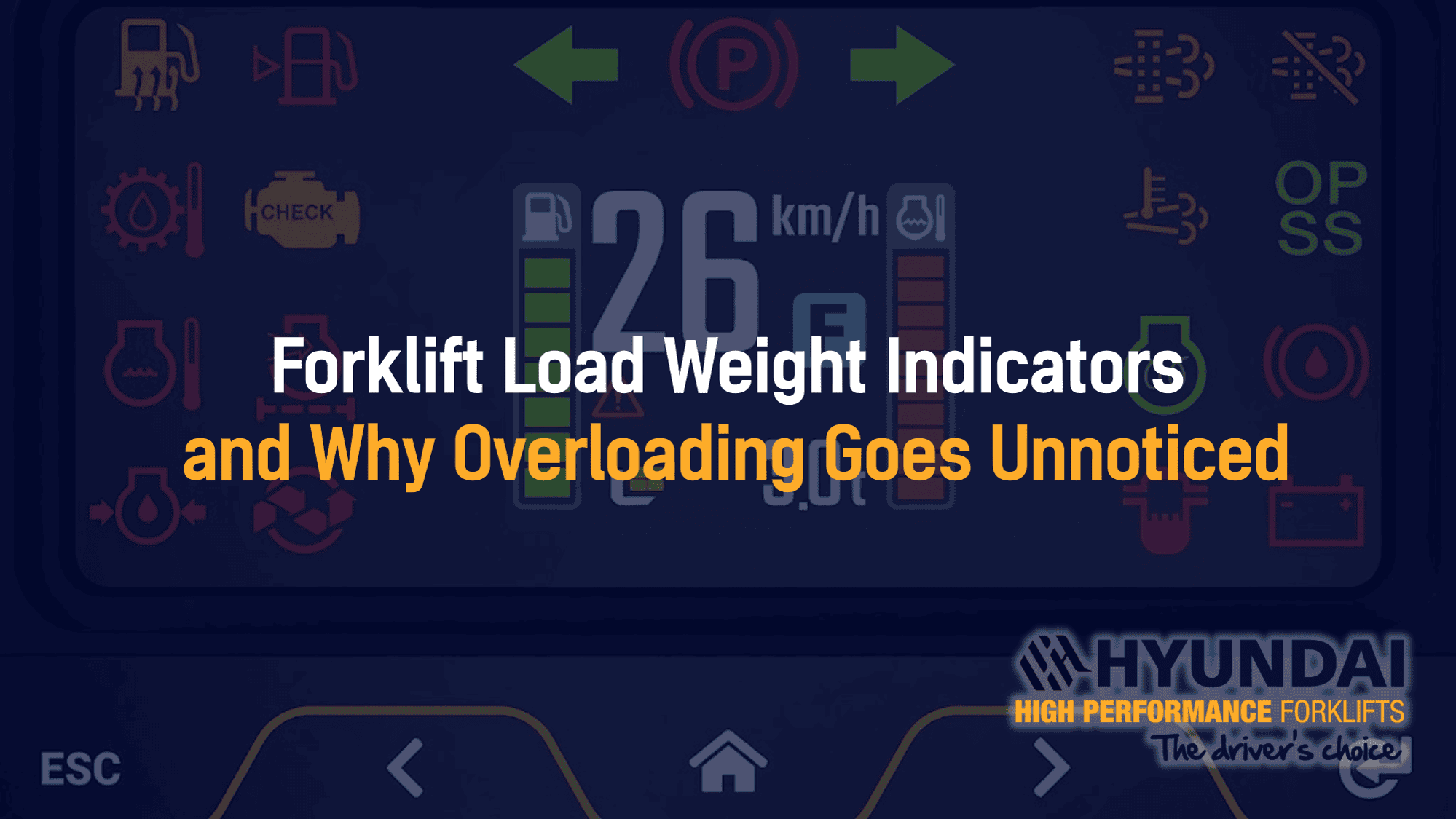
This drives your capacity margin. A forklift chosen to just cover the nominal pack weight keeps no room for wet stock. Buy close to the minimum, and the truck works at its limit the first time it rains. Size for the heaviest realistic load, wet stock included, and the machine stays inside its safe range all year. Hyundai’s load weight indicator shows the actual weight lifted, so wet stock doesn’t tip you into an overload.
A long load sits across the forks and reaches out past the mast. The operator loses the clear forward view a pallet allows. A busy yard mixes people and other machines. That lost visibility becomes a safety problem before it becomes a productivity one.
Mast visibility and carriage stability matter as much as raw lifting power here. A wide carriage supports a long pack across its length instead of letting it flex. Clear sightlines through the mast let the operator place the load without craning around it. The right machine treats the length as a routine task. Hyundai builds for this with high-visibility mast channels and a panoramic windscreen that keep the load in view.
A timber yard is hard on the parts of a forklift that touch the ground. Loose bark, offcuts, and sawdust cut traction and work into moving parts. Rain makes it worse and turns a firm surface slick. Tyre choice becomes a real decision, not a default. A tyre suited to a smooth warehouse floor gives up grip on a wet, debris-strewn yard. Hyundai’s durable axles and drive train are built to carry heavy loads across the uneven ground a timber yard throws at them. Oil-cooled wet disc brakes hold up in wet, dusty yards and need far less maintenance than conventional brakes.
Sawdust also loads the cooling and air systems on a combustion machine. A radiator and air filter in a timber yard clog faster than one in a clean warehouse. Hyundai’s large radiators and cooling packages resist that build-up. The service interval that suits a general site runs too long for a timber operation. Plan maintenance around the real dust load, and you protect uptime. A local dealer knows the conditions in your region, so find your nearest Hyundai dealer to set a service schedule that fits your yard.
Fire risk sits behind all of this. Sawdust burns, and a forklift makes heat and sparks. Matching the machine and its service to a dusty environment forms part of managing that risk.
Timber splits into three weight bands, and your heaviest routine load points to one of them.
Raw log bundles and large sawlogs sit at the top. They routinely call for capacities from around 11,000 kg up to 25,000 kg. This is heavy-duty territory. The machines built for it look and behave nothing like a warehouse truck.
Timber packs coming off the mill fall in the middle, roughly 3,500 kg to 8,000 kg. Operators move them between the saw line, the drying yard, and storage.
Dressed and packaged timber sits at the lighter end, around 2,500 kg to 5,000 kg. Think plywood, board packs, and decking handled in merchant yards and distribution centres.
Work out which band your heaviest load lands in, wet weight included. That one number rules out most of the market.
Timber operations rarely run on one type of machine. The right mix depends on where each truck works.
Diesel forklift stays the practical fit for outdoor timber yards. It delivers the torque for heavy packs and the stamina for long shifts. It handles rough ground, and it refuels in minutes rather than waiting on a charge. For yard-based handling of heavy stock, diesel still earns its place.
LPG forklift suits work that crosses the indoor and outdoor line. A milling shed stays covered but ventilated, and diesel exhaust becomes a problem there. An LPG forklift runs in and out of that space without the fumes, and it still refuels fast. A 7,000 kg LPG machine handles heavy packs while keeping that flexibility. For sites that move stock between yard and shed all shift, LPG earns a place in the mix.
Electric forklift has moved into timber work that used to run diesel only. An operation that runs indoors, in a processing shed or a covered store, gains from an electric forklift. It drops the emissions and noise that matter in an enclosed space. Modern electric machines now reach capacities that used to demand diesel. That opens them up to heavier indoor timber handling than many operators expect.
The decision comes down to the environment each machine works in. It does not come down to a single answer for the whole site.
Attachments turn a general forklift into a timber handler. They also change the capacity equation when they do. A fork positioner lets the operator adjust fork spread to different pack widths without leaving the seat. A wider carriage supports long packs across their length. Both improve control and cut product damage.
Both also add weight and can shift the load centre. That reduces how much the truck can safely lift. So an attachment belongs in the specification from the start, not bolted on after delivery. The forklift, mast, hydraulics, and attachment work as one system. Matching them together keeps the machine safe and productive.
Attachment compatibility varies by model, and the safe lifting figure changes once you fit one. Rather than guess, work the specifics through with a dealer who can confirm what suits your models and loads.
Three questions narrow the choice, in order. How heavy is your heaviest realistic load, wet stock included? Where does the machine work, in an open yard, a mix, or an enclosed store? What does the ground look like underfoot? Answer those three, and you rule out most of the market.
From there, match your answers to a line-up that spans the full timber weight range, from lighter indoor electric machines to heavy diesel log handlers. See the full range on our forklifts for the timber industry page, or contact us about a machine matched to your yard.
Size for the heaviest realistic load, including the extra weight wet timber carries, not the kiln-dried figure on the docket. Then check that the load length and any attachment have not pushed the truck past its safe capacity.
Yes, in the right application. Indoor processing and covered storage suit electric machines, and modern models now handle heavier timber loads that once needed diesel. Open yards with rough ground and long shifts still often suit diesel, so many timber sites run a mix.
Sawdust clogs radiators and air filters faster than a clean site does. Combustion machines in timber yards need more frequent checks of their cooling and air systems. Plan the service interval around the dust load, and you protect uptime and reduce fire risk. Plan the service interval around the dust load. Hyundai’s oil-cooled wet disc brakes also help, lasting longer between services and wearing more slowly than conventional brakes in dusty yards.
If you run forklifts in a dusty yard, precast plant,...
Forklift selection in a precast concrete yard is rarely settled...
A forklift load weight indicator shows the operator how much...