
Reviewing a forklift traffic management plan means walking the floor at its busiest and updating the plan to match. Peak changes Australian warehouses fast, as overflow stock lands in new places, crossings move and new staff start on shift. A forklift traffic management review covers routes, the site map, speed limits, briefings and storage zones. You can run it before peak, during it, or when the site restarts after the Christmas shutdown. Hyundai Forklifts offers optional pedestrian detection on the Hyundai B-X Series, from the 40B-X to the 90B-X.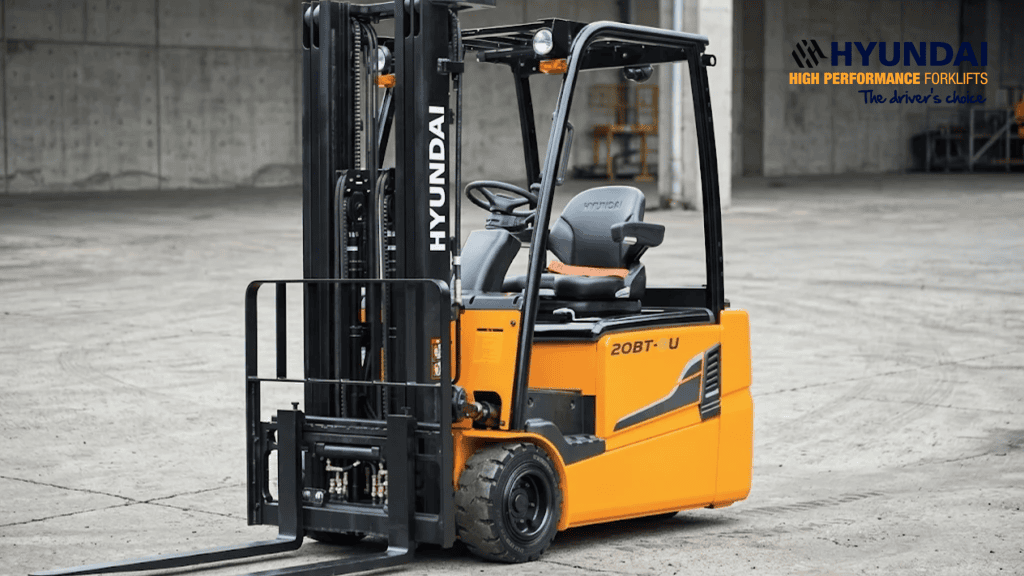
A forklift traffic management plan sets out where forklifts travel, where people walk and where the two meet. It usually includes a site map showing forklift routes, walkways, crossing points and pedestrian-only areas. It also covers driver safety zones at the dock, speed limits, loading areas and signage.
The plan only protects people who know it. WorkSafe Victoria says the workplace induction should include the plan. Contractors and visitors without that training need someone with them at all times. WorkSafe also asks employers to involve health and safety representatives and forklift operators when the plan is put together.
WorkSafe Victoria’s guide to developing a forklift traffic management plan sets out the basics. So does the Safe Work Australia traffic management guide for warehousing. Your state regulator and your own site procedures then set the detail for your workplace.
Between Black Friday and Christmas, peak puts more forklift movements, more foot traffic and more stock onto the same floor. Casual and agency staff may start on shift before they know the routes. Delivery drivers arrive more often and can wander into forklift areas while they wait.
Under deadline pressure, people on foot may take shortcuts and operators may speed up. A clear forklift operator induction for new starters covers the people side. A fleet readiness check shows whether the forklifts themselves can handle the surge.
Any extra machines brought in for peak, and their operators, need the same route briefing as everyone else.
Review the plan on the floor, at the busiest time, with the people who work there. A desk review of last year’s map will miss what has changed since.
During the busiest shift and at shift change, walk the forklift routes and walkways. Take an operator and a picker with you, plus a health and safety representative if your site has one. Stop at aisle ends, crossings, doorways and the dock, and check whether people and operators can see each other in time.
Add every temporary staging zone, overflow area and new crossing to the site map, then make the floor match it. Repaint faded lines and move temporary barriers where routes have shifted. Remove anything that no longer exists, so the map never sends people towards a walkway that is now blocked.
Check that speed limits still suit each area once the layout changes. Lower limits near walkways, doorways and staging zones help. Put the signs where operators see them before they reach the hazard.
Casuals, agency staff and new starters need a briefing on the routes before their first shift. Tell delivery drivers where to park, where to wait and which areas to stay out of. Contractors and visitors need the same briefing, even for a short job.
Check the plan after any layout change, after a near miss and before the site restarts after the Christmas shutdown. Near-miss reports show where the plan is not working before someone gets hurt, so make them easy to raise. Keep a dated record of each review.
The Christmas shutdown is a good time to book forklift servicing, so the machines are ready when the site restarts.
Yes. SafeWork NSW’s traffic management plan template and WorkSafe Queensland’s traffic management guidance plan and example template are free to download and adapt. The NSW template has fields for peak times, traffic volumes and a review date.
A template only gives you the headings. Fill it in after you walk the floor, so the plan describes your site as it runs during peak.
Physical separation comes first, with barriers, fenced walkways and pedestrian-only areas. Where barriers are not practical, marked walkways, set crossing points and signs show people where to walk. These controls follow a set order of preference, covered in forklift safety rules in Australia.
WorkSafe Victoria advises keeping pedestrians at least three metres from an operating forklift where fixed barriers are not reasonably practicable. Mark that distance on the floor at staging zones and crossings, where people tend to stop and talk to operators.
Each crossing point needs clear sightlines and a rule about who gives way. Write that rule into the plan and teach it to everyone, so nobody has to guess at the crossing. Operators hold up their side by slowing at aisle ends, doorways and docks. Using the horn at intersections and making eye contact before passing someone on foot also help. Familiar routes can dull attention, which is why these habits need to hold on every shift.
WorkSafe Victoria says pedestrians make up almost half of all people injured by forklifts. Crushing is the most common injury pedestrians suffer.
Temporary storage should sit in marked zones away from walkways, crossings and aisle ends. Pallets left in aisles narrow the path and can hide a person from an operator.
Overflow space is easier to plan before volume arrives. A marked staging zone near the dock keeps incoming stock out of travel lanes. It also helps to decide who moves stock on when the zone is full, and where it goes. Without that rule, pallets end up wherever there is a gap.
Dock areas see heavy traffic during peak, and safer dock and container loading covers the hazards there.
Yes, technology helps people and operators notice each other sooner. It adds a layer on top of good layout and site rules, and the operator stays in control.
On the Hyundai 20BT-9U, forklift safety features include operator presence sensing. It stops travel and lifting when the operator leaves the seat, and Curve Control limits speed on tight turns.
Hyundai Forklifts’ Pedestrian Detection System is an option on the Hyundai B-X Series, from the 40B-X to the 90B-X. A camera picks up people nearby and highlights the area around them in yellow on the cab monitor. People on foot have nothing to wear or carry. Forklift pedestrian detection systems covers how PDS works on Australian sites.
Blue Spot and Red Zone lighting are separate options that work from the other side. Blue Spot projects a blue light onto the floor ahead of the forklift. Red Zone marks a red boundary around it, so people on foot can see a forklift coming.
Supervisors can also use Hyundai Forklifts’ Hi-MATE telematics, which logs safety events such as collisions. Read alongside near-miss reports, those records help show where the layout needs work. Your dealer can tell you which safety options are available for the forklifts and reach trucks you run.
To talk through safety options for your current or next forklifts, contact Hyundai Forklifts Australia or find your nearest dealer.
From 2 to 4 November, Hyundai Forklifts Australia hosted a...

In our last post, we shared day one of our...
Why we invited our dealers to Korea From Monday 2...