
Electric pallet jacks move more pallets with less effort than a manual jack, and choosing the right one comes down to how far, how often, and how heavy. This guide explains the two main types, the battery options behind them, and how to size a jack to Australian pallets and your real workload. It covers when to switch from manual and where an electric pallet jack fits alongside the rest of the fleet.
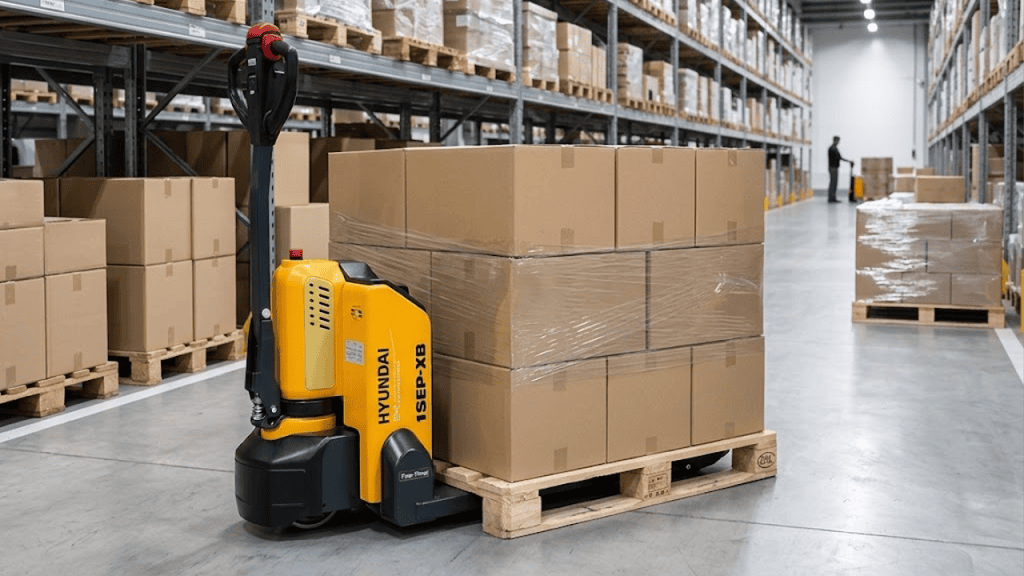
An electric pallet jack is a powered version of the manual pallet jack, using an electric motor to drive and lift instead of the operator’s arm and legs. It moves palletised loads across short to medium distances at floor level. The operator walks behind it or rides on it, depending on the type. The electric drive removes the physical effort that limits how much a manual jack can move in a shift.
Electric pallet jacks split into two types, and the right one follows the distance and frequency of the work.
The walkie pallet jack is the standard model. The operator walks behind it and steers with a tiller. It suits short to medium runs at moderate frequency, which covers most dock to staging and internal transfer work. It takes up little space and manoeuvres easily in tight areas. Our walkie range spans the 12EP-XB (1.2T), 15EP-XB (1.5T) and 20EP-XB (2.0T) for light to heavy duty work, plus the 16EP-X, 20EP-X and 25EP-X for higher capacity loading and unloading up to 2.5T.
A rider pallet jack adds a platform for the operator to stand on. This suits longer runs and higher frequency, where walking behind the jack all shift would slow the operator down and tire them out. Where the same route runs many times a shift over a longer distance, the rider layout keeps the operator moving. Our 20EPR-X and 25EPR-X cover this segment, built for multi shift operation with speeds up to 8km/h.
| Type | Operator position | Best for | Related models |
|---|---|---|---|
| Walkie | Walks behind | Short to medium runs, moderate frequency | 12EP-XB, 15EP-XB, 20EP-XB, 16EP-X, 20EP-X, 25EP-X |
| Rider | Rides on platform | Longer runs, high frequency | 20EPR-X, 25EPR-X |
The signal to switch is workload, not age. Count the moves. Where operators make many pallet moves a shift, push loads over distance, work up ramps, or finish tired from the physical effort, a manual jack has reached its limit. The electric drive removes the strain and lets the same operator move more in the same shift.
Distance and frequency decide it together. A short run made twice a day suits a manual jack. A medium run made fifty times a day does not. Ramps tip the decision faster, because pushing a loaded manual jack up a gradient is where operator strain and injury risk climb.
Electric pallet jacks run on lithium-ion or lead-acid batteries, and the two aren’t shorthand for size or duty class on their own. Voltage and capacity scale with the truck’s tier and workload. Chemistry decides charging behaviour and maintenance.
In our range, the 12EP-XB and 15EP-XB ship standard with a 24V/20Ah lithium-ion pack, with a 24V/36Ah option available for longer shifts. The 20EP-XB steps up to a 48V lithium-ion system to match its 2.0T capacity. The 20EPR-X and 25EPR-X use lead-acid as standard, in the 24V/160 to 350Ah range depending on model, with lithium available as an option for sites running multi shift operation. The 15LPT runs a plug and play lithium pack under 13kg that can be swapped and charged from any standard outlet. The 15EPT uses a maintenance-free lead-acid pack instead.
A 24V system can be lithium or lead-acid. The number tells you the voltage class the truck runs on, not which chemistry sits inside it. Lithium supports fast charging and opportunity charging, meaning you can top up during breaks without waiting for a full cycle. This suits long or multi shift work. Lead-acid needs a full charge cycle and suits single-shift sites with predictable downtime for charging.
Sizing starts with the load and the pallet. Rated capacity has to cover the heaviest pallet the jack will move, with margin for variation. Fork length has to match the pallet so the load sits supported rather than overhanging.
The standard Australian pallet measures 1165 by 1165 millimetres, larger than the international 1200 by 1000 pallet many jacks are built around. A jack sized for the international pallet can leave an Australian pallet unsupported at the ends. Confirm the fork length suits the pallet you actually run before specifying the jack.
Runtime depends on the battery type and the workload. A lithium pack supports fast top up charging across breaks, which suits long or multi shift use. A lead acid pack suits a single shift with time to charge afterward. Match the battery to the hours the jack actually works.
Size the fork length to the 1165 by 1165 millimetre Australian standard pallet if that is what you run, and confirm the rated capacity covers your heaviest load with margin. A jack built only for the international pallet can leave an Australian pallet unsupported.
Explore the electric pallet jack range or talk to us about a jack matched to your pallets and workload.
A stand-up reach truck suits frequent stops and short trips,...
Life in a hire fleet is demanding. A forklift can...
Your forklift fleet is ready for peak season when utilisation...