
Loading a curtainsider or flatbed from the ground puts the forklift in an open yard, with the driver and other staff on foot nearby and work often carrying on after rain or into the evening. The forklift can help by being easy to notice, holding still when the operator is out of the seat, keeping speed in check and suiting outdoor work. None of that replaces the site’s loading rules, but it makes them easier to follow.
This guide goes through each of those, using the Hyundai Forklifts 25/30/35BE-X electric counterbalance range as the example.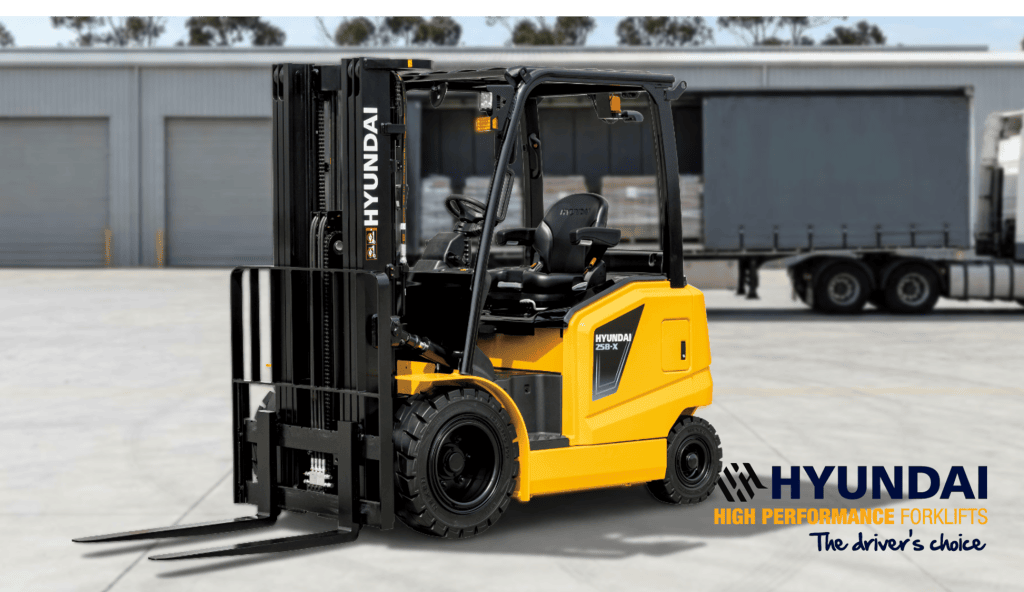
Australian industry guidance recommends a loading and unloading exclusion zone (LUEZ). The truck driver waits in a driver safety zone within the operator’s view, and loading stops if the driver moves out of sight. For curtainsiders and flatbeds, the zone covers both sides of the truck and the route around it.
With that in place, the forklift’s job is to be easy to notice for anyone else in the yard, and for the driver when they return at the end of loading.
An electric forklift is quieter than a diesel one. That is easier on the operator, but people nearby may not hear it coming. A travel alarm gives a sound cue that works day or night. Blue Spot and Red Zone lamps project light onto the ground around the machine. They stand out most in low light, under cover and in the evening, and are harder to see on bright concrete in full sun. An LED beacon is also available.
A panorama mirror is standard, and side mirrors on both sides can be added. They give the operator a second view along the truck, on top of looking in the direction of travel as operators are trained to do.
On sealed yards and hardstand, yes. The BE-X drive and pump motors are IP54-rated against dust and splashing water, and the traction motor sits enclosed within a single drive axle rather than exposed underneath. The controller is rated IP65, the hydraulic control lever uses sealed micro switches, and the key switch has a sealed cap. All of this is standard. That lets one machine unload in the yard and carry pallets into the warehouse without bringing exhaust inside.
Ground clearance under the mast is 142 mm, so the BE-X is at home on concrete, asphalt and compacted hardstand. Solid tyres are standard, and pneumatic tyres are available on the 25BE-X and 30BE-X for rougher sealed surfaces. For loose gravel or unsealed ground, your dealer can suggest a better fit.
Many yards have a fall for drainage. The standard anti roll-back system stops the forklift rolling back after it comes to a stop on an incline, which helps when stopping and starting again on a slope. The parking brake still goes on before the operator leaves the seat.
For loading into the evening, front or front and rear LED work lamps light up the deck and the ground around the truck.
Forks matched to your pallets make ground loading easier. When forks are too long for the pallet, the tips can reach into the next pallet or the curtain on the far side, where the operator can’t see them.
The BE-X comes with 1,050 mm forks, and forks of 900 mm or anywhere from 1,150 mm up to 2,400 mm are available, so fork length can be matched to the pallets you handle. Longer forks suit long loads or carrying two pallets end to end.
Pallets on the far side of the deck are reached by driving around the truck, inside the marked zone, with the driver in view. Fork length and a sideshift both change the rated capacity, so your dealer will check the load chart for the setup you choose.
Operators get off the forklift during a load for ordinary reasons, such as checking paperwork with the driver at handover. The routine is to lower the forks, select neutral and apply the parking brake first.
The standard BE-X seat has an operator presence switch. The optional Operator Presence Sensing System (OPSS) for travel and mast goes further and locks driving, lifting and tilting once the seat is empty. It is a backup for the moment that routine gets rushed. A seatbelt interlock is also available.
The BE-X lets the site set a maximum travel speed through the digital cluster as standard. The operator can’t go above it, so the top speed is held by the machine.
The cap applies across the site rather than changing by zone, so slower travel beside the truck still comes from training and the operator’s slow mode on the cluster. An optional limit does act automatically when the forks are raised, cutting travel to 3 km/h whenever they are above 500 mm or past free lift height. That covers the moment a pallet comes off a high deck.
| Situation | BE-X feature | What it helps with | What it doesn’t replace |
|---|---|---|---|
| People on foot in the yard | Travel alarm, Blue Spot and Red Zone lamps, LED beacon (options) | Makes a quiet forklift easier to notice, with lamps strongest in low light | LUEZ and driver safety zone |
| Operator’s view along the truck | Panorama mirror (standard), side mirrors (option) | A second view along the deck | Looking in the direction of travel |
| Yard and warehouse work | IP54 motors, enclosed traction motor, IP65 controller, sealed switches (standard) | One machine on sealed yards and indoors, no exhaust inside | A sealed, drained yard surface |
| Sloping yards | Anti roll-back (standard) | Stops rolling back after a stop | Parking brake before leaving the seat |
| Evening loading | LED work lamps (option) | Clear view of the deck and ground | Yard lighting |
| Matching pallets and loads | Fork lengths from 900 to 2,400 mm (option) | Forks sized to pallets and long loads | Driving around to reach the far side, load chart check |
| Operator leaving the seat | Presence switch (standard), OPSS and seatbelt interlock (options) | Locks travel and mast if the shutdown is rushed | Forks down, neutral, parking brake |
| Speed | Speed cap and slow mode (standard), 3 km/h raised fork limit (option) | Site-wide top speed held by the machine | Slower travel beside the truck |
Confirm the exact specification with your local Hyundai Forklifts dealer.
This article is part of our truck loading safety series. For loading vans, reefers and shipping containers at a dock, read Choosing a forklift for safer dock and container loading/unloading.
Most loading dock incidents come back to a few situations....
This article wraps up our recent series on HFA service...
Businesses looking at high-voltage forklifts often ask about infrastructure, and...