
A forklift that nobody sees is the most dangerous machine on site. Poor visibility sits near the top of the forklift risk list, and it arrives from several directions. Night shifts run in permanent dark. Rain cuts sightlines and dulls contrast. Cold stores, unlit yards and deep rack aisles stay dim at midday. Dawn and dusk handovers put people on the floor in the worst light of the day.
This guide from Hyundai Forklifts Australia covers the lighting toolkit that keeps a forklift seen, what each light does, which lights come fitted as standard, where lighting falls short, and the visibility checklist that goes with it.
WorkSafe Victoria reports that pedestrians make up almost half of all people injured by forklifts, and that crushing is the most common injury they sustain. In 2022 the regulator accepted 142 forklift injury claims, and 26 of those involved a pedestrian struck by a forklift.
WorkSafe Queensland records an average of 430 accepted workers compensation claims each year involving forklifts since 2012. Forty per cent of those are serious injuries with five or more days off work.
Poor light widens the window where a pedestrian and a machine end up in the same space without either seeing the other in time. Lighting targets that window directly.
Forklift lighting is not one thing. Different lights solve different problems, and a night or wet weather setup usually runs several together.
| Light | What it does | Who it helps |
|---|---|---|
| Work lights | Illuminate the load, the rack and the ground ahead | Operator |
| Blue spot light | Projects a moving blue spot ahead of or behind the truck | Pedestrian, before the truck appears |
| Red zone light | Projects red lines marking a keep out area alongside the truck | Pedestrian, once the truck is visible |
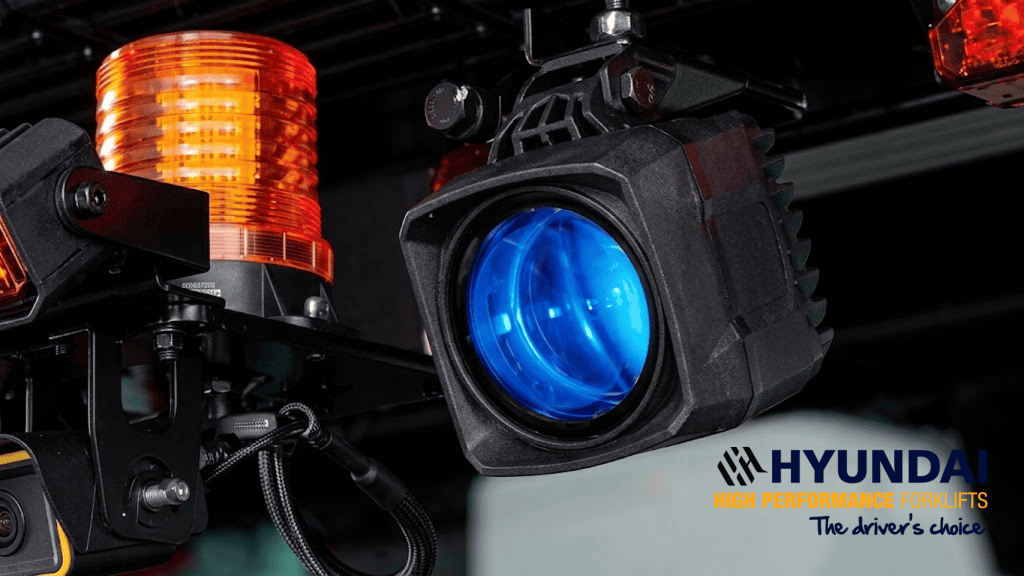
| Beacon | Marks the machine’s position from any angle | Pedestrian and other operators |
| Turn signals and rear combination lamps | Show direction and braking | Pedestrian and other operators |
| Rear camera | Extends the operator’s view into blind spots |
Work lights provide the illumination the operator needs to see the task and the travel path. On any truck working after dark, adequate work lighting is the foundation. It lets the operator see the load, the rack and the ground in front of them. Without it the operator works blind.
Work lights do a second job that most sites overlook. Retroreflective tape on a hi vis vest needs a light source pointed at it before it returns anything. In an unlit yard the forklift’s own work lights are what make a pedestrian’s vest visible at distance.
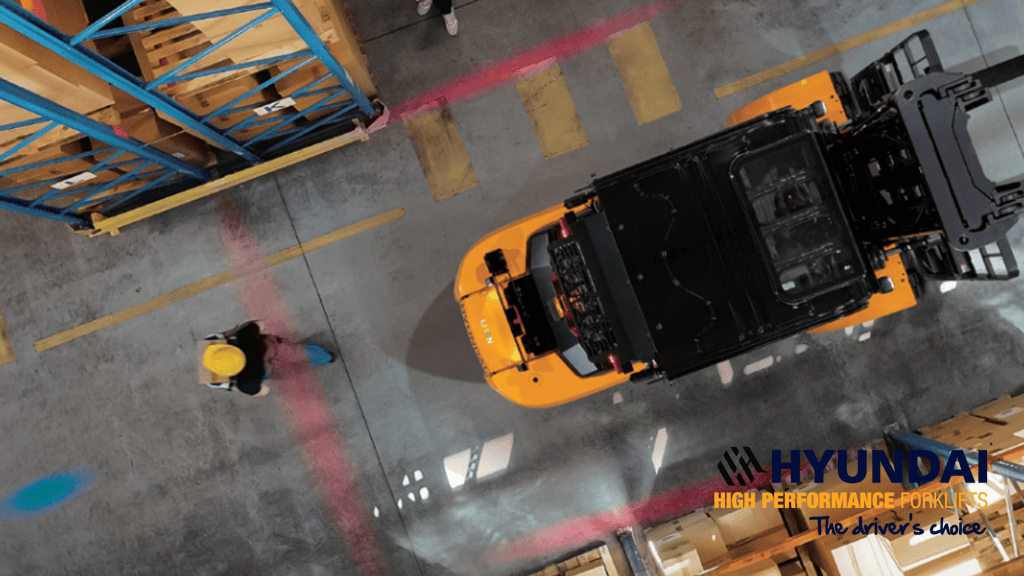
A blue spot light projects a bright blue spot onto the floor ahead of or behind the forklift, moving with the machine. The spot warns pedestrians that a forklift is approaching, even around a blind corner or a rack end where they cannot yet see the truck.
The projected spot arrives before the machine does. That buys the pedestrian time to stop. In darkness the advance warning matters more, because the machine itself is harder to spot.
A red zone light projects red lines onto the floor along the sides of the forklift, marking a keep out zone that moves with the machine. The lines give pedestrians a visible boundary showing how close is too close as the truck travels and turns.
Where a blue spot warns of approach, red zone lines mark the danger area around the machine. Together they tell a pedestrian both that a forklift is coming and where not to stand.
Lighting fitment varies more across a forklift range than most buyers expect. Two trucks of similar capacity can leave the factory with very different visibility packages. The table below sets out what Hyundai Forklifts Australia supplies across four current ranges.
| Range | Capacity | Front work light | Rear work light | Beacon | Blue spot and red zone |
|---|---|---|---|---|---|
| B-X electric, 40 to 55B-X | 4,000 to 5,500kg | LED standard | LED standard | LED standard | Factory option |
| DE/LE-7 diesel and LPG, 25 to 35 | 2,500 to 3,500kg | LED standard | LED optional | Optional | Aftermarket fitment |
| D-9 diesel, 25 to 35DA | 2,500 to 3,500kg | Halogen standard, full LED optional | Optional, bulb or LED | Optional, amber, red or blue | Aftermarket fitment |
| 7M LPG, 15 to 20L | 1,500 to 2,000kg | Headlights standard | Optional work lamp | Optional | Aftermarket fitment |
Two points matter for anyone specifying a truck for dark work.
A beacon ships as standard equipment only on the B-X electric range. On the three engine powered ranges it is a line item you have to ask for. A truck ordered without one arrives with no all round position marker at all.
Rear lighting is the most common gap. The DE/LE-7 carries a front LED work lamp as standard but leaves the rear lamp as an option, and the 7M leaves work lamps off the standard build entirely. Reversing is where most pedestrian strikes happen, so the rear lamp is the last thing to trim from a specification.
Projected pedestrian lighting is a factory option on the B-X series, where it sits alongside a rear camera and a pedestrian detection alarm. On the engine powered ranges it goes on as an aftermarket fitment through your dealer.
A blue spot competes with ambient light. In bright daylight or under strong dock lighting the projected spot washes out and loses most of its warning value. Night shifts and dim yards are where the technology earns its keep.
Wet ground works against it from the other side. A rain slicked concrete apron reflects and scatters projected light, so both the blue spot and the red zone lines lose contrast against the surface. Standing water breaks the shape of the red lines entirely.
Multiple machines create a third problem. Where several forklifts work the same aisle, pedestrians see several blue spots and cannot tell which spot belongs to which truck.
Mounting position sets the warning distance. A spot mounted on the overhead guard throws further ahead than one mounted low on the counterweight. Ramps and uneven yard surfaces shift where the spot lands, so a setup tuned indoors behaves differently in the yard.
Pedestrians on older sites learned to track forklifts by engine noise. That cue weakens as fleets electrify.
The numbers show the gap. A D-9 diesel produces 80 dB(A) at the operator’s ear. The 7M LPG range sits at 78 to 80 dB(A). A B-X lithium electric runs at 74.5 dB(A), and its cabin noise sits 12dB below comparable engine powered models.
Night work compounds it. The machine is harder to hear and the yard is harder to see through at the same time. Pedestrian warning lighting matters more on an electric fleet than it did on the engine powered fleet it replaced.
Rain takes visibility apart in three ways at once. Water on the windscreen and mirrors breaks the operator’s sightlines. Spray and low cloud cut how far anyone sees. Wet ground lengthens stopping distance, so the operator needs more warning to act on what they do see.
Cab specification decides how much of that the operator can manage. A full cabin with front, rear, top and wiper is available on the DE/LE-7 range, and air conditioning with a heater is a separate option that clears fogged glass. Ordering a cab without a wiper leaves the operator wiping the screen by hand.
Equipment rating decides whether the truck belongs outside at all. On the B-X series the battery pack, drive motor, hydraulic motor, power distribution unit and battery thermal management system carry an IP67 water and dust rating, and the vehicle control unit is rated IP69K. The charger is rated IP54 and installs outdoors.
Engine powered trucks handle water at the component level instead. The D-9 range uses a waterproof and dustproof fuse box and relay box, and an optional rear tyre cover keeps thrown debris out of the radiator. That cover is standard on the DE/LE-7 range.
Wet conditions raise the value of controls that do not depend on line of sight. A rear camera keeps working when a mirror is beaded with water. A pedestrian detection alarm keeps working when a person is hard to make out against a grey yard.
Lighting improves what people see. It does not replace the controls that keep people and machines apart. A well lit forklift in a poorly designed traffic layout is still a forklift in a poorly designed traffic layout.
Physical separation comes first. Walkways, barriers and exclusion zones do more than any light, because they remove the interaction rather than illuminating it. WorkSafe Victoria advises that where fixed barriers are not reasonably practicable, pedestrians should stay outside a three metre exclusion zone.
Speed management still applies. A well lit truck travelling too fast for the conditions is still travelling too fast. Every range carries a way to cap it. The D-9 lets you set a maximum between 8km/h and 20km/h from the cluster. The 7M offers a travel speed control system that holds the truck to 15km/h to 17km/h indoors while allowing full speed outside. B-X models reach 25.5km/h loaded and take an optional speed limiter.
No. AS 2359.1, the Australian standard for powered industrial trucks, states that it does not set lighting requirements. It notes that adequate lighting may still be needed to meet the requirements of statutory authorities or to allow operation in areas of low light intensity.
The duty sits in WHS regulations instead. Operators must manage forklift and pedestrian traffic risks so far as is reasonably practicable, and regulators expect a documented traffic management plan. Pedestrian warning lights are one way to show you addressed a visibility risk your plan identified, particularly on a busy site or across a night shift.
Work lights front and rear provide the illumination the operator needs once daylight goes. A beacon marks the truck’s position from any angle. Blue spot lights warn pedestrians of an approaching forklift around blind corners. Red zone lights mark a keep out boundary around the machine. Many night setups run all four, matched to the site’s traffic and blind spots.
On the B-X electric range they are a factory option, supplied alongside a rear camera and a pedestrian detection alarm. On the engine powered D-9, DE/LE-7 and 7M ranges they are not on the factory option list, so they go on as an aftermarket fitment through your dealer. Both are low voltage LED units that draw from the truck’s existing electrical system, and mounting points on the overhead guard or counterweight suit most counterbalance models.
Partly. Both still project, but wet ground reflects and scatters the light, so the spot and the lines lose contrast against the surface. Standing water breaks the red lines up. Sites that work through heavy rain should treat projected lighting as one layer and lean harder on beacons, cameras, detection systems and the traffic plan.
No. Lighting improves visibility but does not replace physical separation, speed management or the traffic plan. Walkways, barriers and exclusion zones come first, and lighting reinforces them where separation cannot be complete. A well lit forklift still needs the controls around it.
Talk to Hyundai Forklifts Australia about lighting and visibility options for your site.
Sites looking at electric forklifts tend to raise the infrastructure...
Spec sheets make forklifts easy to compare. Capacity, lift height,...
Hyundai Forklifts Australia has delivered its first high-voltage forklift training...