
Forklift operator fatigue is a safety issue that comes down to three fixable areas, seat and cab ergonomics, shift design, and the early fatigue signs a supervisor can catch, plus a battery chemistry factor between lead acid and lithium that most warehouse operations overlook. A tired operator reacts slower, judges distances worse, and makes the mistakes that cluster late in a shift. This guide covers the ergonomics, the shift design, the warning signs, and the battery factor in turn.
Fatigue does not announce itself as a safety failure. It shows up as slower reactions, poorer judgement of distance and speed, and reduced attention to the task. Each of those degrades the fine control a forklift demands, and the effect compounds through the shift. The operator who was sharp at the start makes small errors by the end.
And those errors land at a predictable time. A lot of incidents happen late in the shift, when fatigue has built and attention has thinned. The precision that places a load cleanly on a rack or stops a truck at the right point erodes as the operator tires. Reduced noise and vibration is the difference between an operator who finishes fresh and one who finishes with a headache and a sore back, which is the kind of end of shift fatigue that sits behind a lot of late day accidents. Managing fatigue is managing that curve, keeping the operator closer to their start of shift capability through the whole shift.
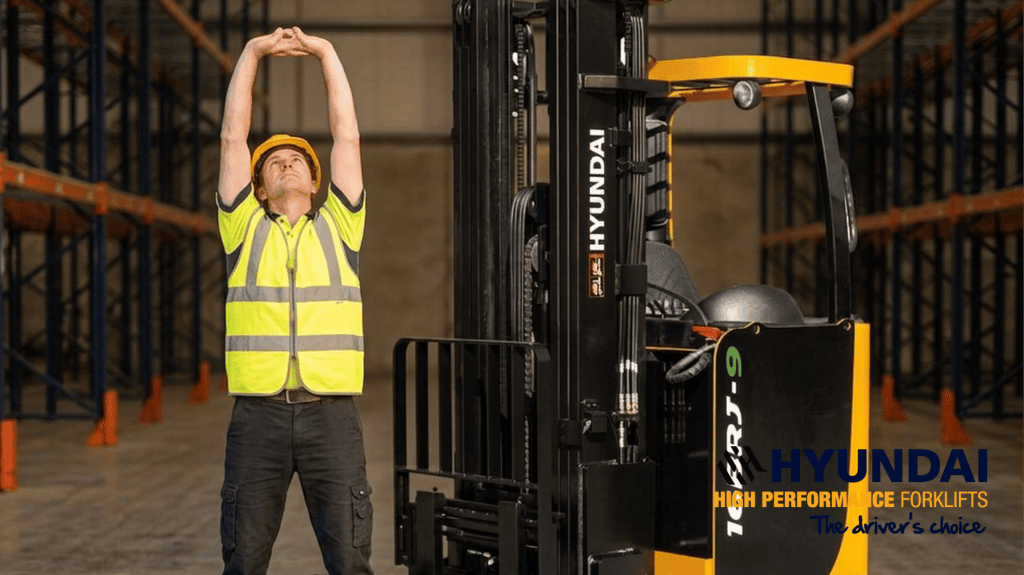
Fatigue has three sources, and each needs its own response. The machine adds or removes physical strain. The shift structure sets how long fatigue has to build. And the early signs tell a supervisor when to act. Working all three does more than fixing any one.
The forklift itself is a major source of fatigue, or a major defence against it. Vibration, noise, control effort, and seat quality all feed the physical toll of a shift. A machine that transmits every bump, forces hard control inputs, and runs loud wears the operator down faster than one engineered to reduce those loads.
But the engineering that reduces fatigue is specific. A full suspension seat that adjusts to the driver keeps a lighter and a heavier operator equally supported. On the Hyundai 16BRJ-9 the seat sets its suspension stiffness to the operator across a 45 to 170 kilogram range. Fingertip controls handle the hydraulics with small, low effort movements, so the hands work less across a shift of repeated tasks. Adaptive steering that adjusts to operator input takes effort out of every turn. Lower noise and vibration reduce the physical drain of the sound and the ride. Each of these targets a source of fatigue directly, and the effects compound together in practice.
How the shift is structured sets how much fatigue has to build. Repetitive tasks dull alertness, especially late in a shift or through a peak throughput period, so the shift design either compounds fatigue or limits it. Rotating operators through different tasks breaks the monotony that dulls attention. Keeping productivity targets realistic stops the pressure that pushes operators past their limit. And building genuine breaks into the shift lets the operator recover rather than run down.
These are operational choices, not machine features, and they belong to the way the site runs its people. A fleet plan that ignores shift design leaves fatigue to accumulate unchecked. Our guide to forklift fleet management strategies covers standardising operator practice across a fleet.
Fatigue is manageable when it is caught early, so supervisors need to know the signs. Slower cycle times as the shift wears on, rougher handling and less precise placements, and operators reporting tiredness or working around the task are all signals. And near misses that cluster at a particular time of shift point to fatigue building at that point.
Acting on near misses early is the control that matters most here. A near miss is a warning that the margin has thinned, and treating it as information rather than luck is what prevents the incident that follows. A supervisor watching for the signs catches fatigue before it becomes a strike.
There is a source of fatigue that hides in the power system. A lead acid battery loses voltage as it discharges, and as the voltage drops, travel and lift speed drop with it. The machine gets slower and less responsive through the shift, and the operator compensates by working harder to get the same output. That extra effort feeds fatigue at exactly the point in the shift when the operator is already tiring.
But lithium changes this. A lithium battery holds its voltage far more consistently across the usable charge, so the last pick of the shift performs much like the first. The machine does not get sluggish as it discharges, so the operator is not fighting a fading truck on top of their own fatigue. The consistent output removes a fatigue source that a lead acid fleet builds in without noticing. Our guide to lead acid versus lithium ion covers the voltage behaviour of each chemistry.
Watch for slower cycle times as the shift progresses, rougher and less precise handling, operators reporting tiredness, and near misses clustering at a particular time of shift. These signals point to fatigue building, and catching them early lets a supervisor act before an incident. Late shift is where the signs concentrate.
Yes, significantly. Vibration, noise, control effort, and seat quality all feed the physical toll of a shift. A machine with a full suspension seat, low effort fingertip controls, adaptive steering, and reduced noise and vibration keeps the operator fresher than one that transmits every bump and forces hard inputs. The machine is a major lever on fatigue.
Talk to us about equipment matched to reducing operator fatigue on long shifts.
A stand-up reach truck suits frequent stops and short trips,...
Life in a hire fleet is demanding. A forklift can...
Your forklift fleet is ready for peak season when utilisation...