
From Monday 2 November 2026, Hyundai Forklifts Australia hosted representatives from eight of our dealers on a three-day VIP program in Korea with HD Hyundai XiteSolution, the HD Hyundai company that develops and builds Hyundai forklifts. Joining us were Re.Group, Rentcorp, TasTrucks, Norlift, Forkbiz, Kentan, Prolift and Masterlift.
In October, Hyundai launched large electric models from 10 to 18 tonnes and began mass production in Korea. Our dealers sell and service Hyundai forklifts across Australia, so we wanted them to see these new models first-hand and hear about the technology directly from the Hyundai team.
Day one started at HD Hyundai’s research centre near Seoul. From there we drove to the Technical Center to see Hyundai’s high-voltage electric forklifts and autonomous forklifts, and then visited the Global Education Center. We ended the day back in Seoul with a welcome dinner. This post covers day one. We’ll share days two and three in our next post.
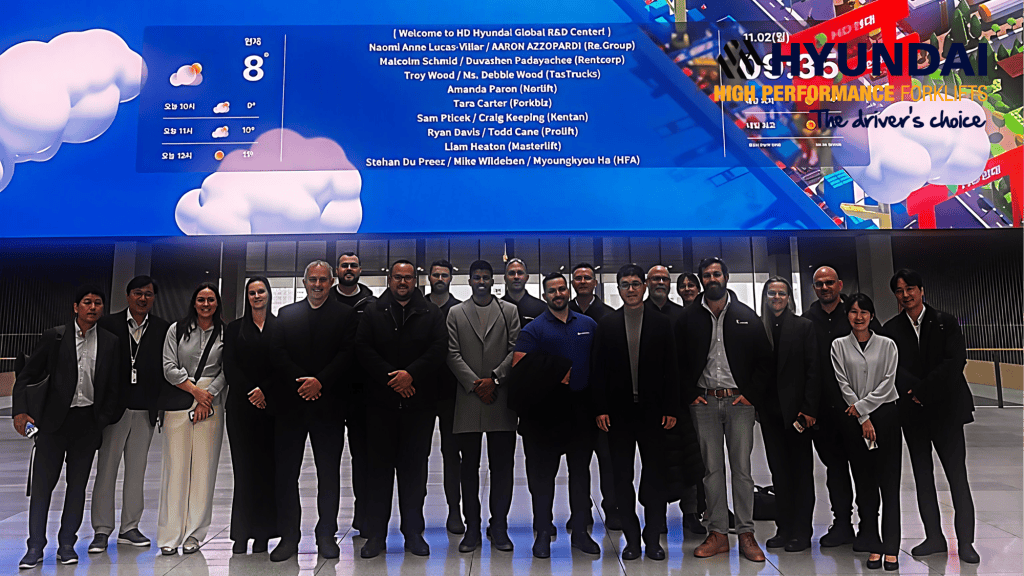
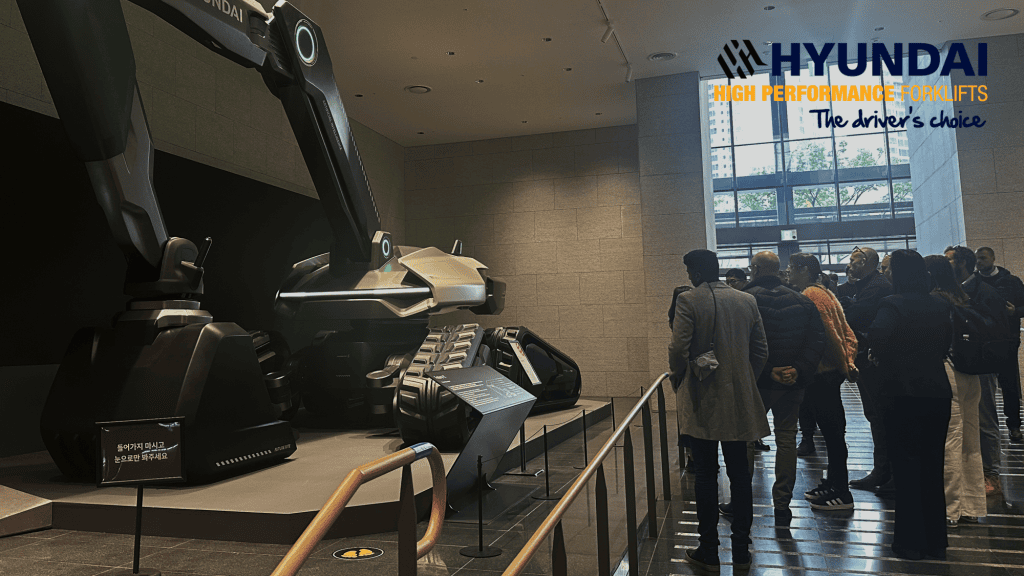
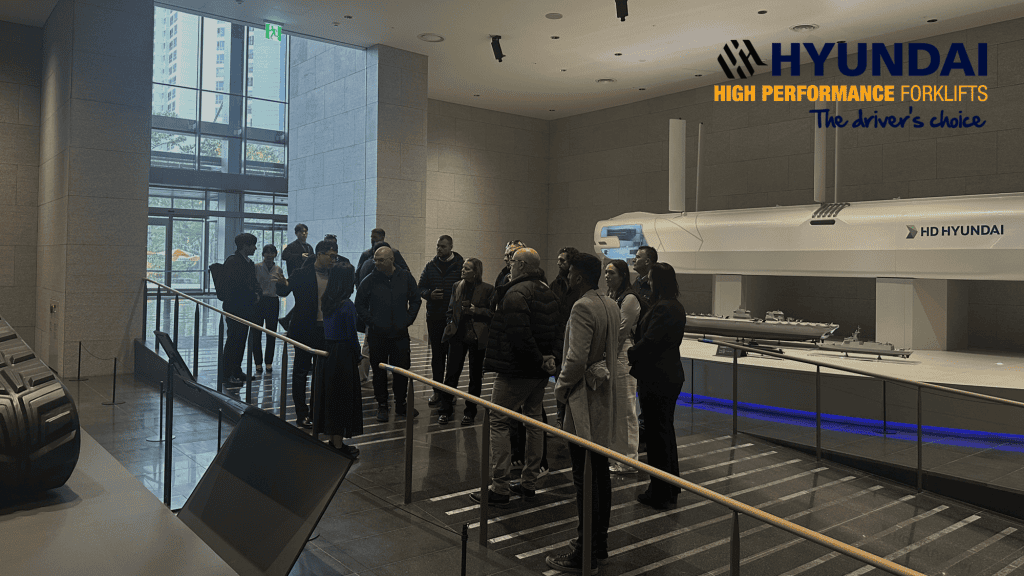
Our first stop was the HD Hyundai Global R&D Center, known as GRC, in Pangyo just south of Seoul. It is the research and development centre for the whole HD Hyundai group.
The building is also home to the Electrification Center, which opened in November 2023. It brought electrification research teams from several HD Hyundai companies together, including the power electronics team from HD Hyundai XiteSolution.
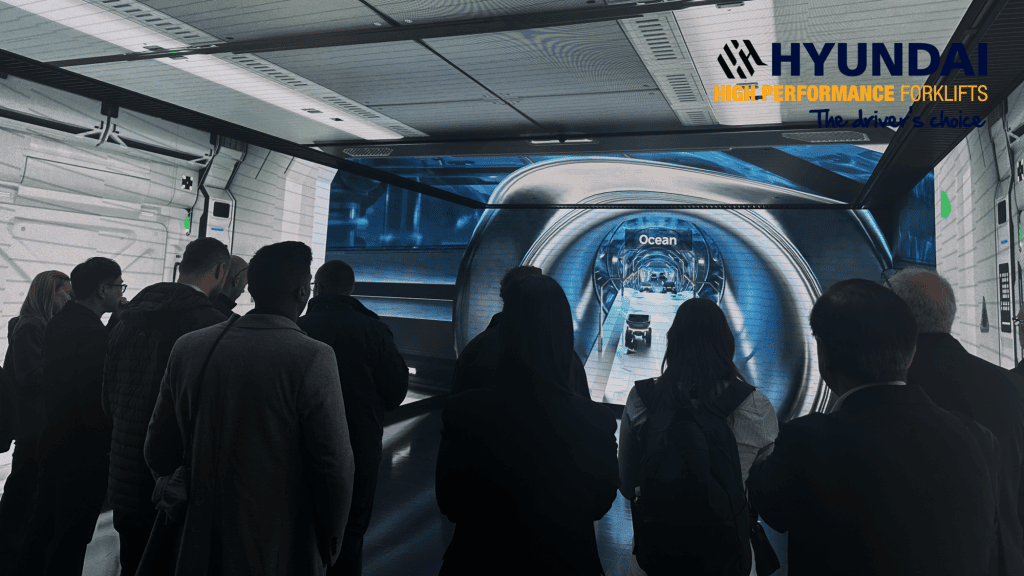
The GRC team welcomed our dealers by name on the large screen in the atrium.
Electric forklifts have mostly been used for lighter work, often indoors, while diesel has been the usual choice for heavy loads and long shifts outdoors.
A high-voltage forklift runs its battery and motor at a higher voltage than a standard electric forklift. Many standard electric forklifts run at 48 or 80 volts. Hyundai’s 4 to 9 tonne models run at around 309 to 348 volts, and its 10 to 18 tonne models use a 618 volt system. Running at a higher voltage makes it easier to deliver more power and supports faster charging. According to Hyundai, its high-voltage models offer working speed, climbing ability and power comparable to engine-powered forklifts.
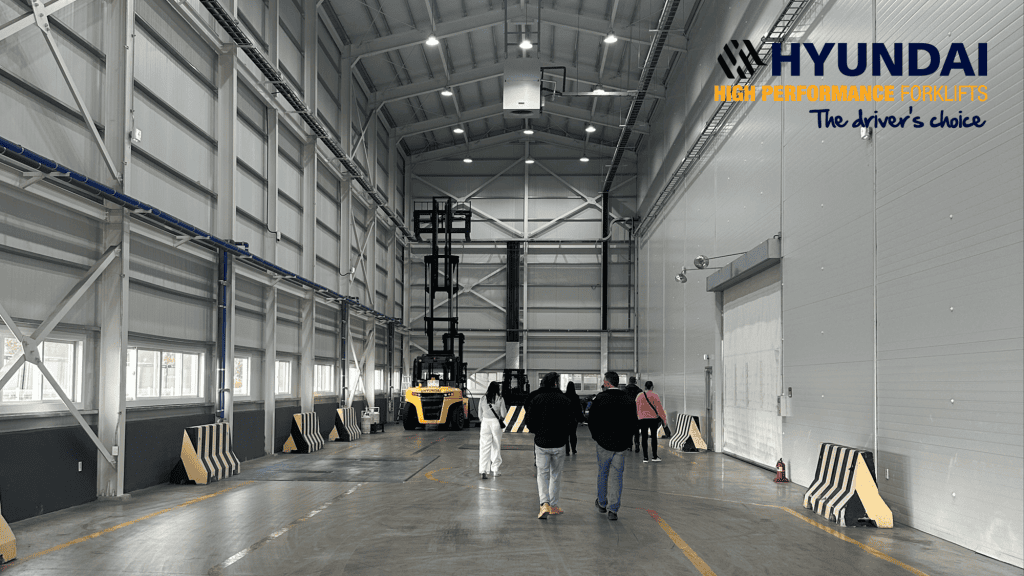
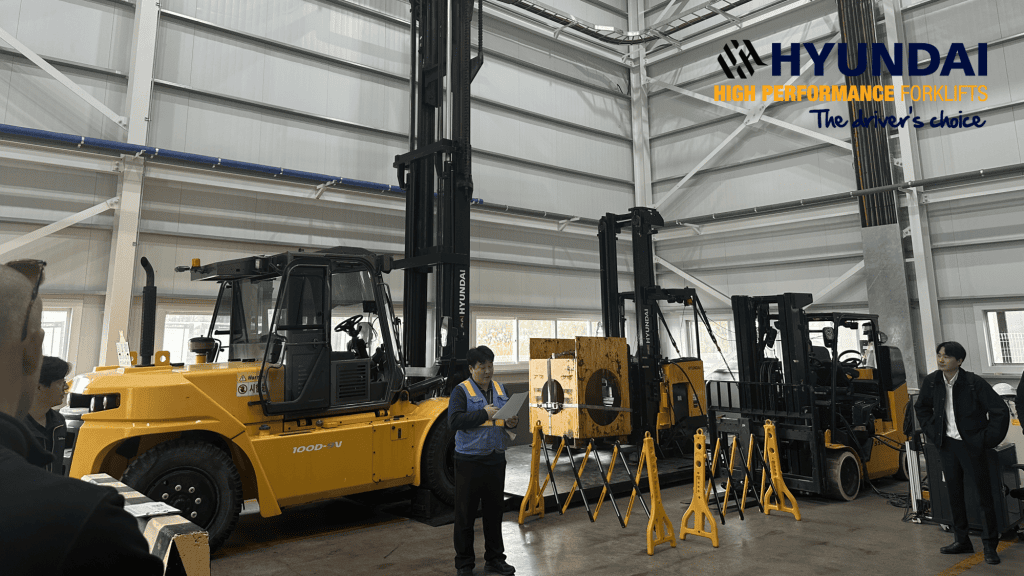
After a two-hour drive and lunch, we arrived at the Technical Center, where the Hyundai team showed our dealers its high-voltage forklifts.
Hyundai’s new 10 to 18 tonne electric models are known overseas as the 100B-X, 120B-X, 130B-X, 160B-X and 180B-X. Here are some of the figures Hyundai has published for them.
| Item | Figure published by Hyundai |
|---|---|
| Run time | Up to 9 hours on a single charge for the 18-tonne model |
| Fast charging | 80 per cent in about 90 minutes with the optional 120 kW charger |
| Battery certification | UL 2580, a US safety standard for battery systems |
| Water and dust | Designed to meet IP67 or higher, which suits outdoor work |
Run time and charging time vary with the load, the application and conditions on site.
Hyundai developed the large models for heavy work in places like shipyards, ports and steel mills. Hyundai also says that, based on total cost of ownership in moderate duty work, the price difference with diesel can be made up in about two to three years. Actual results depend on how the truck is used and on local energy costs.
Your local Hyundai dealer can advise on availability in Australia and help you choose the right model for your site.
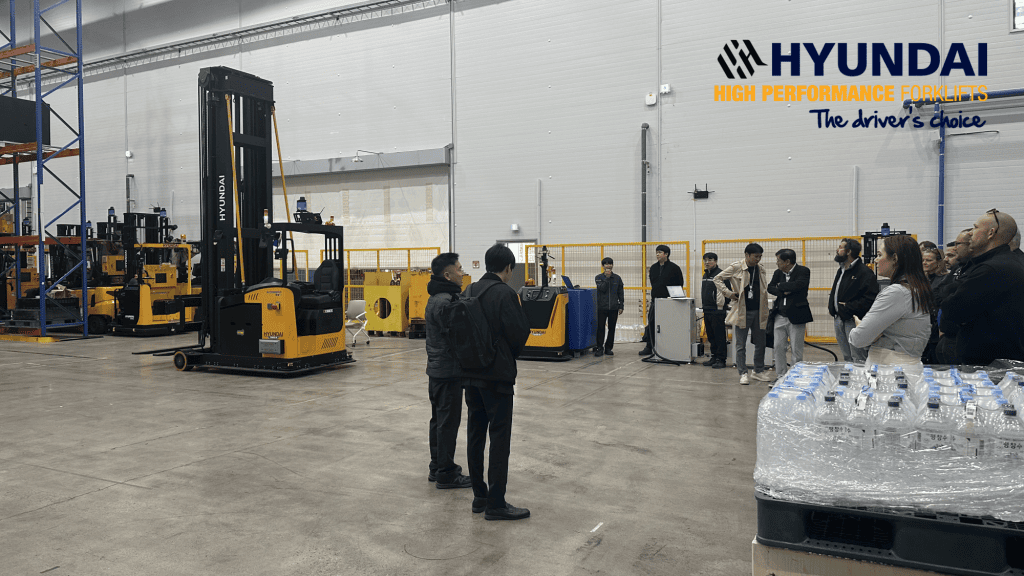
An autonomous forklift moves pallets on its own, with nobody in the seat. It usually relies on sensors and a map of the site to find its way, pick up a load and put it down in the right spot.
At the Technical Center, our dealers also watched Hyundai’s autonomous forklifts at work.
Trucks like these are suited to jobs that repeat all day, such as taking pallets from the end of a production line to storage or moving stock overnight when the floor is quiet.
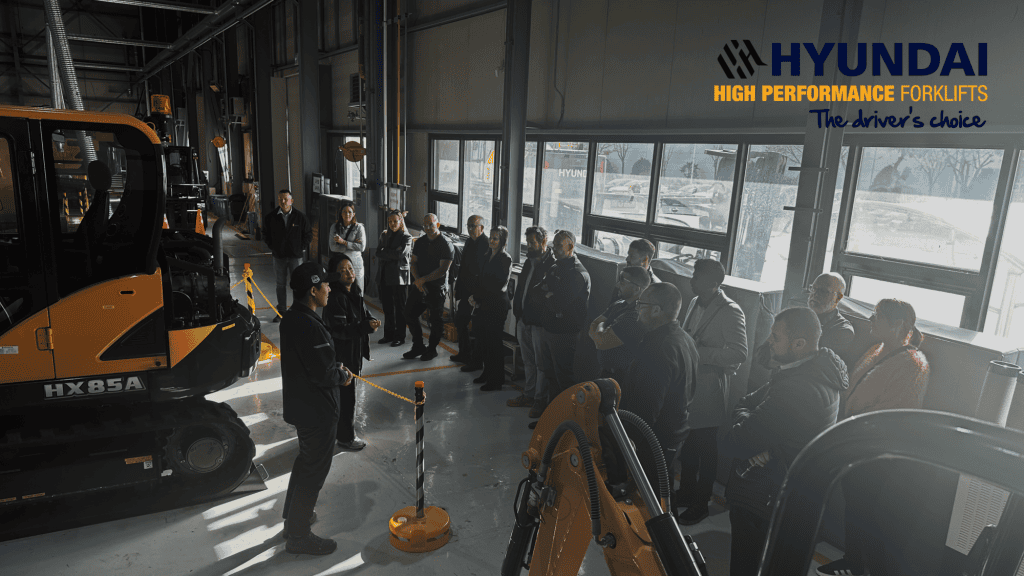
Our last stop of the afternoon was a visit to the Global Education Center.
You can see the Hyundai high-voltage electric forklifts available in Australia on our product page. To ask about the 10 to 18 tonne models, contact Hyundai Forklifts Australia or find your nearest dealer.
Reviewing a forklift traffic management plan means walking the floor...
From 2 to 4 November, Hyundai Forklifts Australia hosted a...
In our last post, we shared day one of our...