
A farm forklift should match your loads, your ground conditions and the fuel that suits your site. Harvest brings heavier workloads to Australian farms, and a forklift can stay useful after the season ends. Harvest jobs, fuel choice, rough ground and the case for buying all shape the decision. You will be ready to decide whether a farm forklift belongs in your year-round fleet. Hyundai Forklifts offers diesel, LPG and electric forklifts through authorised dealers across Australia.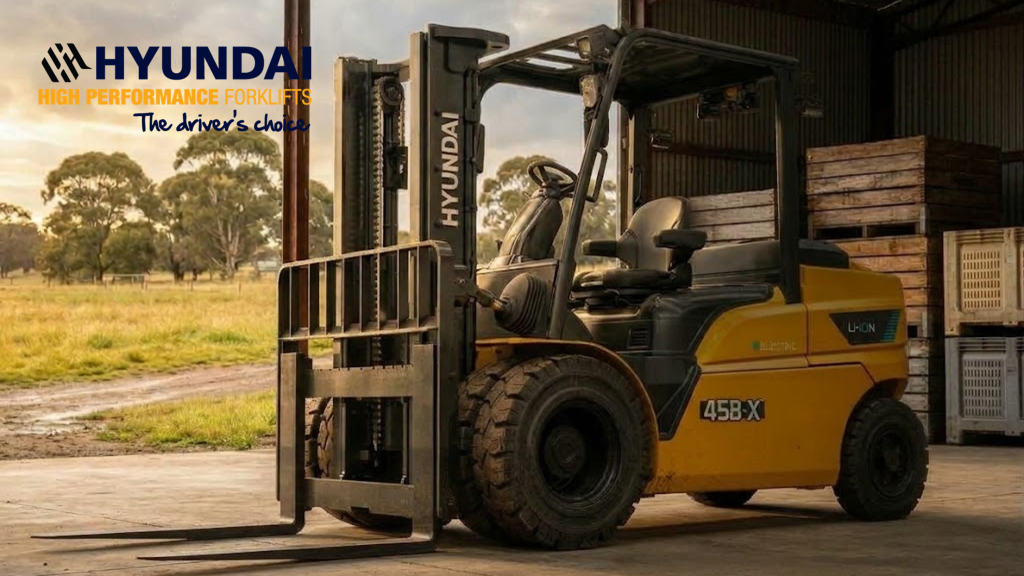
A farm forklift moves bulk bins, bagged seed and fertiliser, hay, chemicals and machinery parts during harvest. In packing sheds, it shuttles fruit bins between the field, cool rooms and packing lines.
Harvest timing varies across the country. Grain harvest in Queensland and northern New South Wales often starts in October, while southern states follow from November. Workloads climb quickly once the season starts.
The same machine can stay busy afterwards. Feed handling, fencing supplies, workshop parts and stock deliveries can fill the rest of the year.
Telehandlers and rough terrain forklifts also appear on Australian farms. A counterbalance agricultural forklift suits firm yards, sheds, packing areas and truck loading.
Fuel choice for a farm forklift depends on where it works, how long it runs and how you refuel it. Diesel suits heavy outdoor handling across yards and paddocks. LPG fits mixed indoor and outdoor work, where quick cylinder swaps keep the machine moving.
Electric forklifts suit packing sheds and cool rooms, with no exhaust indoors. The Hyundai B-X Series, which now reaches 18 tonnes, takes electric further outdoors. Its battery pack, drive motor and hydraulic motor carry an IP67 rating for water and dust protection. That keeps the machine usable in wet weather.
Size matters as much as fuel. The heaviest load you lift, and how high it goes, should sit within the data plate rating. Both forklift capacity and fuel type shape the right match.
Safe farm forklift work on rough ground starts with knowing the machine’s limits and clearing the path. Potholes, soft soil and slopes all change how a forklift handles a load.
Good practice means travelling slowly with the load low and tilted back. On slopes, the load faces uphill, and turning across the slope should be avoided. People stay clear of the work area, especially when visitors or seasonal staff are on the property.
Dust and mud are hard on exposed parts. Wet disc brakes sit sealed inside the drive axle, away from both. Operators can also lean on the same habits that keep warehouse teams safe, starting with a daily pre-start check.
Buying a farm forklift makes more sense when the machine will work beyond harvest. If feed, fencing and workshop jobs fill the rest of the year, an owned forklift stays in regular use.
Ownership also means the machine is ready the day harvest starts. Your team learns one machine, and you set its service schedule around your season.
Hire can cover a one-off spike for a few weeks. Once a forklift is needed every season, owning it can give better value.
The right farm forklift fits your heaviest load, your ground and the jobs it will do all year. A short list of loads, lift heights, surfaces and storage makes the conversation with a dealer easier. The diesel, LPG and electric ranges list capacities for each model.
Support matters on a farm, where a stopped machine can hold up harvest work. Hyundai Forklifts’ national dealer network carries parts holdings across Australia.
To find a farm forklift that suits your property, contact Hyundai Forklifts Australia or find your nearest dealer.
A stand-up reach truck suits frequent stops and short trips,...
Life in a hire fleet is demanding. A forklift can...
Your forklift fleet is ready for peak season when utilisation...