
Two brake systems dominate counterbalance forklifts, and the difference between them shows up on your maintenance invoices long before it shows up in a demo. One is the drum brake, open to the site. The other is the wet disc brake, also sold as an oil-cooled disc brake, sealed inside the drive axle and running in oil.
This guide covers how each type of forklift brake works, what wet disc brakes versus drum brakes actually means for brake fade, service intervals and maintenance cost over a five to seven year fleet life, and the questions to put to a supplier about whether wet disc brakes are standard or a paid option on the model you are being quoted.
A drum brake works the way the rear brakes on an older car do. Shoes press outward against the inside of a spinning drum, and the assembly sits behind the wheel, open to whatever the site throws at it. It stops a forklift perfectly well on day one. The problem is day four hundred.
Dust, grit and moisture get in. On a quarry, a timber yard, a plasterboard operation or a coastal site, that contamination scores ridges into the shoes and eventually into the drum itself. Once the drum is damaged, you are not replacing consumables, you are replacing the assembly. Drum brakes also need periodic adjustment as the shoes wear, which is labour on a machine that should be lifting.
Heat is the second problem. A forklift brakes far more often than a road vehicle, at every pallet placement, aisle entry and dock approach. An open drum has nowhere to put that heat except the surrounding air, so under a hard shift the shoes glaze and stopping power falls away. That is brake fade, and an operator compensating for fading brakes is where incidents start.
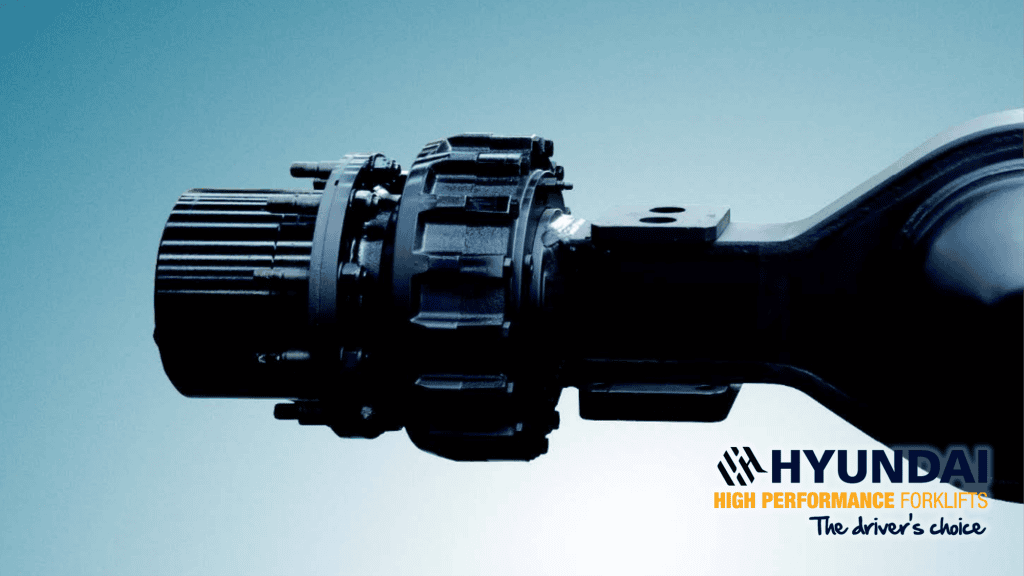
A wet disc brake, also called an oil-cooled disc brake, moves the friction surfaces inside the drive axle and runs them in oil. A stack of discs and plates is squeezed together hydraulically, and the axle oil both lubricates and carries heat away.
Sealing changes the wear equation entirely. Contamination cannot reach the friction surfaces, so the abrasive wear that kills an open brake never begins. The oil bath handles the heat, so braking performance at the end of a double shift matches the start. Multiple discs also mean far more friction area than a pair of shoes, which spreads the work and slows wear further.
The service story follows from that. There are no shoes to replace, no springs or linkages to renew and no adjustment to schedule. Maintenance is periodic oil changes, done alongside axle servicing you were doing anyway.
This is the question worth putting to any supplier, because wet disc brakes are increasingly available across the industry but not always in the same way.
Wet disc brakes are standard across the Hyundai diesel range, not a line item that appears on the quote at a price, and not a feature that only arrives above a certain capacity. Elsewhere in the market you will find them fitted as standard on some models, offered as a paid option on others, and reserved for heavier capacities on others again.
A truck that is two thousand dollars cheaper on the invoice and needs a brake job every eighteen months is not cheaper. Over a five to seven year fleet life, on an Australian site with dust or moisture in the air, the sealed system is usually the cheaper machine.
Braking hardware is one part of stopping a forklift safely. An operator presence system that applies the park brake the moment the seat is vacated, an anti roll back function on gradients, and the discipline of travelling straight up and down slopes with the load low all sit alongside it. No brake specification substitutes for those.
Talk to us about the braking systems on our heavy diesel range, expected service intervals, or a machine matched to your site conditions.
Your forklift fleet is ready for peak season when utilisation...
In busy warehouses and distribution centres, forklift safety depends on...

A forklift pre-start checklist covers visual checks, operational checks and...