
Forklift attachments fit to the carriage or forks and change how a truck picks up, holds or places a load. Australian warehouses and building supply yards use them to handle loads that bare forks can’t. Attachment types, capacity, hydraulics, custom builds and Hyundai forklift options all shape the choice.
You will know which forklift attachments to discuss with your dealer and what to check before one goes to work. For example, in 2026, Hyundai Forklifts Australia and East West Engineering delivered a customised Hyundai 50L-9 for plasterboard handling.
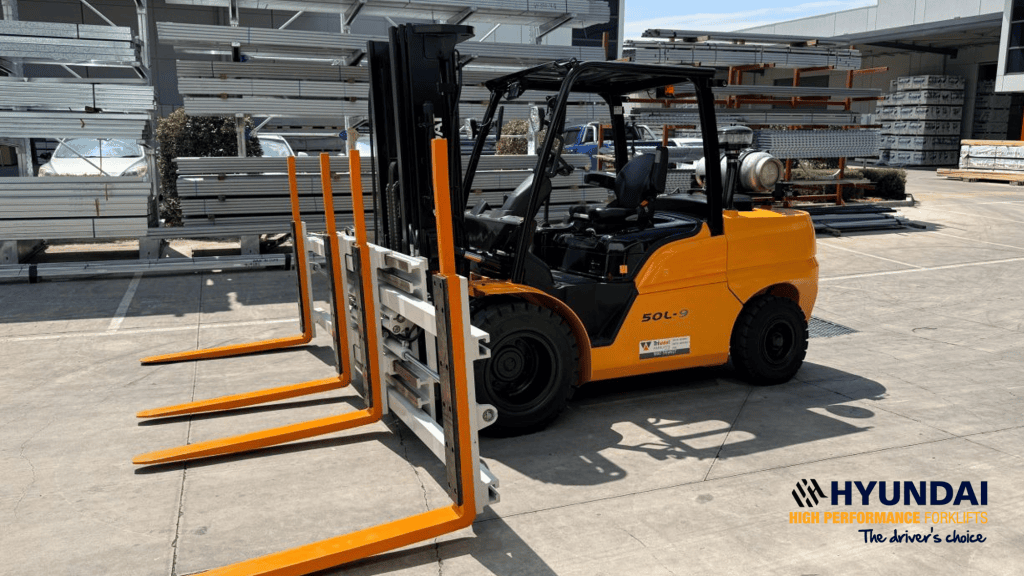
Common attachments fall into a handful of types, each matched to a kind of load.
| Attachment | What it does | Typical loads |
|---|---|---|
| Side shifter | Moves the fork carriage left or right | Pallets in racking and on trucks |
| Fork positioner | Changes the gap between the forks from the seat | Mixed pallet and pack widths |
| Carton clamp | Grips the sides of a load with no pallet underneath | Cartons, whitegoods, boxed goods |
| Push-pull | Draws a slip sheet onto a platen and pushes it off again | Goods stored on slip sheets instead of pallets |
| Multi-pallet handler | Carries two pallets side by side | High-volume food and beverage pallets |
| Fork extensions | Slide over the forks to lengthen them | Long or oversized loads |
| Rotator | Turns the forks to tip or invert a load | Bins and containers |
| Coil ram | A single boom that passes through the centre of a coil | Steel and wire coils |
| Custom engineered attachment | Built around one specific load | Plasterboard, precast panels and other non-standard loads |
In addition, steel, timber and precast concrete handling each call for their own specialist attachments.
A side shifter moves the whole fork carriage left or right. The operator can then line up with a pallet or rack bay without repositioning the truck.
Fork positioners change the gap between the forks from the seat. That saves time when pallet and pack widths change through the day. Across a busy shift, those saved adjustments soon add up. Some sites also run both in one unit, known as a side-shifting fork positioner.
An integral side shifter is built into the carriage at the factory. It sits closer to the mast than a hang-on unit, so the truck keeps more of its rated capacity.
A custom attachment makes sense when no standard attachment holds the load safely. Long, wide or fragile products are the usual reason, because standard forks leave too much of the load unsupported.
Plasterboard is a clear example. It comes in long, wide bundles that crack if they flex or slide, and building supply businesses move a lot of it.
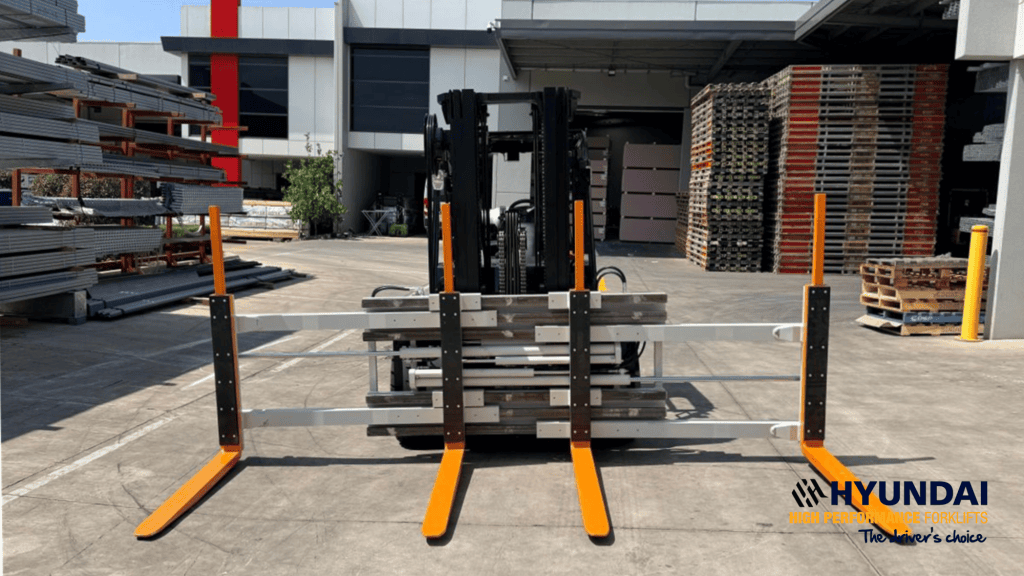
In February 2026, Hyundai Forklifts Australia and East West Engineering delivered a customised Hyundai 50L-9 to CSP Architectural Australia. It was designed to improve safety, efficiency and handling performance in plasterboard operations. The truck carries four forks on a wide carriage, with tall uprights on the two outer forks.
A Hyundai Forklifts Australia staff member shared the project on LinkedIn. The post said the units would begin rolling out across the wider Siniat Australia by Etex network. Triwest Forklifts supported the project as the servicing dealer.
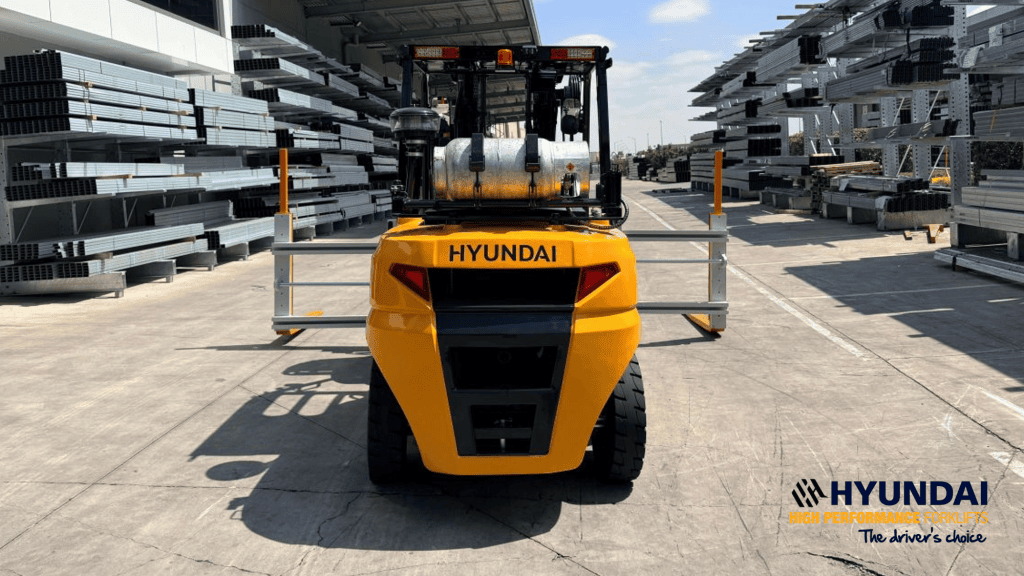
Every attachment adds weight and moves the load further out from the truck. That changes the truck’s rating, hydraulics and handling, so four things are checked before it goes to work.
| Check | What to look at |
|---|---|
| Capacity | The attachment’s weight and length push the load centre out, so the truck can safely lift less. Choosing the right forklift capacity explains how ratings relate to real loads. |
| Data plate | WorkSafe Victoria says the plate must list each attachment with the combined capacity. An attachment that is not on the plate must not be used. |
| Hydraulics | Lift and tilt use two hydraulic functions. A side shifter or clamp adds a third, and a side-shifting fork positioner or rotating clamp needs a fourth. |
| Carriage and mast | The attachment must match the truck’s carriage class, such as Class 2 or Class 3. The mast also needs room for the extra hoses. |
Ordering the attachment with a new forklift is the simplest path. It is set up at build and arrives rated and plated. Adding one to a truck you already run is often possible after the same checks. Operators also need training on each attachment before they use it.
Hyundai forklifts can take a suitable attachment once the capacity, hydraulics and carriage class check out. These three ranges are examples, covering everyday loads from 2.5 to 5.5 tonnes. Other Hyundai forklifts can take attachments too, after the same checks.
| Range | Capacity | Power | Where it fits |
|---|---|---|---|
| 35, 40, 45, 50L-9 | 3,500 to 5,000 kg | Kubota WG3800, 84 HP | Heavier loads up to 5 tonnes. Sealed wet disc brakes and a wide view through the mast. The range behind the CSP plasterboard truck. |
| 25, 30, 33L-9A and 35LN-9A | 2,500 to 3,500 kg | Hyundai L4KB, 59 HP | Everyday pallet work in yards and sheds. Inclination Warning System, Automatic Park Brake, reverse camera and an optional load indicator with overload alarm. |
| 40, 45, 50, 55B-X | 4,000 to 5,500 kg | 309 to 348V lithium | Electric power for sites that move between shed and yard, on the same tyres as engine-powered trucks. Optional Pedestrian Detection System and Blue Spot and Red Zone lighting. |
Sites that work mostly outdoors can also look at the Hyundai diesel range. Your Hyundai dealer can match the truck and the attachment to your loads. To get started, contact Hyundai Forklifts Australia or find your nearest dealer.
Forklifts in summer heat need extra attention to batteries, cooling...
Reviewing a forklift traffic management plan means walking the floor...
From 2 to 4 November, Hyundai Forklifts Australia hosted a...