
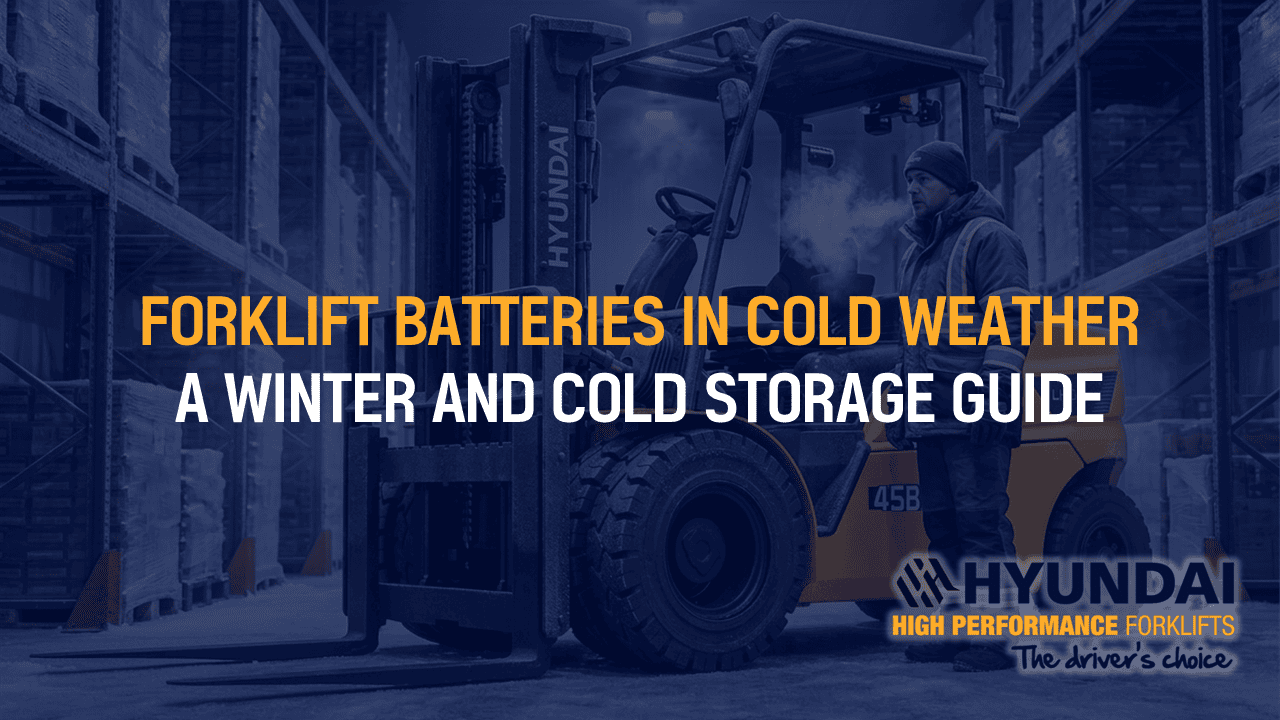
Forklift batteries lose performance in cold weather, and winter in southern Australia is cold enough to matter. Lead acid batteries lose usable capacity in the cold, and lithium batteries limit their charging and throttle output. This guide explains what cold does to a forklift battery, why a frosty morning start and a permanent cold room are two different problems, how a cold storage specification keeps a truck working at −30°C, and how to run your winter charging so the fleet performs from the first shift to the last.
A battery is a chemical system, and chemistry slows down when it gets cold. In a lead acid battery, the cold reduces the chemical reaction that produces current, so the usable capacity drops. A lead acid battery that runs a full shift in summer can fall short of it on a cold morning. The energy is still there once the battery warms, but the cold holds part of it back when you need it.
Lithium batteries react differently. Low temperatures slow the movement of ions inside the cell, and the battery responds by limiting how fast it will accept a charge and by throttling how much power it delivers under load. Both protect the cells from damage. Both also mean a cold battery works below its rated performance until it warms up.
How much this matters depends on where the battery spends its time. A battery that gets cold overnight and warms through the day faces a different problem from one that never leaves a chilled room.
Winter battery performance splits into two situations, and they need different responses. Confusing them leads to fixing the wrong thing.
Across southern Australia, winter mornings bring frost and single digit temperatures to yards and loading docks. A battery that sat overnight in an unheated space starts the shift cold. The first hours run at reduced output while the battery warms through use. Travel and lift feel slower. Charging accepted overnight may have been limited if the battery was cold when it went on charge.
In most cases the cold does no lasting damage here. It places a temporary tax on performance that lifts as the battery warms, usually by mid morning. The planning job is to protect the first shift, not the whole day. Storing charged batteries in a warmer part of the site, or timing the heaviest work for after the battery has warmed, both reduce the morning gap.
A cold room is a permanent condition, not a passing morning. Food, beverage, and pharmaceutical sites run forklifts in chilled and sub zero spaces through the whole shift. The battery never gets a chance to warm up, because the environment is designed to stay cold.
This changes the requirement. A morning start needs a battery that recovers. A cold room needs a truck specified to work at temperature all shift. Standard equipment throttles output to protect itself in these conditions, which shows up as slower charging and reduced power exactly where the operation runs hardest.
Moving in and out of the cold adds a second problem. Warm humid air meets cold steel and cold battery casings, and condensation forms. Across a winter that moisture drives corrosion on terminals and connectors, and it puts stress on seals. Equipment specified for temperature controlled work is built to cope with it. Planning the process so trucks cross the threshold less often reduces the exposure further. Our guide to forklift safety on Australian sites covers the wider safety system for temperature sensitive environments.
| Situation | Duration | Main risk beyond lost output | What the truck needs | Recommended machine |
|---|---|---|---|---|
| Winter morning start | Passing, warms by mid morning | Slow or incomplete overnight charging in an unheated space | A heated seat and cabin, and time to warm before heavy work | 16-18-20 B-9 counterbalance range |
| Cold room or freezer | Constant across the shift | Condensation and corrosion each time the truck crosses the door | A −30°C cold storage specification ordered with the machine | 14-16-20-25 BRJ-9 reach truck range |
Neither problem is solved by the battery alone. A truck that works at −30°C is a truck built for it, and Hyundai offers a cold storage specification as a factory option on both the 16-18-20B-9 counterbalance range and the 14-16-20-25 BRJ-9 reach truck range. That option is the difference between a truck that copes with a cold room and one that is specified for it.
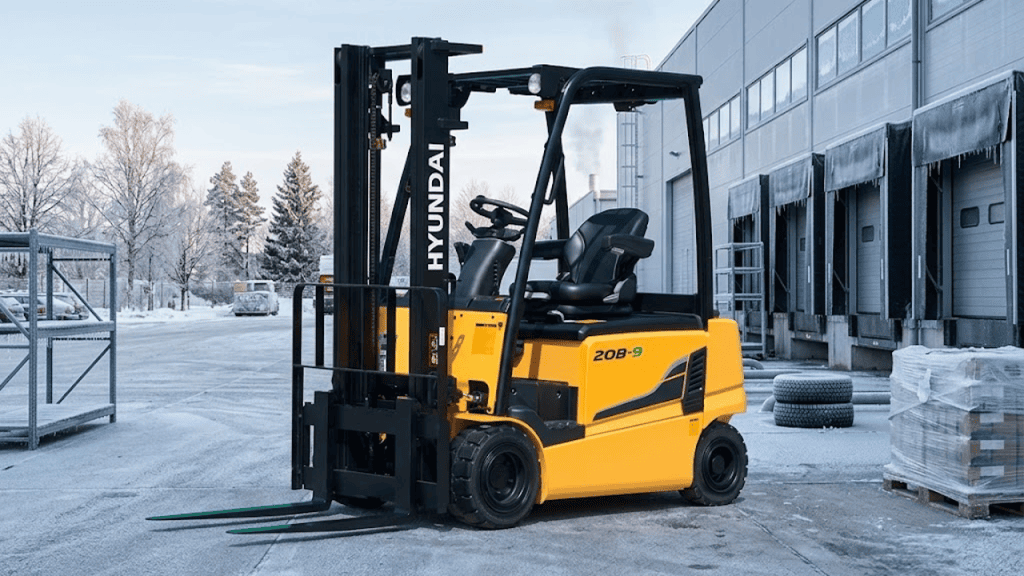
The counterbalance answers the yard and the dock. On the 20B-9, a heated seat is standard equipment, and the cabin option builds up in stages, front and roof, then rear, then side door, then heater, so an operator working a frosty pre-dawn shift is not choosing between visibility and warmth. The ZAPI controller carries an IP65 rating, which matters on a truck that crosses a cold store threshold and collects condensation each time.
The reach truck answers the aisle. A counterbalance cannot work in the racking a 16BRJ-9 is built for, and cold storage is the option list it shares with the counterbalance range. Vulkollan tyres are available in place of the standard urethane, and a heated seat with backrest extension is an option worth taking on a truck that spends the shift below zero.
Both trucks run 48 volt lead acid packs, 585Ah on the 20B-9 and 420Ah on the 16BRJ-9. That is why the charging practice below matters as much as the specification above.
Condensation is hardest on the electrics. The ZAPI controller on the 20B-9 and the MOSFET controller on the 16BRJ-9 both carry an IP65 rating against water and dust ingress, which is exactly the exposure a truck takes every time it crosses the cold store door. Fewer electrical faults through winter means fewer trucks parked up on the days the operation can least afford it.
Brakes take the same moisture. The 20B-9 runs a semi-permanent wet disc brake that holds constant braking force without overheating through long hours of repetitive work, and it needs no regular lining replacement, which keeps maintenance cost down on a truck that is hard to pull out of a cold store for service. The 16BRJ-9 uses an electromagnetic brake instead, sealed by design. Cold store floors carry meltwater and frost, and a yard on a winter morning carries frost of its own.
Winter shifts often start before sunrise, and chilled rooms are lit for storage rather than for driving. LED work lamps, rear LED and halogen lights, a panoramic rear view mirror and an optimised lift cylinder array all matter more in those conditions than they do at midday in summer. Glass fogs when a truck moves between temperatures, so an operator loses sightlines at the worst moment. Optional rear cameras on the counterbalance, and fork and carriage cameras on the reach truck, cover what fogged glass does not.
IPAS, the optional intelligent proximity alert system on the 20B-9, measures the distance to a nearby pedestrian in real time and steps the warning up through three zones as they get closer, from an interrupted alert to a continuous one. Beacon lamps in amber, blue or red are available on both ranges. Our guide to forklift safety on Australian sites covers the wider safety system, including the operator presence sensing system, the anti roll back system and optional load weight indication.
Charging is where a cold weather plan succeeds or fails. Charge in a temperature controlled space where you can. A battery charging at a moderate temperature accepts charge faster and more completely than one charging in a frozen yard corner.
Cold room work needs a decision about where the truck charges. If the forklift only enters the chilled area for part of the shift, charge it outside in the warmer space along with everything else. There is no reason to leave the truck sitting in the cold while it charges. If the truck is dedicated to freezer work and stays inside across the shift, the calculation changes. Every trip through the door brings condensation, so keeping the truck in and charging it in place costs less than moving it out and back. In that case keep the charger and cable in a warmer space outside and run a long cable through to the truck.
On a counterbalance ordered with the cabin option at heater level, the truck stays powered while it charges, so the cab does not go cold during the break. A reach truck has no cab, so the equivalent is the optional heated seat. Choose a plug your operators can handle while wearing gloves. Three phase chargers are available at 220, 380, 410 and 440 volts, so the supply in the warmer space decides where the charger sits.
Do not leave a lead acid battery sitting discharged in the cold. A discharged battery is far more vulnerable to freezing than a charged one, and frozen electrolyte damages a battery for good. Charge it before it sits.
Watch the timing after a full charge as well. A warm battery ready at shift start beats a cold one that charged slowly overnight. Avoid heavy work in the first minutes on a cold battery. Let travel and lighter tasks warm it before the heaviest lifts.
These are winter operating adjustments, not a battery maintenance routine. The day to day care of a battery, the watering and cleaning and checks that lead acid packs need, sits in our guide to forklift battery maintenance. Winter changes the timing and the environment of charging, not the underlying care.
Cold work also changes how many batteries an operation needs. Both the 20B-9 and the 16BRJ-9 run 48 volt lead acid packs, 585Ah and 420Ah respectively, and the cold cuts into what a single pack delivers across a freezer shift. Fleets running dedicated cold store trucks usually carry a spare and change out mid shift. Both machines are built for that. The counterbalance opens on a gas strut hood, and on the reach truck the reach cylinder extends to clear the battery. Our guide to lead acid versus lithium ion compares the two chemistries in full.
Yes, if it is specified for it. Hyundai offers a cold storage option rated to −30°C on both the 16-18-20B-9 counterbalance range and the 14-16-20-25 BRJ-9 reach truck range. A standard truck placed in a freezer will run, but the cold cuts into battery output and condensation works on the electrics every time the truck crosses the door. The specification is ordered with the machine, so the decision belongs at quotation, not after delivery.
A cold battery limits how much power it delivers to protect its cells. Output recovers as the battery warms through use, usually by mid morning. Storing charged batteries somewhere warmer overnight and timing heavier work for later in the morning both reduce the gap. A heated seat, standard on the 20B-9, does the same job for the operator.
Store them charged, in a temperature controlled or sheltered space rather than an exposed yard. A battery that starts the shift closer to its working temperature charges better overnight and delivers more of its rated performance from the first shift. Leaving a lead acid battery outside in a discharged state is the case to avoid.
Talk to us about specifying a truck for your conditions, whether that is a frosty morning start or a permanent cold store.

A farm forklift should match your loads, your ground conditions...
A stand-up reach truck suits frequent stops and short trips,...

Life in a hire fleet is demanding. A forklift can...