
A forklift pedestrian detection system recognises people around the machine and warns the operator in real time. It tells the operator someone is there before the operator can see them. This guide covers why some alarms earn an operator’s trust and others get ignored. It looks at what the technology changes for the driver and for the people on foot. It also shows where detection belongs among the site controls you already run, and how machine size changes what you need.
Anyone who has driven a forklift knows the moment. The load blocks the view forward. You find out what waits at the end of the aisle once you are already in the corner. Almost every time, nobody is there. That is the problem. Almost every time quietly becomes the standard you drive to.
The people most often hurt by forklifts are not the operators. They are the people walking near them.
WorkSafe Victoria reports that pedestrians make up almost half of all people injured by forklifts. It also states that crushing is the most common injury a pedestrian suffers. Forklifts cause more workplace deaths and injuries than any other piece of equipment. More than half of forklift related fatalities have involved pedestrians.
Regulators point to the same cause every time. These incidents usually happen where nothing physically separates the forklift from the person.
Detection technology now appears in regulator guidance, not only in supplier brochures. WorkSafe Victoria encourages employers to consider fitting relatively low cost safety technology. Devices that detect pedestrians sit on that list, alongside barriers, exclusion zones and signage.
Every system uses the same three parts. A sensor finds people. An alert reaches the operator through sound, light, a screen, or some combination. A detection area sets the space the system watches, so it covers what matters on your site rather than everything around the machine. These systems have one thing in common that matters more than any feature. They give the operator information. The operator still looks, judges the situation, and decides what to do.
The word pedestrian appears in two very different places in this industry. It helps to separate them. A pedestrian operated forklift is a machine the operator walks behind. A walkie stacker or an electric pallet jack fits that description. It tells you who drives the machine. Pedestrian detection describes technology that finds people near a machine. The two are unrelated.
A detection system protects people only while the operator still believes it.
Picture an alarm that sounds every time the machine passes a rack leg. The operator looks up the first time. By the tenth time, they stop looking up. By the twentieth, the sound has become background noise. It sits alongside the reversing beeper and the compressor. Then one day the alarm is real. It lands in the same place as all the others.
Nobody did anything wrong in that sequence. The equipment worked as designed. The protection disappeared anyway.
Coverage and usefulness pull against each other for this reason. Watching more space means more alerts. More alerts raise the chance the operator tunes them out. The systems that hold up over a full year do not alert most often. They alert in a way the operator still trusts on the hundredth shift. Our guide to warehouse safety technology looks at this trade off more broadly.
The value of this technology shows up clearest from the two people it sits between.
Attention is not a matter of willpower. It is a matter of time. The first two hours of a shift are easy. Hour nine is the problem, on the fortieth trip down the same aisle, when the route stops requiring thought.
Mirrors and cameras help. They share one limit. They work when the operator looks at them. A detection system does its work in the moments the operator looks somewhere else. Those are exactly the moments when a person gets missed.
What the operator gains is not really information. It is time. A few seconds separates reacting from only realising. It is enough to lift off, slow down, sound the horn, or stop and wait. Without those seconds, none of those options exist.
Most people walking through a busy site assume the operator has seen them. They assume it without eye contact and without slowing down. The assumption holds nearly all the time. That is why it is so hard to shake. It only has to fail once.
Familiarity works the same way on foot as it does in the seat. The more often someone walks a route, the less they check it. They stop expecting today’s layout to differ from yesterday’s.
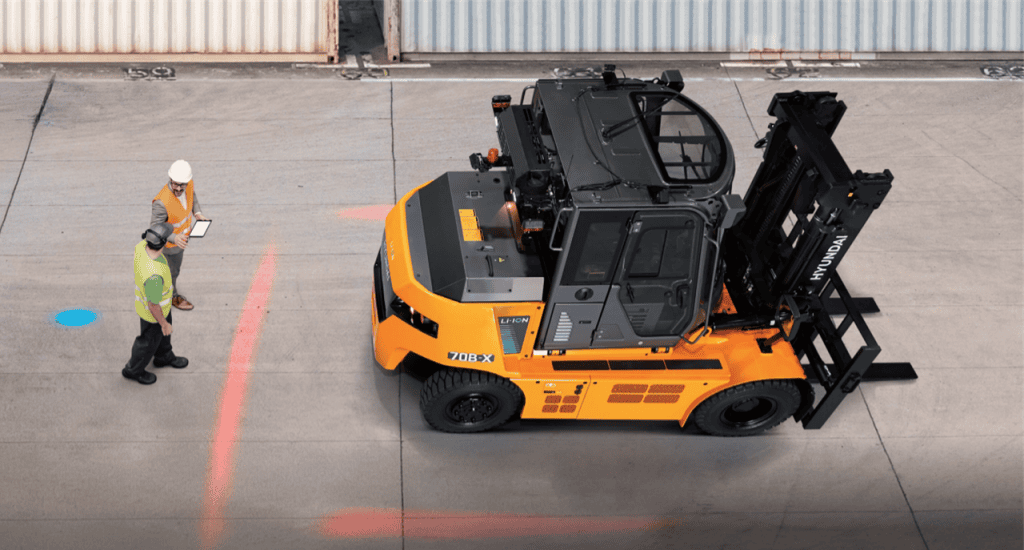
Warning lights do something here that detection cannot. A blue light thrown onto the floor ahead of the machine arrives before the machine does. A red boundary projected around it shows how much space the machine needs. Detection helps the operator. Lighting gives the person on foot a chance to react first.
Detection supports separation. It does not replace it.
The order of preference is well established in Australian workplaces. Keep people and machines apart first, using walkways, barriers and exclusion zones. Where fixed barriers are not reasonably practicable, WorkSafe Victoria advises keeping pedestrians outside a three metre exclusion zone as a recommended minimum. It also advises keeping them away from the load while the forklift works.
Detection earns its place in the gaps separation cannot fully close. Aisle ends and blind corners are the obvious ones. Loading docks put reversing vehicles, foot traffic and time pressure in one space. Mixed traffic zones have people picking stock beside moving machines. Yards change layout with whatever arrived that morning.
Standards give you a reference point for the wider picture. AS 2359.2 covers the operation, maintenance, repair and modification of powered industrial trucks. It also provides guidance on designing the workplaces where they are used. Compliance is not strictly mandatory. Regulators and courts still treat the standard as a benchmark for what counts as a reasonably practicable measure.
Our guide to forklift safety on Australian sites sets out the separation controls and the order they come in.
Your site may already run a traffic management plan, marked walkways and trained operators. Detection replaces none of it. It adds a layer where those controls run out.
A traffic plan works best where the layout stays fixed. It works least well where the layout changes. Line marking works until a pallet sits on the line. Training holds up well, and holds up least in the last hour of a long shift. Detection covers those moments. It does not depend on the layout staying as drawn, and it does not depend on anyone’s attention holding.
A well run site does not need detection to be safe. It uses detection to widen the margin it already has.
Hyundai offers a Pedestrian Detection System, or PDS, as an option across the B-X electric range.
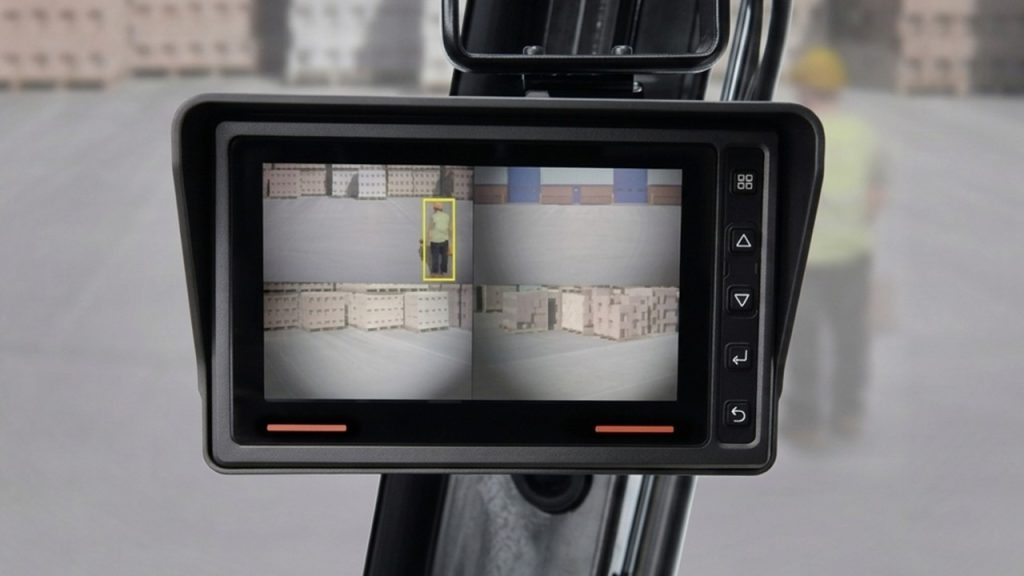
It works from the camera. When the camera detects a person nearby, the system highlights the surrounding area in yellow on the monitor. The operator gets a clear visual warning inside the cab. Nothing has to be worn or carried, so anyone who walks into the area is covered. Visitors and delivery drivers are included.
The visual approach matters for the reason described earlier. An audible alert tells the operator that something is there. A highlighted area on the monitor tells them where. That difference keeps an alert worth reacting to.
Hyundai describes PDS as a safety assist system. It shows the operator what is happening, and the operator decides how to respond. Control of the machine stays with the driver throughout.
Two lighting options are available separately, and they work on the same problem from the other side. Blue spot projects a blue light in front of the forklift. It warns people ahead that equipment is approaching. Red zone uses red lighting to create a visible safety boundary around the machine. Neither one depends on detection, and neither one replaces it. Detection helps the operator see the person. These lights help the person see the machine.
The B-X series suits the sites where this matters most. The range delivers output comparable to internal combustion models, so it works indoors and outdoors on the same shift. Major components carry an IP67 rating for water and dust protection. That covers the battery pack, drive motor and hydraulic motor. The vehicle control unit is rated IP69K. These machines stay usable and storable outdoors in wet weather. They do not spend their lives in one controlled aisle, which is exactly why the pedestrian controls around them have to work in mixed conditions.
The same option runs across the range. The space each machine needs does not stay the same.
The 40B-X through 55B-X carry 4,000 kg to 5,500 kg and turn within 2,987 mm to 3,054 mm. They weigh between 6,528 kg and 7,335 kg unloaded. This is the size that shares a floor with people. It runs the aisles pickers work in. It passes within arm’s reach of someone at a rack face. It shares dock space with truck drivers. The risk here comes from how often machine and person end up near each other.
The 60B-X through 90B-X carry 6,000 kg to 9,000 kg and need 3,380 mm to 3,620 mm to turn. They start at 9,704 kg unloaded and pass 13,000 kg at the top of the range. That is roughly 600 mm more turning space than the smaller series. Aisle width requirements rise from about 4.7 metres to about 5.5 metres. An operator moving up from a smaller truck can underestimate that gap easily. A distance that felt comfortable on a 45B-X is not the same distance on an 80B-X.
The lighting options follow the same logic. The larger models list Red zone with front and rear blue lighting. That covers people approaching from behind as well as ahead. On a machine this size, the person walking up behind it is the one least likely to be seen.
The 80B-XL deserves a separate mention. It carries 8,000 kg at a 900 mm load centre, which means long and bulky loads. Those loads block forward vision most completely. Sightline and detection controls often matter more than lift capacity on these sites. Our forklift selection guide for the steel industry covers how load driven blind spots shape equipment choice.
Option availability and configuration vary by model and by site. Your nearest Hyundai dealer can confirm what applies to your fleet.
It is a safety aid fitted to the machine. It recognises people nearby and warns the operator in real time. It gives the operator awareness of someone they may not be able to see. Blind spots created by the load, the mast or the size of the machine are the usual reason.
That depends on the system. Some use sound. Some use lights. Some use a monitor in the cab. Hyundai’s PDS highlights the area where it detects a person in yellow on the monitor. The operator sees where the person is, not only that someone is there.
It depends on the method. Tag based systems require everyone to carry a tag. Reflective PPE systems require compliant high visibility clothing with retroreflective tape. Camera based systems identify people directly, so nothing needs to be worn or carried. Hyundai’s PDS works this way.
PDS is available as an option across the B-X electric range. That runs from the 4 tonne 40B-X through to the 9 tonne 90B-X. Blue spot and Red zone lighting are also available as options. Confirm availability for your model and market with your local dealer.
Every site has different pinch points. If you want a second set of eyes on where yours sit, and on what suits the machines you run now and the ones you are planning for, our team can help review your fleet and site controls.
Your forklift fleet is ready for peak season when utilisation...
In busy warehouses and distribution centres, forklift safety depends on...
A forklift pre-start checklist covers visual checks, operational checks and...