
Perth’s forklift demand is not spread evenly across the city. It sits in a handful of industrial precincts, and each one wants a different machine. This guide explains where that work is, why the freight numbers point to more of it, and how to read a capacity rating before you sign anything.
Fremantle handled 920,521 TEU in 2025-26. That beat the previous record of 887,514 TEU and was a 3.7 percent increase on the year before. Fremantle Ports publishes the container trade figures each month if you want to track it yourself.
The more interesting number sits underneath it. The WA Government reported that 26.4 percent of that container freight moved in and out of the Inner Harbour by rail, which is more than 240,000 TEU and the highest rail share of any major city port in Australia. Those trains run to intermodal terminals of Forrestfield, Kwinana, Rockingham and Kenwick, which are the terminals eligible under the Fremantle container rail subsidy administered by the Department of Transport. The State estimates the shift took about 164,000 one-way truck trips off Perth roads.
This is not a one-off. Rail carried 14.5 percent of Fremantle’s container freight in 2015-16, and Westport, the State’s long-term port planning program, is working toward a higher share again as freight volumes grow.
Here is why that matters if you own forklifts. A container that moves by rail does not go door to door. It gets railed to an intermodal terminal, trucked a short leg to a warehouse, then stripped and palletised on site. Every one of those breaks is a forklift job. Rail does not reduce handling. It concentrates handling into fewer, busier locations, and those locations are exactly the precincts below.
Kewdale, Welshpool and Forrestfield. The freight and distribution core. Warehouses, third party logistics operators and the Forrestfield intermodal terminal. Most of this work is indoor, sealed floor and palletised, on machines in the 1.5 to 3.5 tonne range running long shifts in tight aisles. Noise and exhaust matter here because the operator spends the whole day inside a building.
Malaga, Bayswater, Hazelmere and Midland. Light industrial and trade supply along the north east corridor. Yards, workshops and building supply mean the same machine goes in and out of a shed all day, from smooth concrete to gravel and back. This is the hardest environment to specify for, because it is two jobs in one.
Kwinana, Henderson and Bibra Lake. Fabrication, marine and processing south of the river. The loads here are the reason people get their capacity wrong. Pipe spools, structural steel, skid modules and pressure vessels are long as well as heavy, and length costs you capacity in a way that weight alone does not. See the section on load centres below.
Mining service and support. Perth carries the workshops, parts warehouses and staging yards behind the state’s mine sites. Mill liners, conveyor components, drill consumables and containers move constantly. Machines destined for regional sites head out on Great Northern Highway toward the Pilbara or Great Eastern Highway toward the Goldfields, and once they are out there, a breakdown is expensive in a way it is not in Welshpool.
Two businesses in the same industry can need completely different machines. The environment decides it, not the industry name.
Sealed indoor floors suit electric. Distribution centres, cold storage and food handling. No exhaust, low noise, and no fuel handling in a building.
Mixed indoor and outdoor work suits LPG or electric. Transport depots, building supply and warehouses with a yard attached. Cylinder exchange is easy across the metro area, which is why LPG has held this ground for years.
Outdoor and heavy work used to mean diesel automatically. That line has moved. High voltage lithium machines now cover 6 to 9 tonnes, which takes in a lot of steel yards, timber yards and container work that would have been diesel-only a few years ago. On the B-X series the battery pack, drive motor, hydraulic motor, power distribution unit and battery thermal management system are all rated IP67, and the vehicle control unit is IP69K. The machine is built to be used and stored outdoors in wet weather.
Above roughly 9 tonnes, diesel is still the answer. Container handling, heavy fabrication and mining support at 10, 16 or 25 tonnes have no electric equivalent yet.
Perth summers hold high ambient temperatures for months, and yards carry dust and unsealed ground. Both put more work into cooling, filtration and drivetrain parts than a sealed east coast warehouse does. That shows up in three places.
Battery temperature, if you go electric. Heat is what shortens a lithium pack’s life. The B-X series runs a battery heating and cooling system plus water-cooled cooling for the battery and key components, which is the feature to ask about on any electric machine you are quoted for a Perth yard, whatever the brand. On the 268Ah pack, roughly two hours of charging supports up to twelve hours of operation, which is what makes single-shift charging practical without a battery change room.
Brakes. Dust and grit are exactly what kills an open drum brake, and a quarry, timber yard, plasterboard operation or coastal site supplies plenty of both. Wet disc brakes run sealed inside the drive axle in oil, so contamination never reaches the friction surfaces and there are no shoes to replace or adjust. Wet disc is standard across the Hyundai diesel range rather than a paid option, which is worth checking on any quote you compare. There is a fuller explanation in our guide to wet disc brakes versus drum brakes.
Service intervals. Standard schedules assume standard conditions. Heat, dust and unsealed ground usually mean filtration, cooling and drivetrain items need attention sooner than the book says.
For container work, heavy fabrication and mining support, capacity runs up to 25 tonnes, rated at a 1,200mm load centre because loads at that size are never compact. Machines in this class are built around a Cummins QSL engine, ZF full automatic transmission, a Kessler planetary reduction drive axle and wet disc brakes as standard.
Two features earn their keep on remote sites in particular. A load indicator puts the weight on the operator’s screen instead of relying on a guess, and Hi-MATE remote management gives you and your dealer service and diagnostic data on a machine that might be a long way up Great Northern Highway. Fault alerts you can see from Perth are worth more than fault alerts you find out about when the machine stops.
Safety hardware belongs in the same conversation. Operator presence sensing, blue spot and red zone lighting and pedestrian detection systems all fit alongside the brake specification rather than instead of it.
Diesel above roughly 9 tonnes, where torque, durability and ground clearance decide it. Between 6 and 9 tonnes, high voltage lithium is now a real alternative for outdoor yards. Below that, it depends on how much of the shift is indoors.
Rated capacity assumes a standard load centre. Long loads move that centre outward and cut effective capacity. Taller masts cut it again, and attachments cut it again after that. A 7 tonne machine on a 7.3 metre mast is a 5.45 tonne machine in practice.
The 6 to 9 tonne lithium machines are rated IP67 on major components and IP69K on the control unit, with active battery heating and cooling for high ambient temperatures.
Usually yes. Heat, dust and unsealed yards load up filtration, cooling and drivetrain components faster than a standard schedule assumes.
Hyundai supports Western Australia through the authorised dealer network. In Perth that is Hyundai Material Handling WA at Unit 1, 36 McDonald Crescent, Bassendean WA 6054, on (08) 9377 3321, which sits in the north east industrial corridor described above. You can reach them at forkliftsperth.com, or find your nearest authorised dealer through our dealer locator.
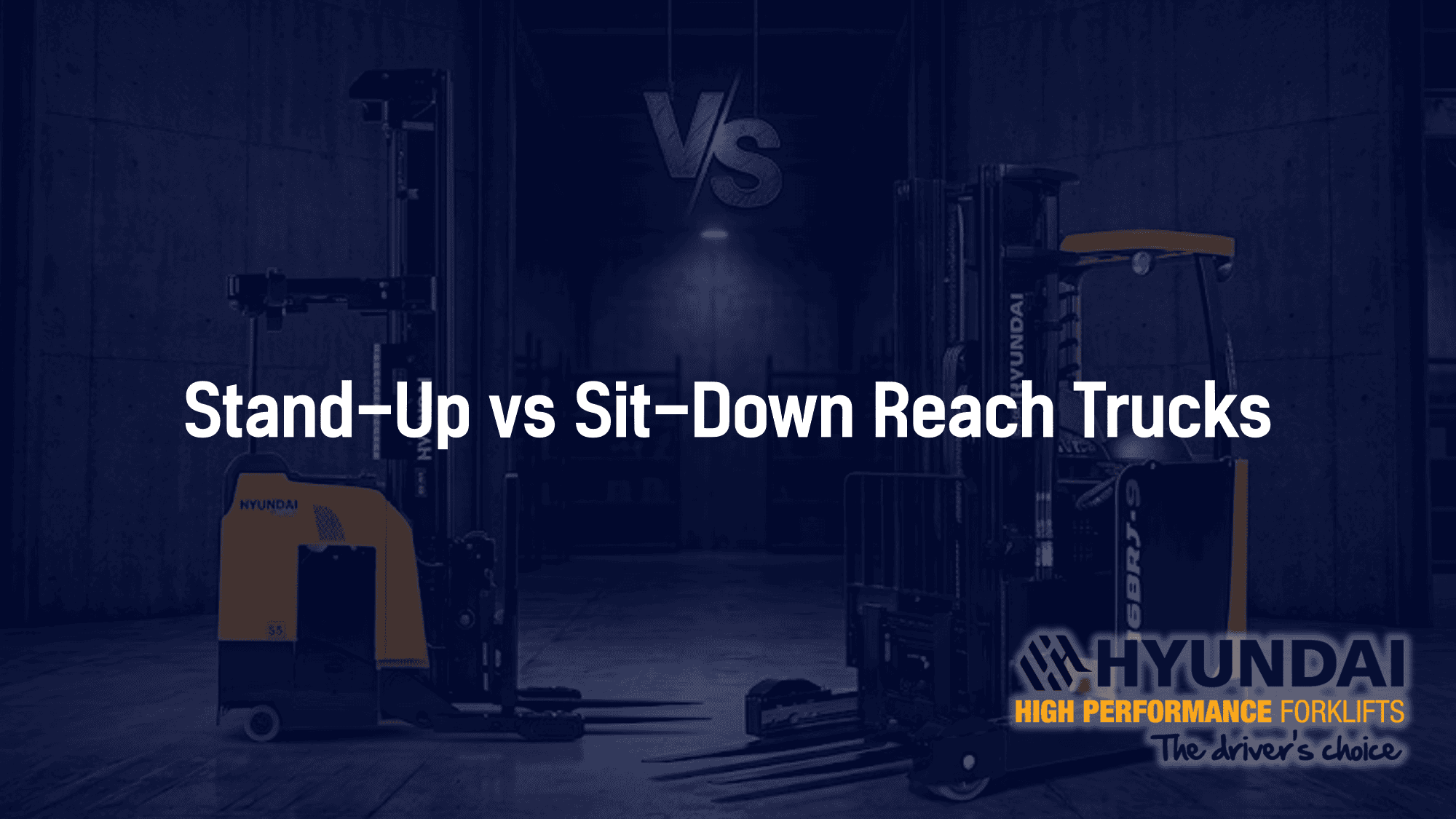
A stand-up reach truck suits frequent stops and short trips,...
Life in a hire fleet is demanding. A forklift can...
Your forklift fleet is ready for peak season when utilisation...