
Forklifts work inside ships far more often than most people outside ports realise. On a geared bulk carrier, the vessel’s own cranes lift forklifts into the hold, where they move cargo from the far corners to the crane pickup point below the hatch. This guide explains how ship hold unloading works, what the hold demands of a machine, and what that means for anyone specifying equipment for port and stevedoring work.
Container ships never need a forklift on board. A wharf gantry crane lifts each box straight off the deck. Breakbulk and bulk cargo works differently. Timber packs, steel products, bagged goods and project cargo travel loose or in units inside the ship’s holds, and a crane can only lift what sits directly beneath the hatch opening.
That leaves the rest of the hold out of reach. Cargo stowed into the wings and corners of the hold has to move to the crane’s pickup zone before it can leave the ship. The machine that does that moving is a forklift, craned onto the vessel and driven inside the hold. The ship’s crane and the forklift then work as a relay. The forklift brings cargo to the square of the hatch. The crane lifts it out to the wharf. Repeat until the hold is empty.
The relay runs on the wharf side too. As the crane lands each lift on the quay, another forklift clears it away to storage so the next lift has somewhere to go.
The ships built for this are geared bulk carriers, vessels that carry their own cranes so they can unload at any berth. When one arrives at an Australian port with breakbulk on board, a forklift going up on the crane hook is a routine part of the job, even if it looks anything but routine from the shore.
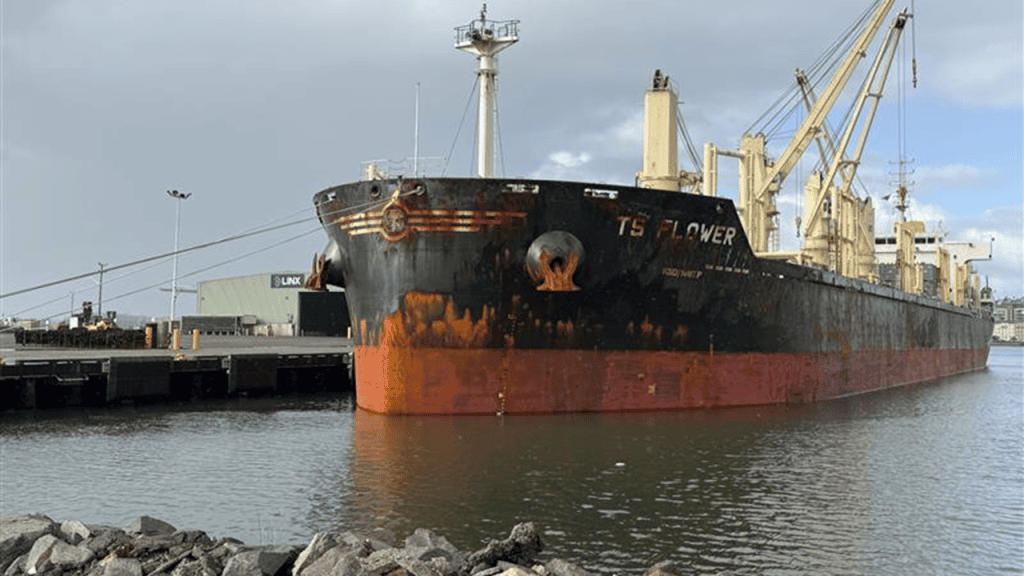
A ship’s hold is one of the hardest working environments a forklift meets, and it filters out machines that suit an open wharf. Four constraints decide what can work down there.
Headroom comes first. Below the hatch coaming and between decks, overhead clearance shrinks, so mast height and collapsed height have to be specified against the hold, not the warehouse. A machine that cannot fit under the deckhead cannot work the wings where the cargo sits.
The floor comes second. A hold floor is steel plate, often uneven, sometimes dunnage covered, and slick where cargo has swept or sweated. Traction, tyre choice and stability all work harder than they would on flat concrete. Our guide to operating forklifts in wet winter conditions covers the physics of reduced grip, and a hold concentrates the same problem in a confined space.
Ventilation comes third. A hold is a semi enclosed space, so engine emissions and air movement have to be managed as part of the stevedoring plan. This shapes the power choice and the work pattern rather than ruling any one machine in or out.
The duty cycle comes fourth. Ship unloading runs against the clock, because a vessel alongside costs money every hour. The forklift in the hold works continuous heavy cycles with no room for downtime. A breakdown inside a hold does not just stop one machine. It stalls the crane, the wharf gang and the ship.
| Hold constraint | What it decides |
|---|---|
| Limited headroom | Mast and collapsed height |
| Steel, uneven floor | Tyres, traction, stability |
| Semi enclosed space | Emissions and ventilation planning |
| Vessel time pressure | Reliability and service backup |
Breakbulk terminals run forklifts across a wide capacity spectrum, from one tonne machines up to 45 tonne units, and hold work sits in the heavy middle of that range. Hold work at Australian ports typically calls for heavy diesel forklifts. The loads are dense, the cycles are continuous, and diesel delivers the torque and stamina the duty demands. Machines in the 10 tonne class handle steel products and heavy breakbulk, which is exactly the territory the Hyundai 100D-9 is built for. Wet disc brakes matter more in a hold than almost anywhere, since dust, debris and moisture reach the machine constantly, and sealed braking keeps working through all of it.
The power choice follows the ship as well as the cargo. Below decks on refrigerated vessels, palletised cargo often moves on electric forklifts, where the enclosed space and the cargo both favour zero emissions.
Specification is where port work differs from buying for a yard. The same model can be configured with different masts, tyres and protection depending on whether it works the wharf, the shed or the hold. An operator specifying for stevedoring should treat the hold as its own environment and match the machine to it, the same discipline our steel industry selection guide applies to dense, awkward loads on shore.
Reliability backup completes the specification. A port machine needs service response measured against vessel time, not calendar time. Local dealer support with parts on hand is part of what the machine choice buys, a point our coverage of heavy forklifts at the Port of Newcastle makes in practice.
For anyone responsible for equipment in the port industry, three decisions follow from how hold work actually runs.
The ship’s own crane lifts the forklift on board using certified lifting points, lowers it through the hatch into the hold, and lifts it out the same way once the hold is worked. On a geared bulk carrier this is a routine part of breakbulk unloading at Australian ports.
Typically a heavy diesel machine specified for the hold, with mast height matched to the deckhead clearance, tyres suited to steel floors, and the torque for continuous dense cargo cycles. Ten tonne class machines handle steel and heavy breakbulk, with configuration adjusted to the specific holds they will work.
The crane can only reach cargo directly below the hatch opening. Anything stowed in the wings and corners of the hold sits outside the crane’s reach, so a forklift moves it to the pickup zone first. The crane and the forklift work as a relay until the hold is empty.
Talk to us about specifying heavy forklifts for port and stevedoring work.
A farm forklift should match your loads, your ground conditions...
A stand-up reach truck suits frequent stops and short trips,...
Life in a hire fleet is demanding. A forklift can...