
Electric forklifts in Sydney are no longer a fringe decision in major distribution centres. They are becoming a practical response to higher land costs, tighter delivery windows, stricter safety expectations and growing pressure to control operating costs. That is what makes warehouse electrification in Sydney DCs more than a technology story. It is an operations story, and for many sites, a competitiveness story.
For warehouse and fleet managers, the real question is not whether electrification is gaining ground. It clearly is. The better question is where electrification delivers measurable gains, where hybrid fleet models still make sense, and what needs to be in place before a site commits capital.
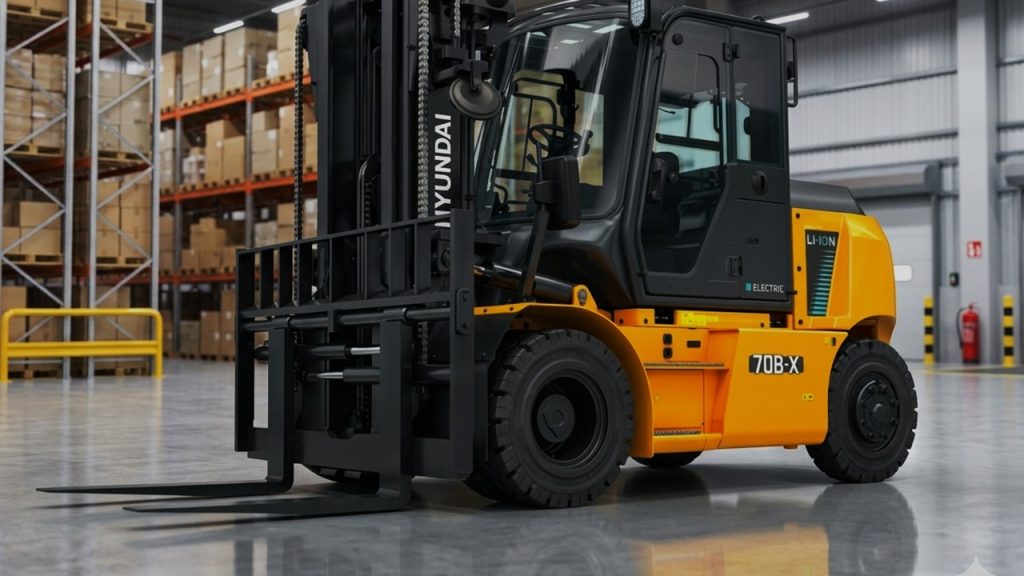
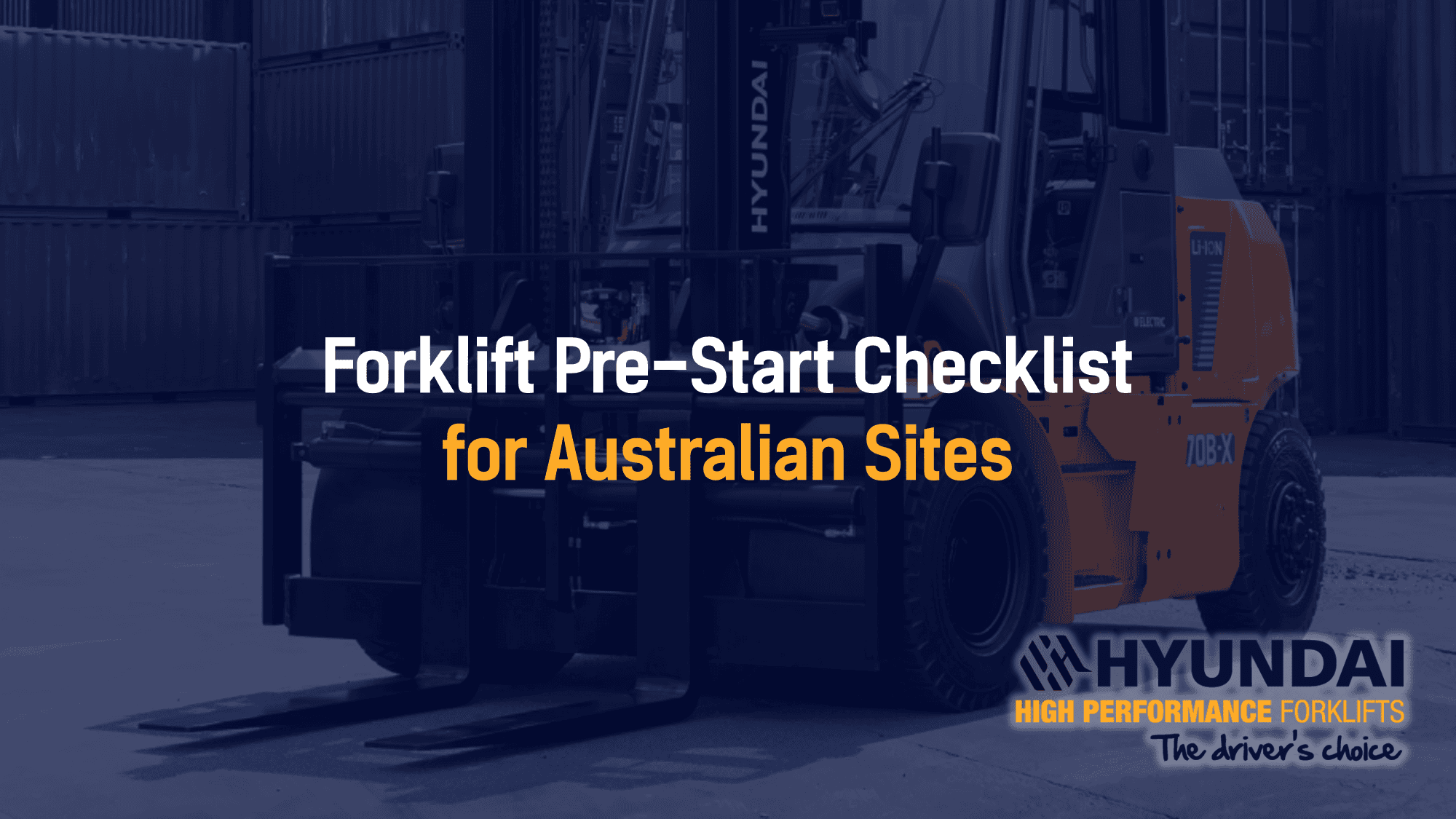
The Hyundai 70B-X is part of the high-voltage BX Series, built for multi-shift distribution centre environments.
Sydney is not just one of many Australian markets. New South Wales accounts for an estimated 24% or more of national forklift demand – the largest share of any state – according to Grand View Research’s Australia Forklift Market Report (2022 base year). That concentration reflects what is happening on the ground: the greater Sydney metro area holds the country’s densest cluster of distribution centres, fulfilment warehouses and third-party logistics operations.
Sydney distribution centres face a specific mix of pressures. Industrial space is expensive, throughput expectations are high, and many operations are pushing harder on same-day or next-day delivery performance. When every square metre matters, fleet efficiency matters too.
Electric forklifts in Sydney fit that operating environment well. They are generally better suited to indoor applications, tighter turning spaces and shift patterns where low noise, precise control and reduced emissions improve day-to-day performance. In multi-shift DCs, especially in retail, food, pharmaceutical and third-party logistics, the value proposition is becoming clearer. The broader market data supports this. According to Interact Analysis’s 2025 mid-year global forklift market update, a 5% decline in forklift demand from the mining sector across Oceania is being offset by a 15% increase in demand for electric forklifts within cold chain logistics – a shift that points directly to where electrification is earning its place. Better energy efficiency, lower routine maintenance and improved operator comfort can produce gains that show up across uptime, labour productivity and site safety.
Sydney’s infrastructure is catching up – but older sites need more planning. This is also a property and infrastructure issue. Newer Sydney DC developments are more likely to be planned with power capacity, charging layouts and sustainability targets already in mind. Older sites can still electrify, but retrofitting requires more planning and a harder look at switchboards, peak demand, charger placement and traffic flow.
The shift is not happening in one step. It is happening through a series of practical decisions across fleet mix, charging strategy and site design.
Lead-acid batteries still have a place in some applications, particularly where budgets are tight and duty cycles are predictable. But for electric forklifts in Sydney DCs running long shifts, lithium-ion is increasingly attractive because it changes how the fleet is managed.
Fast charging and opportunity charging reduce the need for battery change-out areas, spare batteries and the labour that comes with them. That has a direct space and productivity benefit. For operations where floor area is under pressure, reclaiming battery rooms or reducing their footprint can be a meaningful gain.
There is also a maintenance advantage. Lithium-ion systems require less day-to-day battery handling and fewer manual processes, which helps reduce both downtime and operator exposure to battery-related hazards. The Hyundai High-Voltage BX Series reflects where this technology is heading – up to 14 hours of operation from a single charge, with an average of 11 hours of stable output and only 2 hours needed to recharge. For a multi-shift DC, that kind of charge profile removes battery change-out from the equation entirely.
The performance consistency matters too. Unlike lead-acid, which loses voltage and lift speed as it discharges, lithium-ion delivers sustained power from full charge through to depletion – meaning the last pick of the shift performs the same as the first. In high-throughput environments where every minute of operator time counts, that consistency has a measurable effect on daily output.
The infrastructure picture is also shifting. Lead-acid charging requires dedicated facilities – explosion-proof lighting, acid-resistant floors, eyewash stations and ventilation – all of which consume capital and floor space that could otherwise hold stock. Lithium-ion eliminates most of that compliance overhead. Chargers can be positioned close to the work area, opportunity charging can be slotted into natural break patterns, and the battery stays inside the truck.
For Sydney DCs making the transition, the business case is strongest where fleets run hard across multiple shifts. The upfront cost difference remains real, but lithium-ion is widely cited as approximately 30% more energy-efficient than lead-acid in comparable forklift applications – and when maintenance, labour and space costs are factored in, the total cost of ownership picture shifts considerably over a three-to-five year horizon. That is the calculation most procurement teams are now being asked to make – and increasingly, the numbers point in one direction.
One of the biggest changes is the way charging is being treated. It used to be something handled after fleet selection. Now it is part of the fleet planning process from the start.
Sydney DCs are looking more closely at when trucks charge, how many chargers are needed, whether charging can be staggered to manage peak demand, and how charger locations affect traffic flow. A poor charging layout can create congestion, idle time and unnecessary travel. A well-planned one supports throughput instead of interrupting it.
This is where electrification projects often succeed or fail. The equipment may be right, but if the site power supply, charger mix and shift profile do not align, the fleet will not deliver what it should.
Electrification is also pushing better equipment selection. Rather than taking a broad-brush approach, DCs are breaking down tasks more carefully – pallet movement, putaway, order picking, dock work, narrow aisle operation and outdoor transfer.
That matters because not every job needs the same machine, battery size or charging pattern. Reach trucks, order pickers, pallet jacks and electric forklifts each perform differently under load, distance and shift pressure. The strongest results come from fleets designed around actual application data, not assumptions.
As fleets modernise, safety systems and fleet data are becoming harder to separate from electrification itself. Managers want to know not only how an electric fleet performs, but how it is being used.
Telematics can show utilisation, impacts, idle time, charging behaviour and maintenance trends. That data helps sites avoid oversizing fleets, identify underused assets and improve operator practices. In a high-cost DC environment, better visibility is not a nice extra. It supports faster decisions on productivity, maintenance scheduling and replacement planning.
The benefits of electrification are often described in broad terms, but the real value shows up in daily operations.
The first change is consistency. Electric equipment typically delivers predictable performance across routine indoor tasks. Operators notice responsive handling, smoother acceleration and reduced noise. In environments where trucks are working close to pedestrians, pick faces and fixed racking, that control matters.
The second change is maintenance profile. Electric fleets generally have fewer service items than internal combustion alternatives. That does not mean maintenance disappears. It means it shifts. Sites need strong battery management, charging discipline, planned servicing and fast technical support when faults occur. The upside is fewer engine-related issues and a lower routine maintenance burden in the right application.
The third change is environmental control. For enclosed or temperature-sensitive facilities, electric equipment supports better indoor air quality and cleaner operation. That is particularly relevant in food, beverage and pharmaceutical settings where site conditions and compliance expectations are tighter.
Electrification is not an automatic win in every warehouse. The strongest business cases tend to appear where sites run their fleets hard across indoor, multi-shift operations. In those conditions, energy efficiency, maintenance reduction and improved uptime can offset higher upfront equipment and infrastructure costs.
For lower-utilisation sites, or operations with mixed indoor and rougher outdoor tasks, the calculation can be different. Some businesses will get better results from a staged transition or a mixed fleet that keeps LPG or diesel assets for specific applications. Yard work, long travel distances, uneven surfaces and certain heavy-duty use cases still require careful equipment matching.
Capital investment needs to go beyond the truck. Electrification often needs spending beyond the truck itself. Chargers, electrical upgrades, site layout changes and training all need to be budgeted properly. If these are treated as afterthoughts, the project can lose momentum or underperform.
That is why total cost of ownership matters more than sticker price. Procurement teams increasingly want a clearer picture of energy use, battery life, maintenance demand, service support and expected fleet utilisation before making a decision. That is the right approach.
The next phase will not be defined by equipment alone. It will be shaped by how well operators connect fleet, infrastructure and service support.
In practical terms, Sydney DCs are likely to keep moving towards higher percentages of electric warehouse equipment, stronger adoption of lithium technology, and more integrated fleet management backed by telematics and service data. As buildings become more automated and labour costs keep climbing, businesses will keep looking for ways to cut avoidable downtime and make better use of every asset on site.
That creates a higher standard for suppliers as well. The market is shifting from simple machine sales to full fleet support – equipment selection, battery advice, servicing, fault finding, operator training and lifecycle planning. For operators, that support model matters because electrification is not a set-and-forget decision. It needs technical backup and a realistic rollout plan.
For many businesses, the smartest move is not a full fleet replacement overnight. It is a measured transition. Start with the applications where electric equipment already has a clear operational edge. Review utilisation data, monitor charging behaviour, assess service outcomes and then expand with confidence. That staged approach reduces risk and gives decision-makers evidence they can use.
A capable partner can make that process far more effective. For operators assessing electric forklifts in Sydney and across Australia, reach trucks, order pickers or broader warehouse fleet strategy, local aftersales support and application knowledge are just as important as the product itself. That is where a provider such as Hyundai Material Handling Australia can add real value – not simply by supplying equipment, but by helping businesses build a fleet that fits the site, the shift pattern and the productivity target.
Electrification in Sydney DCs is not about following a trend for its own sake. It is about building warehouses that are quieter, safer, more energy-aware and better equipped for the pace of modern distribution. The sites that plan it properly will not just reduce emissions on paper. They will run harder, with fewer interruptions, and make better use of every hour on shift.
Your forklift fleet is ready for peak season when utilisation...
In busy warehouses and distribution centres, forklift safety depends on...
A forklift pre-start checklist covers visual checks, operational checks and...