
Regulator guidance on loading docks keeps coming back to a few situations. A trailer creeps away from the dock while the forklift is working inside it, or the truck pulls away before the forklift is out. A dock leveller gives way under a machine heavier than anyone allowed for. A forklift turns out to be too tall for the container door, or the mast hits the roof while stacking inside. Sites put barriers and procedures in place for these, and they should. The forklift you choose and how you spec it also decide how easy those procedures are to follow on a busy day.
This is the first of two articles in our truck loading safety series. Here we work through the questions a site faces when loading vans, refrigerated trailers and shipping containers at a dock. We use the Hyundai Forklifts 25/30/35BE-X electric counterbalance range as the example. It is a common size class for this kind of work.
Part 2 covers side loading curtainsiders and working in the yard.
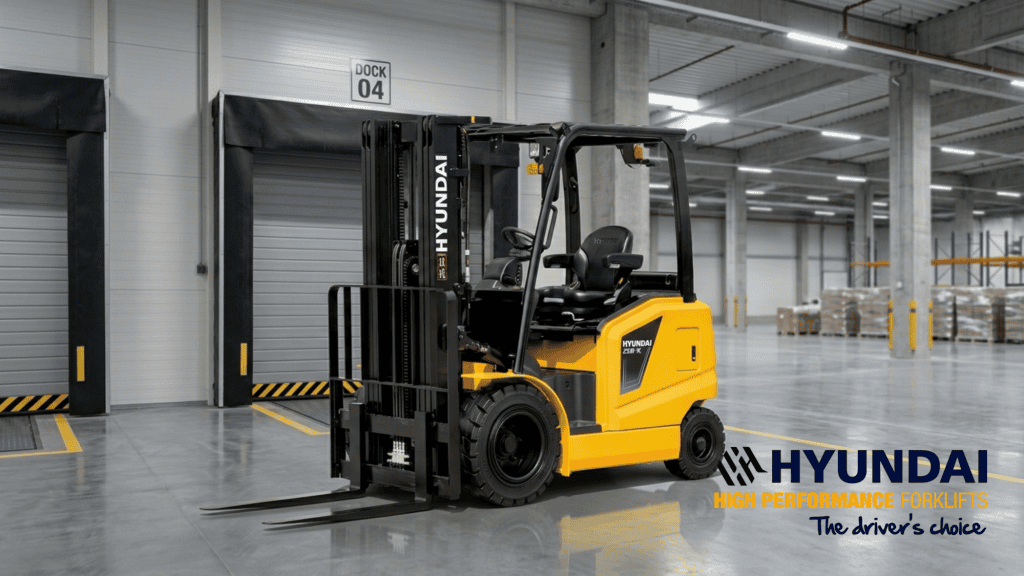
In Australia, truck loading is usually run under a loading and unloading exclusion zone, or LUEZ. Only the forklift works in the marked area, the truck driver waits in a separate driver safety zone, and the forklift operator has authority over the area while work is underway. At a dock, the zone takes in the dock face and the inside of the trailer. The guidelines were published by the Australian Trucking Association, and regulators such as WorkSafe Victoria and SafeWork NSW build on them. WorkSafe Victoria also makes the point that safety features on a forklift never replace barriers or the operator’s own responsibility. Everything below sits inside that system rather than replacing it.
For sites that unload shipping containers, fit is the obvious place to start. The door opening on a standard dry container is roughly 2.28 m high. The 25/30/35BE-X has an overhead guard height of 2,175 mm and a lowered mast height of 2,040 mm on the standard V300 mast. That leaves about 100 mm of headroom at the door, which is enough to work with but not much once a leveller lip or a slight rise at the doorway is added. Measure the containers and docks you actually use, and check again if you plan to add a cabin or other options that change the height.
Because the BE-X runs on battery power, there are no exhaust fumes building up inside a closed container, which is a real concern with LPG or diesel machines working deep inside a box.
Container and trailer interiors are often darker. Optional front or front and rear LED work lamps help the operator see pallets and the floor inside.
Stacking a second pallet inside a container is where the mast choice matters, and it is worth doing the numbers before you buy. A full free lift mast raises the carriage without extending the mast, so the top of the machine stays at its lowered height for longer.
On the BE-X, the TF430 triplex mast has a lowered height of 2,040 mm. The carriage can rise 1,314 mm before the inner mast extends, but with a standard load backrest fitted, the backrest passes the 2,040 mm line once the forks are 860 mm up and keeps rising from there.
So the real question is how high your forks need to go. To place one pallet on top of another, the forks have to clear the bottom pallet plus a margin, and with pallets around 1,100 mm tall that is well past 860 mm. By then the backrest is above 2,040 mm.
Inside a standard container, where the internal height is around 2.39 m and the door header is lower again, there may be very little room left. A high cube container, at around 2.69 m inside, gives more space. If you plan to double stack, tell your Hyundai Forklifts dealer your pallet heights and container types so they can check the raised height of the machine against your containers before it arrives.
An operator may need to move a pallet a short distance with the forks still up. The optional 3 km/h travel limit on the BE-X covers this. It applies whenever the forks are above 500 mm or past free lift height. That keeps the move slow enough to stay controlled.
Every pallet taken off a trailer means reversing back across the leveller into the dock area, where warehouse staff may be walking past.
The optional rear grip bar on the BE-X has the horn built into it, so the operator can hold a steady posture while reversing and sound the horn without letting go.
Front and rear cameras are also available. The rear camera shows the dock floor behind the machine, and the front camera sits beside the forks, which helps when placing a pallet on top of a stack where the operator can’t see the fork tips.
The Blue Spot and Red Zone lamps we cover in Part 2 are useful here too, since they light up the floor to show people on the dock where the forklift is moving as it reverses.
It is easy to check the pallet weight and forget the forklift. A dock leveller has to carry both, and the static total is only the starting point. A 30BE-X with the standard mast weighs 4,947 kg in service, so with a full 3,000 kg load the combined weight is close to 8 tonnes. A taller mast adds weight, and a 30BE-X with the TF430 mast weighs 5,146 kg. Most of the combined weight sits on the front wheels.
The Hyundai Forklifts specification puts the loaded front axle of the 30BE-X at 7,020 kg, almost 90% of the total, carried on two tyres. A forklift braking on the plate, turning on it or crossing it many times a shift also puts more stress on it than the static figure suggests. Leveller manufacturers allow for this with their own selection factors, and the capacity they recommend can be well above the forklift plus load. Give your leveller supplier the service weight, the maximum load, the loaded front axle load and the number of crossings you expect each day, and let them size it. The combined weight is not the rating to buy.
The optional load sensor on the BE-X measures the weight on the forks, so the operator is not guessing at the load weight.
The leveller only works if the trailer stays put. Trailer creep happens as a forklift drives in and out and brakes inside the trailer, and over a long unload the gap can grow until the leveller lip loses its seat. SafeWork NSW recommends wheel chocks, and a trailer restraint that hooks the trailer to the dock gives more certainty. Dock signal lights and control of the truck keys stop the other serious incident, which is a truck pulling away with the forklift still on board. A trailer left without its prime mover also needs a trailer stand under the nose, since a loaded forklift at the front puts much of its weight over the landing legs. These are site controls, and no forklift feature replaces them. Check the trailer or container floor for broken boards, holes and soft timber before the first forklift goes in.
A loaded forklift stopped on a dock ramp is at risk of rolling back. The BE-X has a standard anti roll back system. It stops the forklift rolling quickly down the slope when the operator is off both pedals. It also makes starting again on the ramp easier. WorkSafe WA points to AS 2359.2 for dock edges. It calls for barriers or other suitable systems wherever a forklift wheel could go over the edge. Raised steel edging, fixed balustrades and removable bollards are the usual answers. They matter most at dock doors with no truck present.
Reefers and cold storage docks can put the forklift in and out of low temperatures through a shift. Hydraulic oil thickens in the cold, which makes lifting and tilting less responsive, so the BE-X can be ordered with VG 15 hydraulic oil made for cold areas in place of the standard oil. Non marking tyres are also available for food and cold storage floors. And with no exhaust, nothing is added to the air inside the trailer.
| Where the risk is | What helps on the BE-X | What the site still needs |
|---|---|---|
| Entering containers and vans | 2,175 mm overhead guard, 2,040 mm lowered mast, no exhaust | Door and leveller measurements, floor check before entry |
| Stacking inside containers | TF full free lift mast, 3 km/h elevated load limit, front and rear cameras | Pallet and container height check before double stacking |
| Reversing onto the dock | Rear grip bar with horn, rear camera | Marked walkways clear of the dock face |
| Dock leveller | Known service weight and front axle load, optional load sensor | Leveller sized by the supplier for forklift, load and use |
| Trailer moving or leaving | Anti roll back on ramps | Wheel chocks or trailer restraint, trailer stands, dock lights, key control, edge barriers |
| Reefers and cold docks | Cold area hydraulic oil, non marking tyres | Cold store procedures and floor maintenance |
Availability of options varies by model and market, so confirm the exact specification with your local Hyundai Forklifts dealer.
This article wraps up our recent series on HFA service...
Businesses looking at high-voltage forklifts often ask about infrastructure, and...
Spec sheets make forklifts easy to compare. Capacity, lift height,...