
Most businesses searching for forklifts in Brisbane are not chasing a spec sheet. They are responding to a market scaling faster than their current fleet was ever planned for. That means more volume through the port, more pallets across the dock, and more pressure to keep handling moving while the site itself keeps changing. In Brisbane right now, the forklift decision is less about replacing a tired unit and more about whether the fleet can keep pace with where Southeast Queensland is heading.

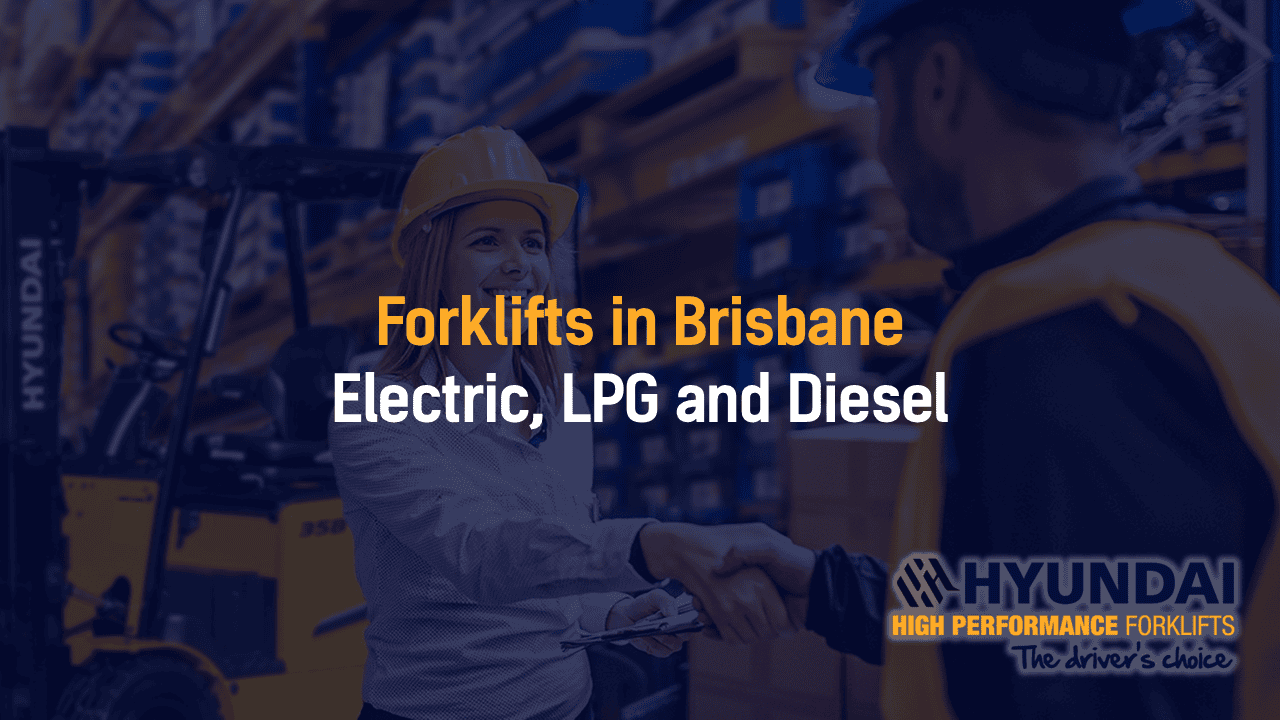
A site manager and operator confirm a Hyundai electric forklift fit on the warehouse floor, where service support keeps the fleet running.
The Port of Brisbane handled a record 1.62 million TEU in FY25, with overall trade up 7.8% to 34.9 million tonnes. Southeast Queensland’s expanding population drove much of that growth, along with the building materials and household goods flowing in to support it. That import-led growth lands directly on warehouse floors across Brisbane’s industrial belt, from Rocklea and Eagle Farm to Pinkenba, Acacia Ridge, Brendale and Yatala. Every additional container is more work for the equipment moving it. Part of what may be feeding this is spillover. Industrial land and labour in Sydney have grown more expensive, and a number of enterprises and workers now appear to be weighing up Southeast Queensland. Relatively cheaper land and strong population inflow there are helping draw distribution and manufacturing activity north.
The construction pipeline sharpens the picture further. The Brisbane 2032 Olympic and Paralympic Games carry $7.1 billion committed to venues and a further $12.4 billion in transport upgrades. Together they make this the largest infrastructure investment in Queensland’s history, and it runs against a fixed deadline. Savills research estimates the state will need at least 800,000 square metres of new industrial space by 2031, and potentially well over 3 million square metres under stronger growth scenarios. New floor space tends to drive demand for new fleets, and rising contract volumes now push existing operators to lift throughput out of buildings that never suited this decade’s demand.
For warehouse and operations managers, that creates a specific kind of pressure. A fleet that comfortably handled last year’s pallet flow can quietly become the bottleneck as contract volumes rise. The question is not just which forklift to buy, but whether the fleet as a whole is built to scale alongside the operation.
It is tempting to treat the forklift decision as a straight electric-versus-combustion choice. In Brisbane, the more useful approach is matching equipment to a genuinely mixed set of demands, because the local market spans clean indoor warehousing and rough outdoor handling in roughly equal measure.
Electric forklifts are the strong fit for Brisbane’s warehousing, logistics, food and pharmaceutical operations – anywhere clean operation, low noise, precise control and good indoor air quality matter. They suit multi-shift distribution work and tight indoor aisles. Modern high-voltage lithium forklifts now deliver sustained performance that removes the old assumption that electric means a compromise on power.
LPG forklifts continue to earn their place on mixed-use Brisbane sites that move constantly between indoor pick faces and outdoor yards. Fast refuelling and broad application coverage make them practical where long recharge windows are not workable and the same machine has to do several different jobs across a shift.
Diesel still suits the heavier, tougher end of the Brisbane market – timber, steel, building materials and yard-based handling where higher capacities and durability under sustained outdoor work matter more than emissions profile. The same heavy-duty end of the fleet serves Queensland’s role as an agricultural gateway. Port of Brisbane’s bulk grain exports jumped 259% in FY25 to nearly 2 million tonnes, including close to a million tonnes of chickpeas. That volume keeps high-capacity handling busy across processing, storage and container yards. With so much of the region’s demand tied to construction supply and agricultural throughput, that heavy-duty capability is not a niche requirement; it is part of the everyday fleet for many operators.
Capacity class is where this gets practical. Most warehousing and general pallet work sits comfortably in the 1.8-2.5 tonne range, which covers the bulk of indoor distribution duty. Mixed sites handling heavier palletised loads or double-deep racking often need 3.0-3.5 tonne units, while timber, steel and container-related work pushes into 5 tonne and above.
But rated capacity is only the starting point. Load centre, lift height and attachment use, whether clamps, slip sheets or long, awkward loads, all change what a truck can realistically handle across a full shift. A machine that looks right on the spec sheet can become the wrong fit the moment those variables enter the picture. Sizing up “just in case” carries a real cost too. A larger counterbalance machine is heavier, less nimble in tight aisles and more expensive to run. The goal is matching the unit to the everyday duty cycle rather than the occasional heaviest lift. It is also worth being candid that electric is not the automatic answer at every capacity point – for sustained heavy outdoor work, combustion units still hold a genuine edge, and a fit-for-purpose mixed fleet usually beats a forced conversion.
Then there is the warehouse support equipment that decides how well the floor actually flows. Reach trucks, order pickers, walkie stackers and electric pallet jacks often have a bigger impact on throughput and space use than the headline forklift. This matters more in Brisbane as industrial land gets dearer. When expanding the footprint is expensive, operations push upward and inward instead, with taller racking, narrower aisles and higher-density storage. That shift moves demand toward reach trucks and narrow-aisle equipment built for exactly those conditions. In a warehouse under pressure to lift output without taking on more floor, the wrong ancillary equipment can constrain the operation just as badly as the wrong forklift.
Battery performance is rarely discussed in terms of local climate, but in Brisbane it should be. Subtropical summers mean high ambient heat and humidity across much of the year, and heat is one of the conditions that affects lithium-ion battery behaviour most directly – influencing charging efficiency, sustained output and long-term battery health on hard-working multi-shift fleets.
This matters because Brisbane operations also run significant cold-chain volume in the other direction. The Port of Brisbane’s refrigerated meat exports rose 12.9% to a record 77,750 TEU in FY25, with more than half going to North Asian markets. Operators handling that product are asking equipment to move between hot loading docks and chilled storage, and that swing puts real stress on battery systems not designed for it. Battery engineering well establishes that sustained heat accelerates the chemical degradation shortening a lithium-ion cell’s usable life. Many systems also throttle charge or discharge rates at high temperatures to protect the cells. On a busy floor, that throttling shows up as slower charging or reduced output exactly when the operation is working hardest.
This is where battery thermal management stops being a spec-sheet line and becomes an operational one. Systems with active battery heating and cooling, such as the Hyundai BX Series, hold output steady regardless of external conditions. That consistency matters as much for a humid Brisbane summer peak as it does for cold storage. The wider point for anyone running several machines is consistency: a fleet whose performance sags on the hottest afternoons is a fleet you cannot plan shifts around.
Buying decisions still tend to start with capacity and mast height, but those numbers describe what a machine can lift, not how well it supports an operator across a full shift. Visibility, steering response, mast stability, ease of entry and ergonomic controls all shape cycle times, and they matter more on repetitive high-volume tasks where operator fatigue builds through the day. A forklift that looks competitive on paper can still slow the floor down if it makes handling harder. Operator acceptance is the quiet variable here: when visibility is poor or controls are awkward, operators end up working around the machine rather than with it, and the truck never reaches its intended value.
For Brisbane’s lithium fleets, charge profile is part of the productivity equation too. The Hyundai BX Series is rated for up to 14 hours of operation from a single charge. In practice, most operators plan around roughly 11 hours of dependable runtime before recharging, which still takes only about two hours. Even at that working figure, the profile removes battery change-out from a multi-shift operation entirely. And unlike lead-acid, which loses voltage and lift speed as it discharges, lithium-ion holds its output far more consistently across the usable charge, so the last pick of the shift performs much like the first.
Smart service technology is also shifting from nice-to-have to genuine advantage. Remote fault finding, faster diagnostics and strong aftersales support shorten repair times and keep units available, which matters acutely on Brisbane sites where one breakdown backs up receivals, picking and dispatch in sequence.
In a fast-growing market, it is easy to treat safety features as add-ons and training as a one-off. That approach rarely holds. Incidents are costly and disruptive, and they usually trace back to predictable gaps – equipment poorly matched to the task, maintenance left too long, or sites introducing operators to new equipment without proper support.
The right setup supports safer operation from the start: stable load handling, strong visibility, predictable braking, warning systems and equipment correctly sized for the job. Training and familiarisation belong in that same category. Even experienced operators need support when sites introduce new battery systems, equipment types or warehouse layouts – and in Brisbane, where sites are actively expanding and reconfiguring, that introduction is happening more often than usual.
Maintenance is part of safety, not separate from it. Delayed servicing, worn tyres, unmanaged battery condition or neglected components become safety problems quickly. The strongest fleets are not simply well bought; they are well supported through planned maintenance and fast access to parts and technicians.
Not every Brisbane operation should buy outright. With so much current demand tied to project work, seasonal peaks and Olympic-linked construction timelines, forklift hire or rental is often the better commercial move – flexibility without locking capital into equipment that may be underutilised once a project ends.
Outright purchase makes sense where utilisation is high and stable, where the business wants long-term asset control, or where specialised attachments and site-specific configurations justify ownership. Many growing Brisbane sites will land on a blend: owned core units for steady daily work, hired capacity to absorb seasonal or project peaks. Whichever pathway fits, the assessment that matters is whole-of-life cost – uptime, service access, utilisation and replacement cycles – rather than the headline price or monthly repayment alone.
There is also a middle path that gets overlooked – reviewing the fleet as a whole rather than replacing units one at a time. Fleet size is only half the question; configuration is the other half. A site can look fully equipped yet still leak productivity every day if the mix is wrong – counterbalance trucks doing work that reach trucks or order pickers would handle faster and in less aisle space, or ageing units quietly serving as backup until service demand spikes and exposes them.
When a site is taking on new contract volumes, changing its layout or scaling for growth, ageing or poorly matched machines tend to be a systemic problem, not an isolated one. A fleet review can surface utilisation gaps, duplicated capacities and opportunities to move to more efficient electric or lithium-powered equipment. In a market moving as fast as Brisbane’s, a fleet that fit the operation two years ago may now be quietly capping its throughput.
Specification matters, but support coverage decides whether the fleet actually performs once it is on site. When a unit goes down, operations teams need fast diagnosis, parts availability and technicians who understand industrial environments – because delays do not stay contained to one machine. They back up the whole flow from receivals through to dispatch.
That is why businesses assessing Brisbane forklift suppliers should look past product range to how service is delivered: how faults are escalated, what warranty support covers, and whether the supplier can back the fleet across its full lifecycle. A capable partner should support sales, rental, planned servicing, emergency repairs, parts, battery systems, operator training and broader fleet strategy as a connected offering rather than a series of transactions.
That is the lens worth applying to any supplier shortlist – and it cuts both ways. For procurement teams, it means weighting service network, parts holding and response times alongside unit price. For dealers and resellers servicing the Brisbane market, it is a reminder that the lifecycle relationship, not the initial sale, is what retains a fleet account.
In Brisbane itself, that authorised support sits with Forkbiz, the Hyundai dealer covering the region from Rocklea, which handles local sales, hire, parts and servicing rather than leaving Queensland operators reliant on interstate backup. Hyundai Material Handling Australia is one of the providers that positions itself around that full-service model rather than equipment alone, but the test for any name on the list is the same: can they keep the fleet running when uptime is tied directly to revenue?
The best forklift choice is rarely the cheapest unit or the one with the biggest number on the spec sheet. It is the machine, or fleet mix, that fits the task, supports operators, holds up under Brisbane’s conditions and comes with support that keeps downtime under control.
For Brisbane operators, that means being honest about where the operation is heading, not just where it has been. Volumes are rising, sites are changing and the next several years will reward fleets that were planned to scale. A forklift decision that lifts throughput, reduces service disruption and gives the floor more confidence under pressure is doing more than moving pallets – it is positioning the operation for the decade Queensland is about to have.
A practical next step is rarely a single purchase. If you are weighing options, start by comparing electric, LPG and diesel models against your real load profile, look at forklift hire in Brisbane to cover seasonal or project peaks, or book a fleet review if several machines are ageing at once. Managing a similar scale-up in another state? Our companion guides on forklifts in Sydney and forklifts in Melbourne cover those markets in the same detail.
Your forklift fleet is ready for peak season when utilisation...
In busy warehouses and distribution centres, forklift safety depends on...
A forklift pre-start checklist covers visual checks, operational checks and...