
Forklift selection in a precast concrete yard is rarely settled by tonnage alone. Rated capacity applies at one specified load centre distance, and long precast elements sit well forward of it. Mast height, fork length and attachments move the figure again. Working through those variables before a purchase decides whether a yard runs at pace.
More of Australian construction is happening in the factory. Prefabricated and modular methods have been expanding as the industry works around a documented shortage of skilled labour and pressure to compress build programmes, and state and federal housing policy now points at off-site methods directly. Precast concrete sits inside that shift, and the yard that stores and dispatches those elements carries the load of it.
Logistics in a precast concrete yard also differ fundamentally from general manufacturing logistics. Instead of standardised palletised cargo, the handling targets are individual structural elements with widely varying shapes and weights. Half slabs and small panels sit at the light end, wall panels and precast columns and beams in the middle, and double-T slabs and box culvert segments at the heavy end. A single yard has to accommodate that whole spread, often with the same fleet.
What a precast operation asks of its equipment comes down to strength, stability and durability. Hyundai Forklifts Australia specifies machines around the heavy, irregular loads and dusty conditions of precast concrete yards, with the aim of keeping materials moving safely and efficiently from casting bed to truck.
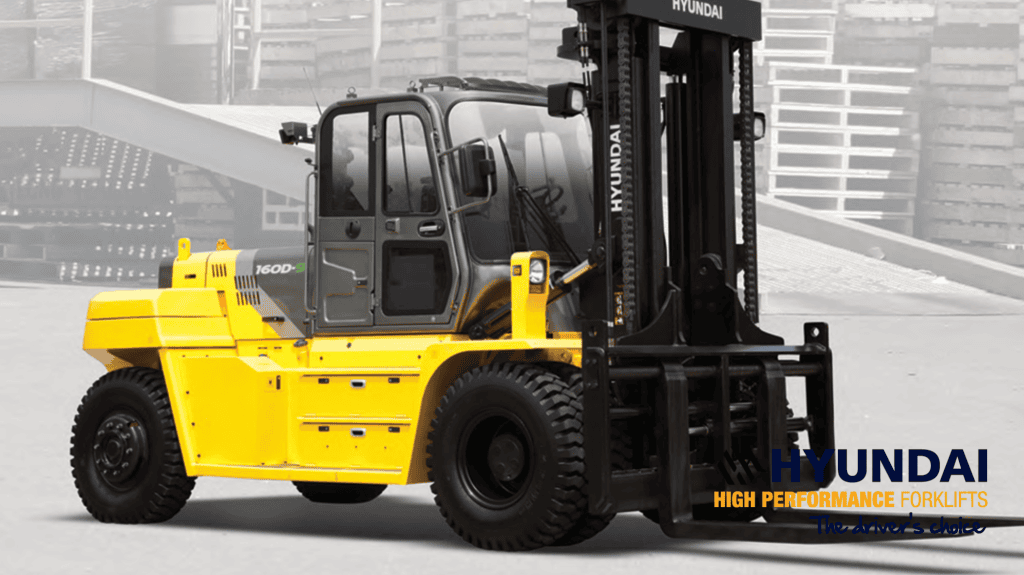
The rated load in a manufacturer’s catalogue is not a standalone number. It applies at a specified load centre distance, measured from the fork face to the centre of gravity of the load, and that distance is not the same across capacity classes. For example, the 160D-9 diesel forklift carries its 16 tonne rating at a 600 mm load centre.
This is where precast differs from palletised handling. A long wall panel or double-T slab puts its centre of gravity well forward of that reference point, and working capacity falls as the distance grows. The published load capacity chart for the 160D-9 runs from 600 mm out to 1,500 mm, and reading a component against that chart is a different exercise from checking it against the headline tonnage.
Mast selection moves the same number again. A two-stage V300 mast on the 160D-9 holds the full 16 tonnes, while the tallest three-stage TS750 configuration is rated at just under 14 tonnes at the same load centre.
Long forks and fork extensions shift the load centre once more, so the chart has to be re-read for the specific configuration being quoted rather than for the base machine. A capacity figure quoted without its mast height and load centre does not tell you whether the truck will actually lift the element in question.
Double-T slabs, precast columns and beams, and mid-size box culvert segments sit in the middle of the heavy range, and the 160D-9 is built for that band. Lighter classes run out of capacity in front of large elements, while heavier classes tend to be justified only where a yard routinely handles the extremes. Which class fits depends on the elements a particular yard actually moves.
Hyundai Forklifts builds the 160D-9 driveline for repeat heavy-load duty, with a Cummins QSB6.7 engine rated at 164 hp, a ZF full-automatic transmission, and a Kessler hypoid planetary reduction drive axle. Loaded gradeability is 37.7 per cent. Braking is by a wet disc system, enclosed to protect it from dust and water, which matters where cement dust is part of the working environment.
Two options speak directly to the load centre problem. An additional counterweight can be specified on the 160D-9, which counteracts the forward moment a long element creates rather than working around it. A wide carriage is also available on the 160D-9, giving greater bearing width under wide panels and double-T sections.
The carriage is constructed from high tensile structural steel, durable side rollers are included for the mast and carriage, and the carriage is narrower than the overall width of the truck, which helps in tight spaces. A separator holder type fork carriage is worth discussing alongside these where a yard cycles between element types. It allows forks and other attachments to be changed more quickly, which matters when the same truck moves panels in the morning and culvert segments in the afternoon.
In storage areas with tight spacing, adjusting a component by moving the forks rather than repositioning the whole truck cuts handling time and reduces the risk of contact with adjacent elements. Where component widths vary widely, hydraulic fork positioning earns its place. Where panel-type items are transported upright, dedicated clamp attachments should be evaluated.
Hyundai Forklifts offers integral sideshift, and integral sideshift combined with a fork positioner, as factory-fitted options with fork positioner bore sizes of 82 or 100 mm. Hydraulic lines and carriage are integrated into the truck’s design at build, so the machine works within its rated envelope from its first shift in the yard.
Yard surfaces carry concrete debris and cut rebar fragments, and the tyre choice follows from how well that is kept in check. Pneumatic tyres absorb shock on rough and uneven ground, which suits yards where heavy elements travel longer distances between the casting beds, the stacks and the loading area. The 160D-9 comes with 12.00-20-18PR pneumatics for that work.
Solid tyres are offered as a factory option for yards where debris is harder to control. The two suit different yards, so it is worth raising the question at quoting stage rather than leaving it to the first replacement.
In a yard that stacks low, line of sight matters more than lift height. Carrying long components with forward visibility obstructed by mast channels increases risk.
The 160D-9 is offered in two-stage limited free lift and two-stage full free lift configurations as well as three-stage full free lift, so there is no need to move to a three-stage mast unless the stacking height calls for it. Since taller configurations also cost rated capacity, specifying lift height to the actual requirement serves visibility and capacity at the same time.
Indoor processing areas, where moulding, demoulding and finishing take place, should be assessed separately from outdoor storage yards. In enclosed indoor areas handling formwork accessories, rebar and embedded materials, electric forklifts deliver zero exhaust emissions and run quietly, while LPG counterbalance trucks remain a practical alternative where ventilation is adequate. Hyundai Forklifts covers all three power sources, and heavy-duty diesel remains the standard for outdoor heavy material transport and trailer loading.
The real variable in moving indoor operations to electric is rarely emissions regulation. It is charging infrastructure and shift pattern. Yards running three shifts should plan battery management, whether through opportunity charging or a battery change-out arrangement, at the same time as they select the truck.
| Operation Area | Handling Targets | Equipment Class to Discuss |
| Indoor Moulding / Demolding | Formwork accessories, rebar, embedded materials | Electric sit-down or LPG counterbalance |
| Small Component Storage / Loading | Half slabs, small panels, manholes, retaining wall blocks | Mid-range heavy-duty diesel |
| Large Component Storage / Loading | Double-T slabs, precast columns & beams, box culverts | 160D-9, 16 tonne heavy-duty diesel |
| Extra-Heavy Segments | Large culverts, special structures | Upper heavy-duty diesel range |
Tip-overs and dropped loads are recognised hazards in heavy element handling. Sharp turns while carrying long, off-centre loads, or changing direction on a slope, are contributing factors. Site-specific traffic management plans that set reduced turning speeds under load, and physical separation of forklift travel lanes from pedestrian zones, are core risk controls under Australian WHS guidelines.
Large forklifts have extensive blind spots created by frame size alone, producing zones where awareness is difficult even for a licensed and attentive operator. The 160D-9 supports a rear view camera with four camera channels, and an operator presence sensing system disables mast and drive movements when the operator is not in the seat. A load weight indicator is also available, and we have covered how overloading goes unnoticed without one separately. Fitting these at procurement means wiring and mounting positions are integrated into the truck’s design.
Cement dust changes what a yard should specify and how often it services, and we will cover that in a follow-up article.
Organising the following operational data before supplier consultations will accelerate specification and procurement:
Once these six parameters are defined, rated capacity, mast type, attachment configuration and tyre specification can be matched accurately to the site.
Bring this information to Hyundai Forklifts Australia and a dealer can work through the heavy-duty diesel load capacity charts and attachment configuration in a single consultation. Precast concrete yards vary too much in component geometry and ground conditions to settle a specification from catalogue figures alone.
Hyundai Forklifts Australia supports sales and aftercare through a dealer network across Australia.
A farm forklift should match your loads, your ground conditions...
A stand-up reach truck suits frequent stops and short trips,...
Life in a hire fleet is demanding. A forklift can...