
Pantograph vs moving mast is the first fork in the road when choosing a reach truck. These are the two reach truck types working Australian warehouses, and they reach in two different ways. Both do the same job, placing pallets into racking from a narrow aisle. This guide explains how each mechanism works, where each one wins, and how to pick the right format for your warehouse.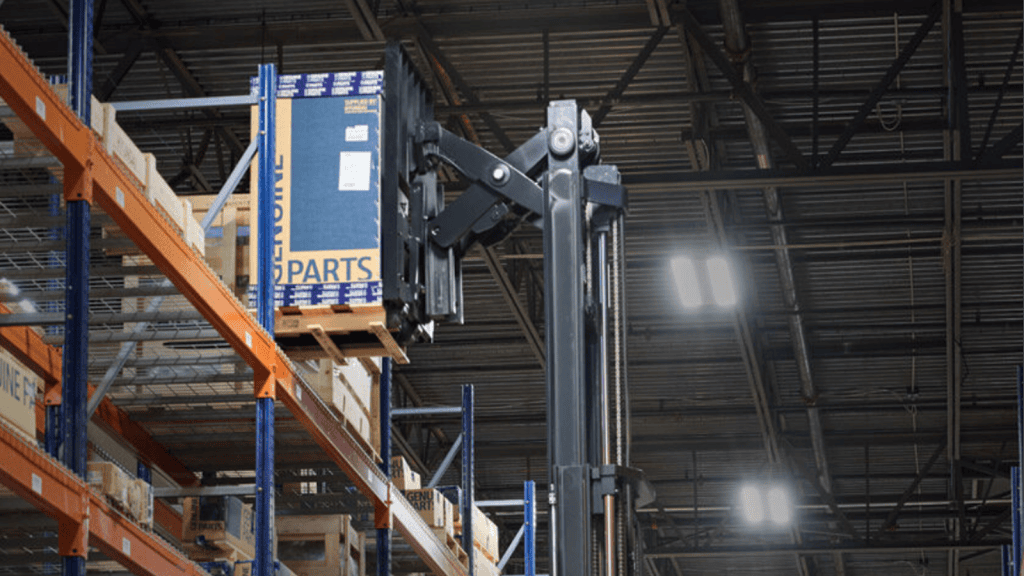
A pantograph reach truck extends its forks using a scissor mechanism. The arms fold flat when the truck travels and stretch forward when the operator places or retrieves a load. The truck body stays still while the forks move into the racking.
The operator commonly stands in the compartment, facing sideways for a clear view in both directions. That stand-up format suits work with frequent stops, because the operator steps on and off quickly between picking tasks. The new Hyundai 15BRP-X brings this format to Australia, built as a stand-up pantograph reach truck for high density warehousing.
A moving mast reach truck reaches differently. Instead of extending the forks, the entire mast slides forward along the chassis. The mast travels out over the baselegs to collect the load, then retracts back within the wheelbase before the truck moves off.
The operator commonly sits side on in these machines, which suits long shifts spent mostly in the seat. Moving mast designs have long been the familiar reach truck format in Australian warehouses, and the 16BRJ-9 in the Hyundai range works this way.
The two formats overlap on the basics. Both work narrow aisles, both straddle their baselegs for stability, and both run on electric power. The differences show up in how they handle, how the operator works, and where each design feels at home.
| Pantograph | Moving mast | |
|---|---|---|
| How it reaches | Scissor arms extend the forks | The whole mast slides forward |
| Operator position | Commonly standing, side facing | Commonly seated, side on |
| Best rhythm | Frequent on and off, picking work | Long stints in the seat |
| Familiar in | North American operations | European and Australian operations |
The honest answer on performance is that a well specified machine of either format handles typical Australian racking work. The choice turns less on raw capability and more on the shape of your shifts, the habits of your operators and the aisles you run.
Numbers settle part of the debate. Hyundai’s moving mast range, the BRJ-9 series, spans four capacity classes and publishes full mast specifications, so the moving mast side of the comparison comes with hard figures.
| Moving mast (BRJ-9 range) | Capacity | Max fork height | Travel speed |
|---|---|---|---|
| 14BRJ-9 | 1,400 kg | Up to 10.5 m | 14 km/h |
| 16BRJ-9 | 1,600 kg | Up to 10.5 m | 14 km/h |
| 20BRJ-9 | 2,000 kg | Up to 12.0 m | 14 km/h |
| 25BRJ-9 | 2,500 kg | Up to 12.0 m | 14 km/h |
Two things stand out in the table. Reach trucks lift far higher than counterbalance machines, which is the whole point of the format, and capacity climbs with the model rather than with the reach mechanism. The 15BRP-X on the pantograph side carries 1,500 kg, sitting between the 14 and 16BRJ-9 classes. Its Australian lift height specifications should be confirmed with your dealer.
Mast choice matters as much as model choice. Each BRJ-9 model offers a range of three stage full free lift masts, and the mast decides both the maximum fork height and the lowered height that has to clear your doorways.
Specifications shown are from the current 9 Series range, and final configurations should be confirmed with your dealer.
Safety systems now run across both formats, and the overlap says something useful. Curve control appears on the pantograph 15BRP-X and across the moving mast BRJ-9 range alike, cutting the risk of taking a turn too fast. The safety philosophy stays constant even where the reach mechanism differs.
Each format then adds its own layer. The moving mast BRJ-9 machines carry an anti roll back system that stops the truck rolling backward on a ramp, automatic centre positioning that straightens the drive wheel at key on, a steering angle display so the operator always knows where the wheel points, and a down safety valve that holds the forks if a hydraulic line fails. The 15BRP-X counters with hill assist and an optional pedestrian safety system using cameras with light and audible warnings. Whichever format you choose, the safety specification deserves the same attention as the capacity plate.
How often do operators leave the truck? If the role mixes driving with picking, checking and other tasks on foot, the stand-up pantograph format saves seconds on every dismount and those seconds add up across a shift. If the operator stays in the seat for hours moving pallets, the seated moving mast format carries the shift more comfortably.
What are your operators used to? Retraining costs time and slows a crew down. An operation full of drivers raised on one format has a real reason to stay with it. This matters less than it used to on the controls side, since the 15BRP-X runs an industry standard joystick that needs minimal training, but the standing or sitting habit itself still counts.
What do your aisles and racking demand? Aisle width, lift height and pallet weights should be measured against the specific models on your shortlist rather than decided by format alone. Our guide to the best equipment for narrow aisles walks through how reach trucks compare with the other aisle machines, and your dealer can match exact specifications to your racking.
The battery plan belongs in the decision too. The moving mast BRJ-9 range runs a 48 volt platform, while the 15BRP-X runs 36 volts with a lithium-ion option. Neither voltage wins on its own, because the right answer follows your shift pattern. Single shift operations charge overnight and rarely notice the difference. Multi shift operations lean toward lithium-ion with opportunity charging during breaks, and that currently points to the pantograph side of the range. Weigh the battery strategy alongside the format, not after it.
The good news for Australian operations is that the choice now exists within one range. With the 15BRP-X joining the line-up alongside moving mast machines, both formats come with the same dealer support behind them.
A pantograph reach truck extends its forks on a scissor mechanism while the truck body stays still. A moving mast reach truck slides the entire mast forward instead. Both place pallets into racking from narrow aisles, and the main practical differences are the operator position and the working rhythm each format suits.
Neither wins outright. Stand-up machines suit work with frequent dismounts, such as mixed driving and picking. Sit-down machines suit long stints spent moving pallets from the seat. The best fit follows the shape of the shift and what your operators are used to.
Moving mast reach trucks have long been the familiar format in Australian warehouses. Pantograph machines are now arriving in Australia, with the Hyundai 15BRP-X bringing the stand-up pantograph format to the local range.
Hyundai’s moving mast reach trucks lift to 10.5 metres in the 1,400 and 1,600 kg classes and up to 12 metres in the 2,000 and 2,500 kg classes, depending on mast choice. Lift height always trades against lowered mast height, so the right mast fits both your top beam and your lowest doorway.
Talk to your local Hyundai dealer about matching a reach truck to your aisles.
The Hyundai 15BRP-X reach truck is launching into Australia. It...
Forklifts work inside ships far more often than most people...
Warehouse peak season preparation should start in July, not October....